Showing posts with label Essex. Show all posts

Thursday, September 28, 2017

St Peter’s on the Wall


By Carole Barclay


This chapel, built on the ruins of an old Roman fort in the 600s, is a place for contemplation. Though only a mile away from civilisation, this spot on the Essex coast takes you back to a bygone age when Essex was still a kingdom in its own right and Christianity was battling against the pagan beliefs of the old gods of the Anglo-Saxons.
            St Peter’s was founded by Cedd, a monk trained at Lindisfarne in Northumbria, who had been invited to spread the word by the newly converted King of Essex. In 654 Sigeberht the Good gave Cedd land inside the ruins of the old Roman fort to build the first monastery in the East Saxon Kingdom.
The 1km footpath from the car-park in Bradwell-on-Sea is, in fact, the old Roman road to the Roman fort of Othona. But little is left apart from a small section of the wall hidden in the undergrowth because most of it was swept away in a disastrous storm and tidal wave in 1099.
 The monastery, built entirely from the stones and bricks taken from the Roman ruins, declined as the population drifted after the storm to what is now Bradwell village. The monastery continued as a chapel-of-ease during Catholic times for peasants working along the bleak coastline far from the parish church in the centre of the village.
St Peter’s was dissolved when Henry VIII broke with the Catholic church in the 16th century.  It then sank into obscurity, being used as a barn until it was restored and reconsecrated as an Anglican chapel in 1920.
What’s left is just the nave of a more substantial church. The foundations of the long-lost apse, tower and two small porches are marked out in concrete, and there’s an image on the notice board inside of what it might have looked like in its heyday. 
Don't hesitate to visit the nearby Anglican retreat that uses the chapel as its spiritual centre and if you have time take the coastal footpath to Bradwell village, which will take you around the site of the air-base used by night-fighters in the Second World War. Nearby a memorial with a replica Mosquito aircraft is dedicated to the Bradwell Bay-based airmen who fell during the war. More RAF memorabilia can be found at the Bradwell Bay Military & Science Museum in Eastlands Meadows Country Park, which is only open on weekends.
In the village you can pass by Bradwell Lodge, an 18th century mansion built on the foundations of a much earlier Tudor house. There Erskine Childers, the Irish Republican writer who was shot by the Free Staters in 1922 during the Irish Civil War, wrote the novel The Riddle of the Sands, which was published in 1903.
The lodge was later owned by Tom Driberg, the left-leaning Labour MP who pioneered the modern gossip column as “William Hickey” of the Daily Express; became a friend of Guy Burgess, the leader of the Soviet ‘Cambridge Spies’ that included Donald Maclean and Kim Philby, and allegedly peddled tittle-tattle to Soviet and British intelligence throughout the Cold War!
Bradwell-on-Sea is on the Dengie peninsula in Essex. It is best approached by car because the nearest train station is 10 miles away at Southminster. There is a regular bus service from Southminster and a more sporadic service from Maldon.


Thursday, September 14, 2017

Audley End: A palace in all but name


By Carole Barclay

 Audley End in northern Essex is what people used to call a ‘stately home’ back in the 1930s when most of them were still owned by the landed gentry. Later it was taken over by the Special Operations Executive (SOE) to train Polish commandos preparing to join the resistance movement against the Nazi occupation during the Second World War. It remained in private hands until 1948, when was sold to the public. Today the house is one of the jewels in the crown of English Heritage, the charity that now runs many of our historic buildings and monuments.
Audley End shows that some sections of the ruling class could live like kings in the 17th century. Thomas Howard, the first Earl of Suffolk, built this mansion on what had been a much more modest house built on the plunder of Walden Abbey during the Reformation.
Suffolk, who was the Lord High Treasurer of England, built his pile to impress a king. But when James Stuart, the first Scottish king of England, stayed at Audley End he began to suspect that his chancellor had had his greedy hand in the royal till. In 1619 Suffolk was charged with embezzlement and sent to the Tower of London. Only a hefty fine secured his release and he died in disgrace in 1626.
Later owners modernised the building and landscaped the grounds whilst demolishing whole wings to cut the costs of running the house. What was once the largest private house in the country was reduced to a third of its size. But it still retains much of its former grandeur and the interior houses period collections, a number of works of art, and exhibitions of life in Jacobean and Victorian days.
Audley End is open throughout the year, though it is wise to check in advance because the house is sometimes closed for filming. Buses from Saffron Walden pass nearby, and Audley End railway station is about a mile and a half away. There’s free parking on the site. Tickets cost £17.50, and £15.80 for students and pensioners. Admission is free for members of English Heritage.

Tuesday, June 06, 2017

The Bloodier Battle of Valence

By Carole Barclay

 The 17th century came to life in the middle of a council estate in Dagenham last weekend courtesy of the Valence House Museum and the English Civil War Society. The two-day free event in Valence Park included displays of musketry and horsemanship, and a living history camp showing what life was like during the English Civil War. But the highlight was an hour long portrayal of a skirmish between Royalist and Parliamentary troops, which involved over 500 re-enactors on both sides of the civil war.
During the struggle between Parliament and the King, which finally ended with the trial and execution of Charles Stuart in 1649, Valence House was held by the Royalist Fanshawe family. But most of the people in this part of south Essex were staunchly for Parliament throughout the civil war. It’s a pity that this was not reflected in this imaginary battle in which the Royalists were depicted as the victors. But this was entertainment – not an open-air lecture on the nuances of 17th century politics. The grown-ups filmed the costumed drama and kept the beer tent going. The kids were predictably more attracted to the burger and ice-cream stalls outside the historic moated manor house that goes back to the 13th century!

Friday, March 17, 2017

The Crucible – a new look at a Miller classic


 By Andy Brooks
Back in the 17th century a wave of hysteria swept a small town in what was then the English colony of Massachusetts in New England. Based on the accusations of children, the largely Puritan settlers of Salem started an enquiry that turned into a frenzied witch-hunt that was used to settle old scores between rival factions in the town. Twenty people, 14 of them women, were executed and five others, including two infants, died in prison before the whole process was halted by broader public opinion.
Salem became such a by-word for superstition, bigotry and persecution that it inspired Arthur Miller to write this play during the notorious anti-communist “witch-hunts” of the early 1950s led by Senator Joseph McCarthy and the notorious House of Un-American Activities Committee.
The Crucible is a dramatic interpretation of the Salem witch trials of 1692 but it is clearly an analogy of McCarthyism, which hounded communists, and those whom the rabid Senator deemed to be ‘fellow-travellers’, out of their jobs. Those that refused to become turncoat informers were often forced to go into voluntary exile. Some were even jailed on trumped charges of conspiracy, subversion or being agents of the Soviet Union.
Miller himself said that the Crucible was “by far my most frequently produced play, both abroad and at home. Its meaning is somewhat different in different places and moments. I can almost tell what the political situation in a country is when the play is suddenly a hit there – it is either a warning of tyranny on the way or a reminder of tyranny just past.”
The current production by the Sell A Door Theatre Company and the Queen’s Theatre Hornchurch began in February at the Queen’s Theatre in Hornchurch, another part of Essex now in Greater London, and will now tour the country.
It stars Charlie Condou, best known for playing Marcus Dent in Coronation Street, as the witch-hunting Reverend Hale, and Victoria Yeates of BBC’s Call the Midwife fame. It is directed by the Queen’s Theatre’s Artistic Director, Douglas Rintoul.
It’s currently on in Dartford and moves to Cheltenham next week. Check out the full details of the Crucible UK Tour on the web to see if it’s coming anywhere near you. It’s well worth a visit.

Witchery in Dagenham

by Carole Barclay

Valence House in Dagenham may seem to some an unlikely venue for an exhibition about the occult arts – but the Bruja exhibition, the word is simply the Spanish for witch, has considerable interest in the London borough that was once part of south Essex.
This modest display of sketches, paintings and ‘magic’ paraphernalia by Alisha Ward is tucked away in one of the rooms of this historic moated manor house, which goes back to the 13th century. It now contains permanent exhibitions on history and life in Barking and Dagenham, including displays from the old London County Council’s massive Becontree Estate.
Alisha Ward is an artist, illustrator and art student from London. She says that her work traditionally “takes the basis of the female form, using this as a catalyst for ideas which revolve around mental illness and the human condition, and takes a narrative form incorporating mythology, folklore, gothic, literature and pop culture references.”
In this exhibition in the Whalebone Gallery, Alisha combines the iconography of magic with her interest in folklore, film and the spooky side of life to create a narrative of the landscape of human experience.
It’s well worth a visit if you’re in the area and the rest of the museum is packed with interesting displays that reflect life in the borough from the Stone Age onwards, as well as a gallery dedicated to the social impact that the building of a massive council estate in the 1920s and the subsequent arrival of the Ford Motor Company had on what had been a rural village on the outskirts of London. There’s a ‘cinema’ that shows newsreels about Dagenham on a continuous reel and a very good café at the nearby visitors centre.
Valence House is not the easiest to find if you don’t know your way around the estate, so take a map with you. The nearest stations are Chadwell Heath and Dagenham Heathway, but they are both a 20 minute walk away from the park. Admission is free and the museum is open Tuesday to Saturday from 10:00 to 16:00; and the exhibition runs until 6th May. Admission is free at:
Valence House Museum
Becontree Avenue
Dagenham RM8 3HT
Phone: 020 8227 5293 or 2034

Monday, May 06, 2013

A manor in a housing estate


By Carole Barclay

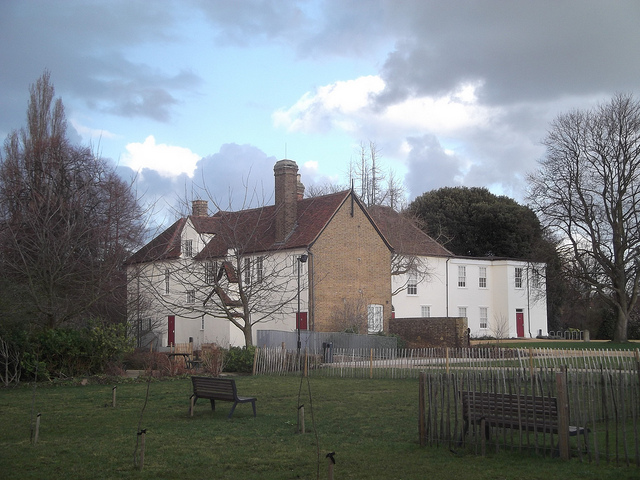
FOR SOMEONE who grew up in Dagenham, Valence House has always had a special place in my heart and is a reminder of a rural Dagenham long since forgotten. It is the only manor house left in the borough and within its walls are relics and mementoes from Roman days right up to the 21st century.
Some parts of the house date back around 700 years and it was most recently a working farm run by the May family until it was compulsorily purchased in 1921 to make way for the building of what was to become the largest council estate in Europe.
The museum opened its doors to the public in 1937 and was initially just a small collection of finds run by the local library and open only a few afternoons a month, while the rest of the house was used for public meetings and local exhibitions. Two major renovations, including a major revamp in 2007 financed partly by a Heritage Lottery grant have transformed it into one of finest local museums in Greater London.
People settled the area during the Stone Age and the display of their tools and other flint implements is the path through which visitors wend their way through the building. Finds include the “Dagenham Idol” – a Neolithic wooden totem unearthed during sewage works in 1922. A scattering of  finds testifies to the impact of four centuries of Roman rule, while Saxon and medieval Dagenham is well represented in the history of nearby Barking Abbey and the local manor houses which were all swept away when the great Becontree council estate was built to provide “homes fit for heroes” after the First World War.
            In the 20th century Dagenham was virtually synonymous with the Ford motor company, which until recently provided employment for a large number of workers. It was also known for the Dagenham Girl Pipers, a bagpipe marching band set up by an eccentric Congregational church minister in the 1930s that continues to entertain people to this day. You can see them in the small museum cinema that screens a rotating series of films created by the Dagenham Cooperative Film Society, which highlight life on the Becontree Estate.
            The nearby Valence Park, a fragment of the original estate, contains a children’s playground while the museum grounds boast a beautiful herb garden that also includes a restored Anderson air-raid shelter from the Second World War as well as a bookshop, café and archive collection for students and scholars of all ages.  Valence House, like many estates in Essex, was moated and the building is still surrounded by most of the ancient water course, a haven for ducks and the local Becmain Angling Club!
            Valence House is not the easiest to find if you don’t know your way around the estate so take a map with you. The nearest stations are Chadwell Heath and Dagenham Heathway but they are both a 20 minutes walk away from the park. Admission is free and the museum is open daily from 10am to 4pm, apart from Sundays at: 

Valence House Museum
Becontree Avenue
Dagenham RM8 3HT
Phone: 020 8227 5293 or 2034.