Showing posts with label museum. Show all posts

Friday, June 22, 2018

Fun for all ages!


By Carole Barclay

Once the playground for the Prince Regent and his jaded aristocratic mates in the 18th century Brighton has continued to re-invent itself over the decades to retain its position as the paramount resort of the south coast. Entertainments range from the traditional seaside attractions of the pier and amusement arcades to the bohemian world that revolves around the art festivals, the gay scene and the student world. Brighton’s race-course, dog-track and football club are there for the sporting fraternity while the conference centre has been the venue for all the major political parties and many of our unions for decades.
For many visitors their first impression of ‘London-by-the-sea’ is the concourse of Brighton station. But under the arches of that vast Victorian pile is a hidden gem – a toy museum that spans some 200 years of children’s entertainment.
The Brighton Toy and Model Museum is a treasure trove for the young and the young at heart. Founded in 1991, the museum has over 10,000 toys and models on display. Some go back to the Prince Regent’s day but most of the exhibits focus on the golden age of toy making during the first half of the 20th century.
There’s the inevitable Meccano sets and the construction toys that were the precursors of the Lego mania of today. But this was the era of the train set and they dominate the main gallery which also includes a wonderful working model railway along with the toy cars, planes and boats that were a constant feature of boys’ comics until computers came along. Girls are not completely ignored. And the collection of prams, dolls and doll’s houses as well as puppets and soft toys reflects the market that sadly reinforced the female stereotype that was perpetuated by the education system until well into the 1970s.
Though the evolution of toys tells a story in itself this museum is largely a mecca for model makers and collectors of all ages. Vintage toys, with prices ranging from a few pounds to those in three or four figures, are on sale by the in-house work-shop which restores many items that will later appear in one of the galleries.

The Brighton Toy & Model Museum is at 52-55 Trafalgar Street, Brighton, Sussex, BN1 4EB. It’s well-signed posted from the station and it is open from 10:00 to 17:00 from Tuesday to Friday and from 11:00 to 17:00 on Saturdays, It’s closed on Sundays and Mondays. The basic admission charge is £6.50 but there are concessions for students, disabled and senior citizens.

Friday, December 01, 2017

God’s Wonderful Railway


By Andy Brooks
The King George V with the ‘Bristolian’ route headboard

STEAM –  the Museum of the Great Western Railway, also known as Swindon Steam Railway Museum – is a must see for anyone interested in Britain’s railway history. It is located at the site of the old railway works that was once the heart of the old Great Western Railway (GWR). Modern Swindon is largely the creation of the GWR, whose works, at its peak in the 1930s, directly employed over 14,000 workers to build and repair the locomotives and carriages of the railway dubbed “God’s Wonderful Railway” during the Victorian era.
The inevitable rationalisation following the nationalisation of the railways in 1947 and the decline of steam led to the scaling down of the plant, which eventually closed in 1986. Although the first GWR museum opened in another part of Swindon in 1962, the replacement that opened in 2000 is housed in a Grade II listed building that was part of the original Swindon Works.
The exhibition is essentially a tribute to the old GWR, its first chief engineer, Isambard Kingdom Brunel, and the men and women who built the railway and kept it running from 1833–1948.
There are plenty of hands-on exhibits and interactive displays, as well as steam engines, rolling stock, and reconstructions including a period signal room as well as a local platform, waiting room and booking office, to interest the casual visitor. Trainspotters and the railway buffs known as 'gricers' can, meanwhile, immerse themselves in the immense collections housed in what was once one of the largest railway industrial complexes in the world.
There’s a lot of old nonsense said about the ‘romance of steam’ by those who have never worked in the industry. It is, indeed, true that working on the railways isn’t just a job – it's a way of life. But what that really means on the operating side is that life is just one big shift.
Whilst the displays give us a glimpse of that world, the daily life of the workers who kept the trains rolling is barely touched upon. The images of the GWR’s bosses beam down on us in the lobby and the monuments to the workers who died in the First World War form part of one display. But there is no mention of the role of the transport and engineering unions that built the GWR and, indeed, led the demand for its nationalisation in the 1940s. Nevertheless what is on show certainly justifies the admission fee.
STEAM, the Museum of the Great Western Railway, is located in the Rodbourne area of Swindon in Fire Fly Avenue (SN2 2EY). It is approximately 10–20 minutes walk from Swindon Town Centre and is open daily, apart from 24th–26th December and 1st January. The museum is fully accessible – with disabled toilet facilities, lifts and ramps giving wheelchair and pushchair access throughout the museum. There is an in-house café and shop, and a near-by shopping mall. Admission is £8.90 with the usual concessions for students, senior citizens and children.


Monday, May 06, 2013

A manor in a housing estate


By Carole Barclay

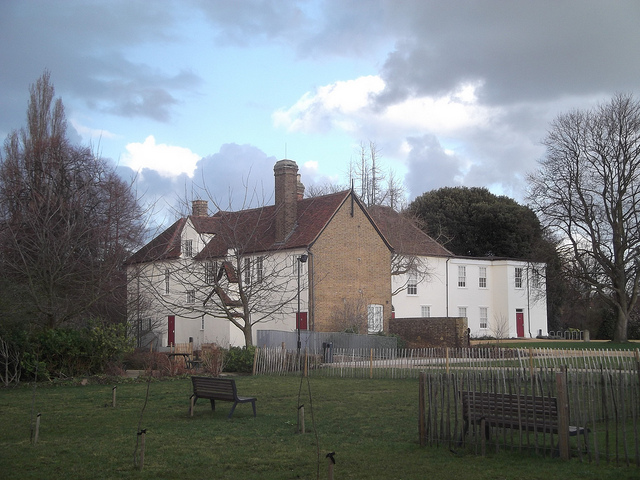
FOR SOMEONE who grew up in Dagenham, Valence House has always had a special place in my heart and is a reminder of a rural Dagenham long since forgotten. It is the only manor house left in the borough and within its walls are relics and mementoes from Roman days right up to the 21st century.
Some parts of the house date back around 700 years and it was most recently a working farm run by the May family until it was compulsorily purchased in 1921 to make way for the building of what was to become the largest council estate in Europe.
The museum opened its doors to the public in 1937 and was initially just a small collection of finds run by the local library and open only a few afternoons a month, while the rest of the house was used for public meetings and local exhibitions. Two major renovations, including a major revamp in 2007 financed partly by a Heritage Lottery grant have transformed it into one of finest local museums in Greater London.
People settled the area during the Stone Age and the display of their tools and other flint implements is the path through which visitors wend their way through the building. Finds include the “Dagenham Idol” – a Neolithic wooden totem unearthed during sewage works in 1922. A scattering of  finds testifies to the impact of four centuries of Roman rule, while Saxon and medieval Dagenham is well represented in the history of nearby Barking Abbey and the local manor houses which were all swept away when the great Becontree council estate was built to provide “homes fit for heroes” after the First World War.
            In the 20th century Dagenham was virtually synonymous with the Ford motor company, which until recently provided employment for a large number of workers. It was also known for the Dagenham Girl Pipers, a bagpipe marching band set up by an eccentric Congregational church minister in the 1930s that continues to entertain people to this day. You can see them in the small museum cinema that screens a rotating series of films created by the Dagenham Cooperative Film Society, which highlight life on the Becontree Estate.
            The nearby Valence Park, a fragment of the original estate, contains a children’s playground while the museum grounds boast a beautiful herb garden that also includes a restored Anderson air-raid shelter from the Second World War as well as a bookshop, café and archive collection for students and scholars of all ages.  Valence House, like many estates in Essex, was moated and the building is still surrounded by most of the ancient water course, a haven for ducks and the local Becmain Angling Club!
            Valence House is not the easiest to find if you don’t know your way around the estate so take a map with you. The nearest stations are Chadwell Heath and Dagenham Heathway but they are both a 20 minutes walk away from the park. Admission is free and the museum is open daily from 10am to 4pm, apart from Sundays at: 

Valence House Museum
Becontree Avenue
Dagenham RM8 3HT
Phone: 020 8227 5293 or 2034.