Saturday, August 20, 2022

Murder before Evensong

by Ben Soton

Murder Before Evensong by the Reverend Richard Coles, Weidenfeld & Nicholson London 2022, Hardback: 368pp; rrp £16.99.


The Reverend Richard Coles is the archetypal rock star vicar. In the 1980s he was a member of the band The Communards; today he hosts Radio Four’s Saturday Live and has appeared on Strictly, QI and in an episode of Holby City where he played himself. He has now taken up crime fiction with his first novel Murder Before Evensong published this year.
    What could be described as Father Brown set in the 1980s; an era when the internet was in its infancy and computers and mobile phones were rare. The hero is clerical sleuth Canon Daniel Clement whose crime-solving skills emanate from his interpretation of Greek Biblical text. If you are looking for a rough and ready hard drinking Gene Hunt type you will be disappointed. Instead, you have an OCD vicar who lives with his mother and two sausage dogs.
    The book his as much a window into 1980s village life as a crime adventure. Set in the fictional Champton, somewhere in the English Midlands; dominated by both the Church and its patrons the aristocratic De Flores family. Champton is still living in the shadow of the Second World War; where it acted a base the US Air Force and a Free French hospital. The book begins with what seems a silly row about the installation of a toilet inside the church. I believe today all public buildings are required to contain such facilities. However, in a world dominated by ultra-conservative interest groups, namely the local Flower Guild such a moderate improvement creates not only opposition but opens up a whole can of worms.
    The 1980s, as were every decade in history, a time of change; for instance, there were changes in attitudes towards gays, an issue that arises in the novel. The decade coincided with the height of Coles’ music career and may well have been the period in his life when he came to terms with his own homosexuality. I speculate as whether the character of Cannon Clement, an unmarried man in his forties is in fact Coles’s alter ego. Is it just a coincidence that the author is also the owner a pair of sausage dogs? In other is Coles writing a novel with himself as the lead character. Why not?

Sunday, August 14, 2022

Princes of Persia

by Ben Soton

Persians: The Age of The Great Kings by Lloyd Llewellyn-Jones. Hardback:
Wildfire: London, 2022; 448pp; rrp £25.99.

From Classical Antiquity to the early Modern Period imperial dynasties have ruled over vast tracts of land that Westerners called the Persian Empire. The most famous was the Achaemenid Empire; which is the subject of the recent book by Lloyd Llewellyn-Jones, Professor of Ancient History at Cardiff University. It lasted from the time of its founder Cyrus the Great in the sixth century BC to its eventual destruction at the hands the avenging Greek army of Alexander the Great in 330BC.
    Geographically it covered an area from Libya in the west to Pakistan in the East encompassing almost the entire Middle East, northern Greece and parts of central Asia. In its time it was the largest land empire the world had seem
    The book’s unique selling point is its use of Persian sources whereas previous studies were reliant on Greek texts in particular Herodotus and his work The Histories. For instance, Tom Holland’s book Persian Fire: The First World Empire and the Battle for the West almost exactly mirrors Herodotus; as well as being written from a largely Greek perspective. However, Llewellyn-Jones points out that the Greeks cannot be ignored as they were the first to record information in book form rather than in the form of poems and fables.
    When looking at ancient history there is always the danger of overlooking the elephant in the room – slavery. A whole chapter is devoted to the Kurtash; workers who were moved around the empire to carry out functions ranging from construction to childcare for the elite. Slavery is often overlooked in studies of the ancient world; although there is so far little evidence of slave revolts in the Achaemenid Empire. There were however numerous rebellions against Persian rule throughout the Empire’s existence; although these revolts should not be confused with modern national liberation movements
    According to the author, unlike other more recent Empires the Achaemenids did not impose Persian culture on those they ruled over. He makes comparisons with the Roman Empire and the British Empire in the nineteenth century. Interestingly he makes no mention of an even more modern empire that imposes its culture in the form of tenth-rate fast food restaurants across whole swathes of the planet.
    A significant part of the book is devoted to the Persian Court; whether powerful concubines, overbearing Queen Mothers or influential eunuchs. The fundamental weakness of the Achaemenid Empire was its lack of an orderly line of succession as was the case in European monarchies from the Medieval period. Instead, a successor would emerge from the reigning monarch’s children born from the royal harem; a system that continued in the much later Turkish Ottoman Empire. This inevitably led to instability with a power struggle taking place after the death of almost every monarch; an example being the struggle between the brothers Artaxerxes and Cyrus the Younger following the death of Darius II.
    If you have ever read poetry or eaten a kebab on the way home from a pub, or used sulphuric acid or eaten a Meze in a Greek or Turkish restaurant; these things along with the postal service and even the notion of Human Rights (with reference to the Cyrus cylinder) can be said to have originated in Persia. For these reasons the Achaemenid Empire is worth studying making this book worth reading.


Standing by the Donbas in Dublin

by New Worker correspondent

The plight of the people of the Donbas was highlighted in the Irish capital last Saturday when people took to the streets of Dublin to show support for the anti-fascist resistance in Ukraine. The protest, supported by Lawyers for Justice Ireland and a number of other movements including the Humanitarian Battalion of Ireland & England and the Russian ex-pats community’s For Our People campaign, denounced the expansion of NATO and condemned the genocide of the Donbas population by the puppet Zelensky regime. The demonstrators reminded the Irish political elite that Ireland is still a neutral country while calling for an end to the shelling of defenceless cities and the use of anti-personnel mines which kill civilians
    "We want the world to know that Ukraine is shelling its own citizens - the residents of Donbas, we want children to stop dying", said one of the participants, holding photographs of dead children in her hands.
    The protesters organised a direct connection with people in Donbas who sent their greetings straight from the front. Many with tears in their eyes thanked the participants of the protest for their support, because “someone in the world still cares and cared for last 8 years".

No to Zionist terror!

People are demonstrating on the Arab street and across the rest of the world this week in solidarity with the Palestinians in the Gaza Strip who were again battered by the Israeli air force last weekend. Over three days Israel's renewed bombing killed 46 Palestinians. Over 360 others, including 151 children were injured in the terror bombings which the Zionists claimed was a pre-emptive move against the Islamic Jihad resistance movement.
    Bourgeois politicians on both sides of the Atlantic rushed to defend Zionist aggression claiming, as usual, that it was Israel’s “right to defend itself” – a right they never recognise when it comes to the Palestinians or indeed anyone else who dares to stand in the way of imperialism.
    We know the truth that every act of violence used to sustain a system of occupation, apartheid, and settler colonialism is by definition illegitimate. It is Palestinians who have the right to resist and defend themselves.
    In the occupied West Bank Israel violates international law and pursues unabatedly its expansionist policies. The Zionists continued the building of settlements and the colonising of Arab East Jerusalem and the rest of the occupied territories. The Israelis routinely ignore the protests of the powerless “autonomous” Palestinian Authority they pretend to recognise to evict Palestinians, demolish their homes, steal their land and water and all the other resources that belong to the Palestinian people. A policy reminiscent of ethnic cleansing.
    Israel still clings to the dream of dominating the Middle East and colonising Palestine. But its petty ambitions and dreams are not the driving force of Anglo‑American imperialism.
    The tail does not wag the dog and Israel and the American “Zionist lobby” do not dictate American foreign policy. They serve it.
    In the past they provide Anglo‑American imperialism with a convenient alibi to play the role of “honest broker” in the Middle East. They enabled the feudal Arab oil princes, whose thrones are propped up by imperialist bayonets, to claim that the Arabs’ enemy is not imperialism as such but Israel and this supposedly all‑powerful “Zionist lobby”, which pulls the strings in the United States.
    The Zionists get away with it because their interests serve those of Anglo-American imperialism. Israel is in all but name part of the NATO pact, an American protectorate that helps to guard the interests of the big oil corporations that have sucked the life out of the Arab world for the past hundred years.
    We reaffirm our support for and solidarity with the Palestinian people in their struggle to regain their legitimate and inalienable national rights, including the right to self-determination and the establishment of an independent and sovereign Palestinian state.
    We call for the immediate and unconditional end to the Israeli blockade of the Gaza Strip and for a comprehensive peace treaty to end the conflict in the Middle East based on past United Nations resolutions.
    The UN resolutions have provided the basis for a just and lasting peace in the Middle East. First of all Israel must totally withdraw from all the occupied territories seized in 1967, including Arab East Jerusalem and Syria’s Golan Heights. The Palestinians must be allowed to establish a state of their own on the West Bank and Gaza Strip. The Palestinian refugees whose homes are now in Israel must be allowed to return or, if they so wish, be paid appropriate compensation in exchange. All states in the region, including Israel, should have internationally agreed and recognised frontiers guaranteed by all the Great Powers.
    American imperialism believes it can call all the shots in the Middle East today. The imperialists, and the Arab collaborators who do their bidding, believe that all resistance can be crushed by brute force. But In the Middle East imperialist violence always leads to an equally violent resistance. Imperialism’s refusal to recognise this has led to the spiral of violence and terror that began in 1948 as a regional war, to a conflict that now spans the whole world.

Friday, August 12, 2022

Nancy Pelosi’s reckless visit to China’s Taiwan

Statement issued by Friends of Socialist China

We condemn in the strongest possible terms the provocative and war-mongering visit of US House Speaker Nancy Pelosi to China’s territory of Taiwan.
    Pelosi is a reactionary, anti-working-class imperialist politician with a long record of inveterate hostility to Socialist China and the Chinese people. Her visit to Taiwan is a major political provocation that carries with it a grave danger of leading to regional and even world war. It is a gross violation of international law and, in particular, of UN General Assembly Resolution 2758 and the clear provisions of the three joint communiques by China and the United States.
    There is only one China in the world and its sole legal government is that of the People’s Republic of China. This is an absolute and immutable fact on which there is no room for compromise. This much is recognized by 180 countries around the world, including the US, as well as by the United Nations. When and how China completes its historic goal of complete national reunification is the internal affair of the Chinese people and the Chinese people alone. No outside interference of any kind is acceptable.
    Pelosi’s visit once again makes clear to all humanity that the United States is the world’s number one rogue state. Its diatribes about a so-called ‘rules based international order’ are nothing but a fig leaf for its hegemonic behavior, its gangster-like bullying and its flagrant disregard for international law.
    The idea that Pelosi’s visit is some kind of unilateral action, for which the US administration is somehow not responsible, is ridiculous. She is constitutionally the second in line of succession to the Presidency. As Pelosi’s military aircraft landed in Taipei, the US assembled a veritable armada in waters off Taiwan’s east coast, including an aircraft carrier strike group, a guided missile cruiser and a destroyer. As Commander-in-Chief, President Biden bears full responsibility for this.
    Pelosi’s visit caps – and escalates – a series of moves by both the present US administration and its predecessor to encourage the separatist element in Taiwan, to undermine the One China principle, to escalate the militarization of the region, and to gravely threaten peace and stability in the Asia-Pacific region and indeed the world. This includes public remarks by Biden himself on several occasions. As President Xi Jinping solemnly pointed out to Biden in their recent telephone conversation, those who play with fire will end up getting burned. The United States bears full responsibility for its egregious actions and for all the consequences arising therefrom.
    We stand by the Chinese people, government and military in their just response to this serious infringement of China’s sovereignty and territorial integrity. We join with the brave people of Taipei who gathered outside Pelosi’s hotel, to demand, in words that echo and resonate from Cuba to Korea and from Venezuela to Iran: “Yankee, go home!”

Organisational signatories

  • ANSWER Coalition
  • Center for Communist Studies
  • China Environment Net
  • Communist Workers League
  • Connolly Youth Movement
  • Critical Theory Workshop
  • Freedom Road Socialist Organization
  • Guerrilla History podcast
  • Geopolitical Economy Research Group
  • Goldsmiths Anti-Imperialist Society
  • Hamilton Coalition to Stop the War
  • Hampton Institute
  • Institute for Independence Studies
  • International Action Center
  • International Manifesto Group
  • Iskra Books
  • La Città Futura
  • Laika Press
  • Multipolarista
  • Network in Defense of Humanity (Quebec chapter)
  • New Communist Party of Britain
  • Party of Communists USA
  • Party for Socialism and Liberation
  • Peace, Land, and Bread
  • Pivot to Peace
  • Qiao Collective
  • Radical Education Department
  • Revolutionary Left Radio
  • Socialist Unity Party
  • The Canada Files
  • The International Journal of Critical Media Literacy
  • United National Antiwar Coalition
  • Vatan Party
  • Workers World Party

Saturday, August 06, 2022

China-bashing a tragedy for 10 Downing Street

by Ding Gang

April 7th 1840 is a day that the Chinese will not forget. On that day, the British Parliament debated issues related to China. Historians originally believed that it was that meeting that made the decision for the British to invade China. Later, a journalist investigated and found that British warships were already on their way to China at the time of the debate. The British Parliament did not pass the appropriation for the military expenses of the expedition to China until July 27th 1840, after the outbreak of war. The facts show that the Opium War was initiated by the British government.
    The reason why I thought of this is that I saw that the two candidates for the British premiership both use the "China threat theory" to denounce each other in their election campaigns in order to attract more votes. Their rhetoric is very reminiscent of the word "war" and reminds me of the Western media's portrayal of the competition with China as "an ideological war."
    The Opium Wars took place at the height of the British Empire's global expansion, a time when the greed and madness of capitalism was most fully revealed. For raw materials and markets, war was a necessary means to satisfy the Empire's lust for treasure. Empire means war. The whole world was the object of its colonial plunder, and China was certainly not an exception.
    This imperial hegemony and greed continued into the 1950s, even as late as July 1965, when then British Prime Minister Harold Wilson said " our frontier is on the Himalayas." Historians generally agree that the Suez Canal crisis of 1956 confirmed the decline of Britain as a global power. And the handover of Hong Kong to China on July 1st 1997, marked the formal end of the Empire on which "the sun never sets."
    The end of an empire is the decay of power, but the end of its spirit is often not so quick. While Britain's prime ministerial candidates claim China as a major threat, there is still a strong sense of empire left on their mind. Rishi Sunak, the former British finance minister who is running for prime minister and head of the Conservative Party, said on July 24th that he would adopt a tough policy toward China if elected as the next British prime minister. He also said that China is the "largest threat" to British and global security this century. Another Conservative rival, Liz Truss, has accused Sunak of being "weak" on China.
    Britain is now facing a serious crisis with inflation expected to hit 11 per cent by the end of the year, and the British media estimate that the biggest problem for whoever becomes prime minister will be coping with the sharpest fall in real incomes in Britain since the 1950s. That the candidates for the British prime minister would now use China as an excuse to canvass votes is a testament to their inability to lead the country out of crisis. They are more like a spiteful complainer, pouring out their incompetence on others. Instead of trying to convince the public that they can make their country rise again, they are misleading voters with their self-made fears. This is the tragedy of British politics.
    Today's China is on a completely different path from the rise of the British Empire. China's rise doesn't follow the road to imperialism. China overtook Britain and many developed countries to become the second largest economy in the world, without plunder and war. This is the essence of the "China model" – a reality that British politicians, still steeped in the psychological delusion of the British Empire, are unwilling to accept.
    Although their means of trying to contain China appear to have changed, their expansionist nature remains the same, making it impossible for them to allow China to compete with them on an equal and reasonable basis, and are resorting to more financial and economic means to contain China's peaceful global advancement. This is probably considered the last hysterical cry of the imperial psyche. The world has changed dramatically from the Opium Wars, when the British Parliament discussed how to open the gates of China, to today's UK which does everything possible to curb the legal and peaceful entry of Chinese companies and influence without a single warship to accompany them to Britain.
    British politicians who pretend not to see this change because they don't want to accept it are doomed to take this country down a dark path.


The author is a senior editor with People's Daily, and currently a senior fellow with the Chongyang Institute for Financial Studies at Renmin University of China.


Stand by China!

Nancy Pelosi’s controversial trip to Taiwan may have helped divert attention away from the claims coming from the Republican camp that much of her immense wealth comes from insider trading. But she was clearly speaking for the most reactionary elements of the American ruling class on both sides of the House when she embraced the puppet leaders of Taiwan to tell them that the United States will not "abandon our commitment" to the island that began following the defeat of Chiang Kai-Shek’s reactionary forces in the Chinese civil war and the establishment of the people’s government in 1949.
    US imperialism and its lackeys imposed a diplomatic and economic boycott of People’s China while Taiwan thrived under American protection. General Chiang made the island a stronghold to pose as the legitimate government of China at the United Nations until it was kicked out in 1971.
    US imperialism has long sought to make the Pacific an American lake. This seemed almost attainable following the defeat of Japan in the second world war but the American dream was shattered by the revolutionary upsurge that led to the communist victories in China and Korea.
    The American attempt to over-run the Korean peninsula was halted in 1953 and their puppets were driven out of Indo-China in the early 1970s. The Cold War against China was faltering and realistic circles were coming to the fore in Washington.
    In 1972 the American leader, Richard Nixon, made a ground-breaking visit to Beijing for talks with Chairman Mao that paved the way to normalisation. Formal diplomatic relations were established in 1979 with the United States recognising the People’s Republic of China as the sole legal government of China.
    Kicked out of the United Nations Taiwan’s status reverted to what it always had been in reality – a breakaway Chinese province that was, in reality, a US dependency. People’s China has long sought peaceful re-unification under the principle of “one country – two systems” that applies in Hong Kong and Macau while working with General Chiang’s successors over tourism and commercial flights.
    But in recent years separatist cliques encouraged by US imperialism have come to power on the island raising the banner of an “independent” Taiwan and reviving the old American “two China’s” policy that many had hoped had been buried during the Nixon era.
    Now Nancy Pelosi and the sinister ‘deep state’ forces behind her want to turn the clock back to the dark days of confrontation. It didn’t work in the 1950s when China was still recovering from civil war. It certainly won’t work with modern China – a nuclear power that is also the second largest economy in the world.
    Sadly Liz Truss now talks about China’s “growing malign influence” and Rishi Sunak tells us that Chinese educational centres in Britain – the Confucius Institutes that promote Chinese culture and language – are the “biggest-long term threat to Britain”.
    But China isn’t a threat. It’s an open door for mutually beneficial trade. China is one of our biggest trading partners. Trade has expanded rapidly in recent years. China now accounts for over 10 per cent of UK imports compared with 2 per cent in 1999. Last year the UK imported £63.6 billion of goods from China. This accounted for 13.3 per cent of all goods imports, making China our largest importing partner. There were £18.8 billion of goods exports to China (5.8 per cent of all goods exports), making China our sixth-largest exporting partner.
    Crawling to the Americans comes as second nature to Tory politicians who believe that the interests of the ruling class are best served through the might of US imperialism. But these are not our interests. Britain needs China more than ever. The revival of the British economy can only succeed with a closer economic partnership with China. Confrontation can only lead to disaster.

Sunday, July 31, 2022

Workers fight while Starmer does nothing

Tens of thousands of railway workers walked out in another 24 hour strike over pay, jobs, pensions and working conditions bring most of the national rail network to a halt this week. The employers are planning the biggest attack on railway workers pay and working conditions for 20 years, in the middle of a cost-of-living crisis. The Tories threaten to bring in new laws to outlaw strikes that do not provide a guaranteed ‘minimum service’ to limit disruption to passengers and a new hate campaign has begun in the bourgeois media to vilify the leaders of the railway unions. But what is Sir Keir Starmer doing?
    Nothing, or at least nothing to help the railway workers. The Labour leader refuses to support the railway unions’ strikes and he’s ordered his front-benchers to stay away from the picket lines. Shadow transport minister Sam Tarry has been kicked off the Labour front-bench for defying the Starmer diktat and joining striking rail workers outside London’s Euston station. Starmer now washes his hands on the modest renationalisation pledges that included the railways that he made during his party leadership bid claiming they may not be possible in the current economic climate.
    Starmer and his Blairite clique think that the way back to power is by wooing a mythical “middle England” and seeking some sort of partnership with the Liberal Democrats. But disaffected Tories are, by and large, always going to turn to the Lib-Dems and the Liberal Democrats preferred coalition partner will inevitably be the Tories – not Labour.
    Labour’s only hope is to mobilise its traditional working class support but there’s not much chance of that with Starmer at the helm.
    One transport union leader, Mick Lynch of the RMT, says Labour will only be able to reclaim its traditional heartlands if it could “identify with working class people’s needs and their campaigns”. Another, Transport Salaried Staffs Association (TSSA) General Secretary, Manuel Cortes, said his union was “ashamed” of Labour and suggested it was “deluded” to think the party could defeat the Conservatives without the support of union members. Many others would agree.
    Ominously the leader of the giant Unite union, Sharon Graham, told the media that: “the Labour sacking of Sam Tarry for supporting working people on strike, against cuts to their jobs and pay, is another insult to the trade union movement. Quite frankly, it would be laughable if it were not so serious.
    “At a time when people are facing a cost of living crisis, and on the day when the Conservative Government has launched a new wave of attacks on the rights of working people, the Labour Party has opted to continue to indulge in old factional wars.
    “Labour is becoming more and more irrelevant to ordinary working people who are suffering. Juvenile attacks on trade unionists will do absolutely nothing to further Labour’s prospects for power.”
    At the moment Labour is eight or nine points ahead of the Tories in the opinion polls. That’s still not enough to give them an overall majority in parliament. Labour needs a much bigger swing to take back the “Red Wall” seats in the north or make inroads north of the border.
    The Tories know when to dump a lame-duck leader. It’s time Labour did the same.

Friday, July 29, 2022

Jurassic World Dominion

by Ben Soton

Jurassic World Dominion (2022). Dir: Colin Trevorrow; Writers: Derek Connolly (story), Emily Carmichael & Colin Trevorrow (screenplay); Stars: Bryce Dallas Howard, Chris Pratt, Laura Dern, DeWanda Wise, Jeff Goldblum, Sam Neill. 12A 207 mins.

The Jurassic Park franchise, where scientists employed by a faceless corporation create cloned dinosaurs for a wild-life theme park built as an attraction for wealthy tourists, has reached its finale with Jurassic World Dominion. The film sees the return of the some of the original Jurassic Park stars, including Jeff Goldblum and Sam Neil, who meet the heroes of the later Jurassic World series, Bryce Dallas Howard and Chris Pratt. If two sets of species, separated by 66 million years can be brought back to life, why can’t two sets of actors separated by three decades do the same?
    In Dominion, Claire Deering (played by Bryce Dallas Howard) and Owen Grady (played by Chris Pratt) are living in hiding shielding a cloned child; whilst their pet velociraptor ‘Blue’ lives in a nearby forest with a child of its own. Meanwhile, Cretaceous-era locusts destroy whole swathes of the world’s grain crop.
    The villain of the film is Biosyn; the faceless corporation that created the locusts and kidnaps the child and the baby velociraptor. At this point Deering and Grady embark on a global search to rescue both missing infants. In their travels they meet up with Kayla Watts (played by DeWanda Wise), a free-lance pilot whose wreck of an aircraft is reminiscent of the Millennium Falcon in Star Wars.
    Their journey takes them to the Biosyn headquarters and dinosaur sanctuary in the Italian Dolomites. There Deering and Grady meet up with the stars of the original series: Alan Grant (played by Sam Neill), Ian Malcolm (Jeff Goldblum) and Ellie Sattler (Laura Dern). One of the features of the original Jurassic Park series was to make intellectuals look glamorous; a process possibly started with the Indiana Jones franchise. Grant and Sattler are both palæontologists whilst Malcolm is a specialist in Chaos Theory.
    The notion of out-of-control corporations is a theme in Michael Creighton’s original Jurassic Park novel and many of his other works. This has obvious progressive undertones; however, this needs to come with a health warning. Some on the utopian right believe that capitalism has been superseded by a bizarre system referred to as Corporatocracy; this concept is popular amongst Trump supporters in the USA and has been echoed by Tory weirdo Michael Gove. In other words, the existence of monopolies is not the logical evolution of capitalism but diversion from it.
    Meanwhile Dominion raises several highly important issues, including climate change, the illegal trade in endangered species and cloning. Not to mention who should have control over these activities and who should put a stop to them.
    The film contains a number of brilliant and realistic action scenes, as well as the compulsory dinosaur fight where the T-Rex comes out on top. I almost laughed out loud when the closing scenes showed pterodactyls co-existing with birds, mosasaurs swimming along with Blue whales and triceratops walking with elephants – maybe I should not take things so literally but as an analogy to existing species facing extinction.

Chinese Ambassador visits Cardiff University

A sweatshirt for old times!
by New Worker correspondent


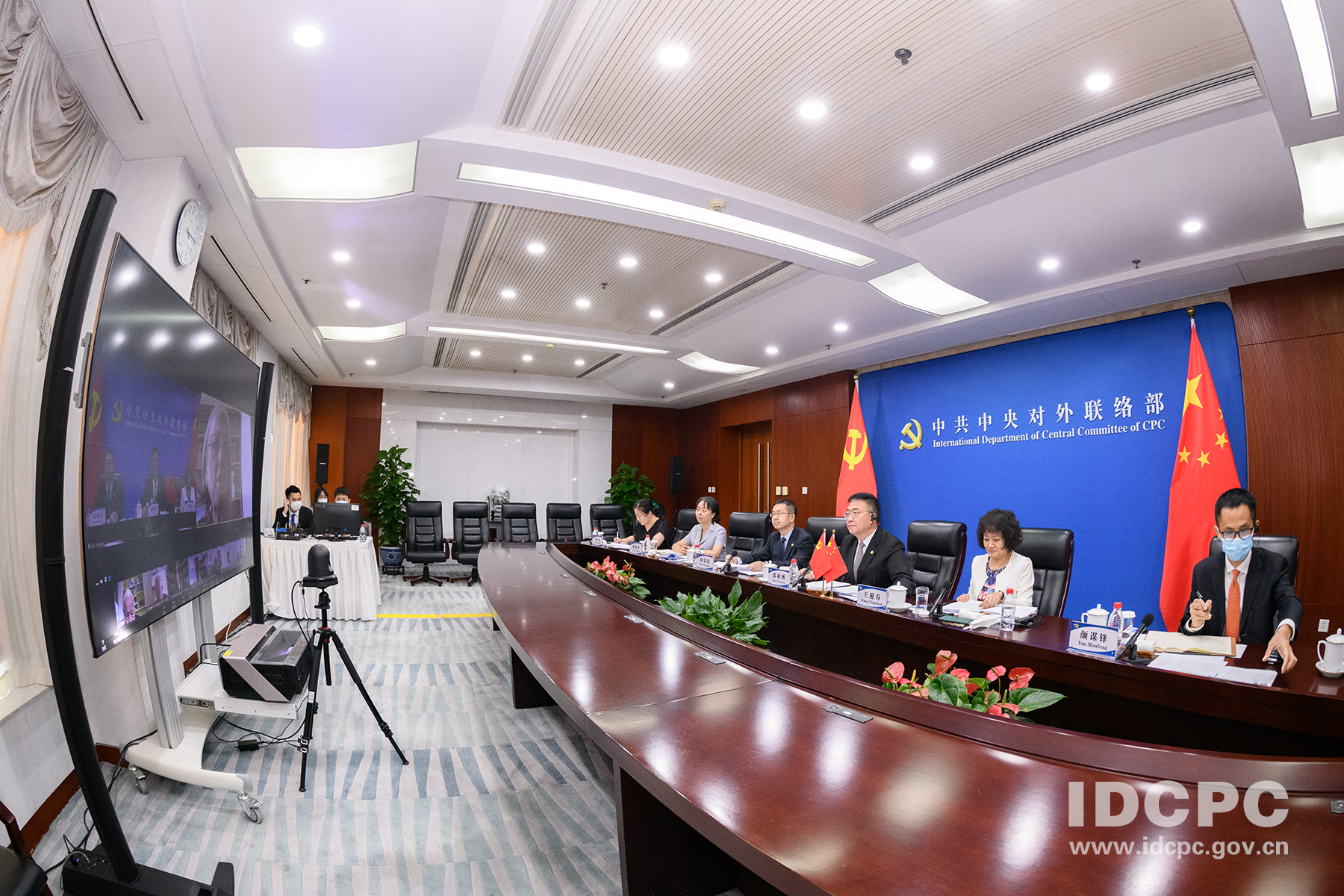
The Chinese ambassador recalled his student days in Wales when he returned to the Welsh capital on 7th July to meet Colin Riordan, the President and Vice-Chancellor of Cardiff University to discuss deepening exchanges and co-operation between the university and People’s China.
    Prof Riordan warmly welcomed Zheng Zeguang back to his alma mater after 36 years and updated the Ambassador on the University's progress in teaching, scientific research and co-operation with Chinese universities in recent years.
    Cardiff University has established long-term co-operative relations with Xiamen University, Beijing Normal University and Peking University in China. These projects have played an important role in the improvement of teaching and scientific research capabilities on both sides.
    Some 4,000 Chinese students currently attend Cardiff University, which would like even more to come and study in the future. The University is also willing to strengthen co-operation with Chinese industry to promote the transformation and application of scientific research results.
    Zheng congratulated his alma mater on the great changes that have taken place over the years. Calling it a first-class research university, the Ambassador commended its profound historical heritage and its open and diverse campus culture. The Chinese side appreciated Cardiff University's firm commitment to promoting China–UK educational exchanges and co-operation, and the attention and care given to Chinese students during the epidemic.
    He recalled his experience as a student at Cardiff University College in the 1980s, when China was in the early years of reform and opening-up. China has undergone tremendous changes since then. China's comprehensive strength and the people's living standards have improved significantly, and socialism with Chinese characteristics has entered a new era.
    China adheres to comprehensive and deeper reforms and higher-level opening-up to the outside world, and will continue to encourage Chinese universities to deepen exchanges and co-operation with Cardiff University. He hoped that Cardiff University would continue to play an exemplary role in China–UK educational exchanges and co-operation.


Tolpuddle returns!

By New Worker correspondent


Thousands of people braved the soaring temperatures to take part in the Tolpuddle Martyrs’ Festival after a two year Covid break and remember the pioneers of the labour movement unjustly transported to Australia in 1834 for setting up a union.
    This year we heard rail workers’ leader Mick Lynch and Angela Rayner, the deputy head of the Labour Party, talk about the cost of living crisis and the way forward for the labour movement.
    The Tolpuddle spirit has been recalled every year since the Thirties, apart from the second world war and the recent Covid crisis, in the village where the modern union movement began.
    In 1834 six agricultural labourers from the village of Tolpuddle in Dorset, England were convicted of swearing a secret oath as members of the Friendly Society of Agricultural Labourers. They were arrested on charges under an obscure law during a labour dispute against cutting wages and sentenced to penal transportation in Australia. Mass protests led to their pardon in 1836 and they returned to England between 1837 and 1839.
    There has been an annual gathering since the 1930s. It began as a Sunday afternoon event with wreaths laid on the grave of one of the Martyrs, James Hammett, followed by a procession of union banners and a rally . Today, the annual event sees thousands of trade unionists from around the world descend on the small village of Tolpuddle, to celebrate the legacy they left behind.
    A Martyrs monument was erected in Tolpuddle in 1934, and a sculpture of the martyrs, made in 2001, stands in the village in front of the Tolpuddle Martyrs Museum.
    The annual Tolpuddle Martyrs festival is usually held in the third week of July, organised by the TUC and featuring a parade of banners from many trade unions, a memorial service, speeches and mus
ic.

Westward Ho!

by Ben Soton


Why is West Country drama all the rage these days? The English West Country; the region starting in Dorset and heading west across Devon, Cornwall, while including Somerset and Avon and ending around Gloucestershire is often seen as a rural backwater but the area includes major cities such as Bristol, once the home of the slave trade, as well as the cathedral city of Bath.
    It seems ironic that in recent months both major terrestrial television channels have screened Sunday night dramas set in this English region. The BBC recently hosting the second series of The Outlaws, Stephen Merchants black comedy set in his native Bristol; whilst ITV showed the third series McDonald & Dobbs set in Bath.
    However, these two dramas could not be more different. In the case of McDonald & Dobbs the focus is on the relationship between two very contrasting police officers. Jason Watkins plays Detective Sergeant Dodds a somewhat OCD officer in his fifties whilst Tala Gouveia plays Detective Sergeant McDonald, aged around thirty, on secondment from the Met with a desire for promotion. Whilst McDonald & Dobbs focuses on the police The Outlaws, perhaps by its very name, focuses on the criminal.
    The overriding theme of The Outlaws is anti-crime but pro-criminal. It’s heroes are a diverse group of minor offenders ranging from a black civil rights campaigner and a business man sacked by his own father while another leading character is a drug dealer forced into crime by lack of job opportunities. All of these characters are victims of a London based gangster known as The Dean.
    This is an obvious reference to the so-called County Lines operations where London based criminals are taking over business from local drug dealers. The Outlaws is set in the ethnically diverse, city of Bristol; a mayor seaport once noted for its aircraft industry; whilst the city came to fame in recent years when a group of its residents through the statue of slave owner, Edward Colston, into the Bristol Channel.
    On the other hands McDonald & Dobbs is essentially a whodunit with complex plots; the level of complexity resembles Jonathan Creek from the 1990s. In the series both the victims and suspects are a mix of social-media celebrities, Formula One drivers and high-level academics. Scenes are interlaced with panoramic shots of the city of Bath; with its unique eighteenth century architecture as well as views of the surrounding countryside. This unique mixture gives the show a touch of Agatha Christie meets Death in Paradise.
    It is good to see television series set outside of London once in a while although regional crime dramas are not unique. Morse and Endeavour were set in Oxford, Life on Mars and Line of Duty set in Manchester to name but a few. I can even recall the fictional television presenter suggesting a detective series based in Norwich!
    But as a Sotonian I suggest maybe it’s time we had a series based in Southampton…

Saturday, July 23, 2022

Bye Bye Boris

Boris Johnson thought the world was his oyster back in 2019 when he first set foot in Downing Street as Prime Minister and leader of the Conservative & Unionist Party. He said he was going to deliver Brexit, unite the country and defeat Jeremy Corbyn – but although he did beat Labour and carry out the wish of the people to leave the European Union, he never united his own party let alone the country he led for the last three years.
    An incorrigible liar, he was surrounded by hand-picked people lesser than himself who proved incapable of dealing with the crises that beset his Government from the start. Tens of thousands died when Johnson took his lead from Donald Trump and embraced the crackpot theory of ‘herd immunity’ during the Covid pandemic. He only came to his senses after mass pressure from his own grass-roots supporters to do something forced him to impose the draconian lock-downs that held the plague in check until the vaccine breakthrough in 2021.
    Whilst the Johnson team used subsidies and “furlough” money to stave-off mass unemployment and economic collapse during the coronavirus crisis, it returned to its true-blue colours this year with draconian energy bill hikes and proposed new anti-union laws to curb the already limited right to take industrial action.
    The Tory rank-and-file could put up with his cronyism and scandalous private life as long as it kept the Corbynistas in their place. But they’re not so happy when the value of their property and their juicy pensions are threatened. Inflation has risen for the ninth month in a row; it now stands at 9.4 per cent.
    At recent by-elections some flocked to the Liberal Democrats in their droves. Others supported the long-standing moves to dump Johnson that have nothing to do with his disreputable private life nor his endless deceptions.
    Like all vain men, Boris Johnson was incapable of seeing himself as others see him. BoJo, as he liked to be called, certainly got Brexit done. But what did he do afterwards?
    Johnson put all his eggs in one basket, hoping that a Trump re-election would lead to a new trans-Atlantic free trade agreement – a Treaty of Washington to replace the Treaty of Rome, which would be paid for by selling off the NHS to American interests. It didn’t happen and Johnson had no fall-back position.
    A few paltry trade deals with friendly members of the British Commonwealth but no real exploitation of the freedom that was on the table when Britain finally left the European Union. Instead of broadening our trade with People’s China, Johnson slavishly followed Trump in restricting Chinese investment in the UK. The ‘golden age’ of trade with China is over and it may not come again.
    ‘Britain’s Trump’ imagined that he was the second Churchill, posing with Zelensky and other third-rate Eastern European politicians, and making empty threats to Putin from the safety of his armchair in Downing Street.
    The reality was that Putin never took any notice of anything Johnson said. Nor, more importantly for British imperialism, did the leaders of Franco-German imperialism let alone Joe Biden in Washington.
    Whoever takes over from Johnson will have to immediately try to restore the bridge with Europe and the ‘special relationship’ with the USA. Upholding the Northern Ireland Protocol that Johnson signed up to in the first place would be the best place to start.

Boris tries to dodge the flak

Prime Minister Boris Johnson is taking an unusual interest in foreign affairs at present. This is partly because he needs an excuse to get out of the country as often as possible to avoid awkward questions and attacks from his opponents.
    These opponents are not the ineffective ‘Opposition’ from the spineless Opposition front-bench team headed, rather than lead, by Sir Keir Starmer, but from Johnson’s own parliamentarians.
    The fact that the Tories have lost two recent by-elections will only have strengthened this particular opposition, with even the most loyal Johnson supporters fearful of losing their seats. As both by-elections were caused by sex scandals it was almost inevitable that the Tories would lose these seats, even Tiverton where a 24,000 majority was overturned. But a Liberal revival is, of course one of these traditional signs of the coming of summer that do not herald any great positive change. Losing the much more marginal Wakefield was probably less of a surprise than was the winning of that traditional Labour seat at the last General Election.
    Jonson being replaced by another Tory, who will be a Remainer, or later by a right-wing Labour government led by Starmer, will not be much or even any improvement.
    More positive opposition is to be found in the upsurge of industrial action. One small example of these struggles is that of the striking parking enforcement officers in the south London borough of Wandsworth who are striking to not just to secure pay parity with those in other councils but for their jobs to be brought back in house, which would ensure that parking fines are reinvested locally rather than used to pay dividends. If successful, this action will benefit all local people and not just the enforcement officers.
    Train strikes have dominated recent headlines. It is noteworthy that despite the disruption they cause and repeated attacks by the right-wing media against RMT, public opinion, admitted by the same right-wing media, is on the side of the striking railway workers.
    As a small stop press: it is pleasing to note that David Lammy, who was criticised in our trade union news for refusing to support the Heathrow Airport British Airways strikers, has backtracked. He claims that he was misled into thinking the workers were fighting for a pay rise rather than the reversal of a previous reduction – but this change of heart might be due to his local party rebelling and him being forced to think again. It is perhaps telling that Starmer has taken no action against those MPs, including a few front-benchers, who defied his instructions not to visit RMT picket lines.
    Industrial militancy is stepping up in the most unexpected places. The British Medical Association, which is the main trade union for medical doctors, has launched a campaign to secure a 30 per cent pay rise.
    This figure is not absurd. Dr Emma Runswick, in her speech urging support for the figure, mentioned a long list of recent inflation busting rises: “All around us workers are coming together in trade unions and winning big, last month bin men in Manchester 22 per cent; Gatwick airport workers won a 21 per cent pay increase two weeks ago; and in March cleaners and porters at Croydon hospital won a 24 per cent pay rise.”
    It is not just those in the medical profession who should carefully heed her closing words: “Those workers got together and used a key tool that trade unions have – the ability to collectively organise, collectively negotiate and collectively withdraw our labour… vote for this motion and I’ll see you on the picket lines.”

Wednesday, July 06, 2022

Support the Rail Workers


Tens of thousands of rail and tube workers will be striking over pay, jobs and pensions this week. Thousands of jobs are threatened by Management’s proposals. Proposed cuts put passenger safety at risk.
    These disputes are all down to the decision by the Tory Government to cut four billion pounds worth of funding from our transport systems – two billion from national rail and two billion from Transport for London.
    A victory for the RMT will be a victory for all workers and for all trade unions. It will help us all in the fight to stop the Government-driven race to the bottom on pay and working conditions. We’ve lived under the austerity regime for far too long. Working people should not pay the economic price for the capitalist crisis while corporations make record profits and billionaires grow richer every year.
    Stand with rail workers; stand with the RMT. Show your support and get down to a picket line near you!

Hobson’s choice

Covid, golden wall-paper, partygate – the writing’s certainly on the wall for Boris Johnson. And, so it seems, for the useless leader of the Labour Party. While Johnson’s rivals plot his downfall in the shadows of the corridors of power similar scenes are taking place in Labour’s committee rooms amid talk that Starmer is finally going to throw in the towel – possibly even before Labour’s annual conference in September.
    Though former Labour premier Gordon Brown is backing him, saying Mr Starmer should "ignore" criticism "because what's exciting about the possibility of Keir Starmer's leadership is he will have a plan for Britain" Brown’s support is usually the kiss of death for any ambitious Labour politician these days.
    Starmer’s vendetta against the Corbynistas has driven hundreds of thousands of members out of the party. His poor personal ratings in the opinion polls and his dismal performance on the street show how hopeless he is at campaigning.
    It’s said that Sir Keir Starmer has already told his followers to prepare the succession if he is forced to resign over claims that he, and deputy leader Angela Rayner, broke the Covid lock-down rules last year.
    An alleged friend of Starmer's told the media that the Labour leader reportedly told colleagues: “I will not let this party become a basket case again. I will not let our hard-won gains be squandered so we will need to be ready in the unlikely event that the worst comes to the worst”.
    Starmer’s apparently told the Blairites to get ready for a new leadership contest to stop even the hint of a Corbynista comeback and he’s apparently given his blessing to Lisa Nandy and Wes Streeting who, according to the Sunday Times, have been told to prepare bids for the top job. Both have dismissed these reports as nonsense – a wise move given that premature lobbying often proves fatal in the leadership stakes.
    There are, of course, others who covet the Labour crown. Angela Rayner may step down over “beergate” but that doesn’t stop her for running for the leadership. Andy Burnham is equally ambitious though he will need to get back into Parliament to enter the race. But clearly the worst is still to come if Remainers like Streeting or Lisa Nandy get to lead Labour.


How the East wasn’t won

by Ben Soton

Russia – A Thousand Year History of the Wild East by Martin Sixsmith Hardback: Harry N Abrams (reissue edition 2012); 611pp; Softback:‎ BBC Books (reprint edition 2012);‎ 624pp; RRP £12.99.

In August 1991 I was unemployed, little more than a teenager and living in a flat above a newsagent. One morning I woke to the news that a coup was taking place against the traitorous Soviet leader Mikhail Gorbachov. On realising what was going on I was ecstatic with joy. Meanwhile in Moscow someone from a more privileged background was covering the same events. That person was Martin Sixsmith, the BBC’s Moscow Correspondent.
    In this book first published in 2011 he regurgitates numerous reactionary misconceptions about that country and its people. According to Sixsmith Russians are not proper Europeans; pointing out that for around two hundred years (1237 - 1480) Russia lived under the Mongols as part of what came to be known as the Khanate of the Golden Horde. He makes childish references to Lenin having slanted shaped eyes as evidence of some possible Mongolian heritage. Imagine the (totally justified) outcry if a writer was to make reference to another ethnic group having hooked shaped noses.
    The section on Ivan the Terrible (1533-85) shows how similar Russia is to western Europe. Ivan was a tyrannical absolute monarch; however, the sixteenth century also saw the growth of absolute monarchy across Europe. The period saw the rise of the Tudor dynasty in England; with Henry VIII executing two of his wives and two chief ministers, not to mention numerous lesser people. Absolute monarchies were also established in Spain and France.
    On reading about various false claimants to the Russian throne, the so-called ‘False Dimitris’ in the early seventeenth century I was reminded of the false claimants to Henry VII’s throne namely Perkin Warbeck and Lambert Simnel. The only difference with Russia was that absolute monarchy lasted longer than in most of western Europe.
    Sixsmith shows his real ignorance when it comes to the Soviet era. He makes the nonsensical claim that during the Stalin era as many as sixty million people lost their lives as a result of the Soviet government’s policies. But he can’t explain how the population of the Soviet Union managed to increase by around fifty million in that period. A death toll of this magnitude would not only have led to a population decrease but would have also caused a massive birth deficit resulting a population decline. Whatever the rights and wrongs of Joseph Stalin; when he took the helm of the Soviet Union after the civil war it was in ruins. He left a superpower on the verge of space exploration.
    Meanwhile Sixsmith praises Margaret Thatcher and Ronald Reagan as champions of human rights. No concern for the victims of Latin American death squads and striking British miners. When I thought he couldn’t stoop any lower, Sixsmith praises the Soviet traitor Andrey Vlasov, who fought for Hitler in World War II. Maybe his next book will be an attempt to rehabilitate William Joyce, the British fascist dubbed “Lord Haw Haw” who went to Germany to broadcast Nazi propaganda during the war who was hanged in 1946 for treason.
    The later chapters cover the period from the rise of Gorbachev to the present day. Sixsmith says he was excited in the early days of Perestroika when entrepreneurs were setting up small taxi firms, restaurants and bakeries. However, he is now disappointed that the Russian economy is dominated by oligarchs. It was at this point when I stopped being angry and started laughing. Capitalism is not about individuals setting up restaurants and taxi firms; it is about a drive toward monopoly which inevitably results in an economy dominated by yes, oligarchs, who are not unique to Russia. You only have to watch the TV series The Apprentice, where the highlight of the show is an oligarch telling twenty somethings that they are fired.
    I do not approve of book burning and nor do I believe does this newspaper; however, with rising energy costs and the need to make ends meet…needs must.

Monday, June 20, 2022

Anything goes with Boris

Back in the good old days the sun never set on the British Empire that brought trade and justice to the four corners of the world. Though this was all nonsense the ruling class always paid lip-service to the bogus bourgeois morality that they invented to keep workers in their place and repeatedly broke behind closed doors and away from the prurient eyes of the popular press.
    At school we were taught that Britons were universally respected because an Englishman’s word was his bond – and this, amongst other things, is why we went to war with Germany to defend “plucky little Belgium” in 1914. If you were caught out you did the “decent thing” and resigned to avoid a scandal. If you lied in Parliament you walked.
    These days it seems that anything goes with the Johnson government unilaterally tearing up the EU Withdrawal Agreement to appease the bigots in Northern Ireland and the hard-line Brexiteers on the Tory back-benches while ready to send Third World asylum seekers to camps in central Africa – a move which many believe is in breach of the UK’s international obligations to refugees.
    The deportations to Rwanda, branded by the UN Refugee Agency (UNHCR) as unlawful, have been put on hold following an intervention by the European Court of Human Rights. This was supported by the Stand Up To Racism movement that said, “It’s hugely welcome that nobody has been deported to Rwanda tonight. Solidarity with all those who protested. But we know this is not the end and the struggle goes on against all racist deportations and state racism.”
    The Government claim their plan is aimed at deterring the cross-Channel trafficking gangs that exploit the plight of desperate asylum seekers. But it’s clearly one law for people from the Third World and another for the Ukrainians now being welcomed with open arms by the Government that stoked up the flames of war that forced them to flee in the first place.
    Rwanda already houses some 130,000 refugees mainly from other African countries, They have welcomed the deal which will give them £120 million upfront for housing and integrating the asylum-seekers. More will follow as the numbers rise. They say conditions in the camps in rural areas are good and that the refugees will be well-treated. That may well be so. But it’s a one-way road for the refugees who would never be able to come back to Britain whatever the outcome of their application for political asylum. If they are successful they would be allowed to live in Rwanda. If not they will be deported to some unknown destination.
    Johnson clearly hopes that this dog-whistle racism will revive his party’s flagging fortunes and help him stave off new challenges to his leadership from Tory dissidents. We must prove him wrong.
    The New Communist Party recognises the need for any sovereign state to set an immigration policy in accordance with its resources. But we firmly oppose any immigration policy that discriminates, either directly or indirectly, on the basis of race, creed, colour or gender.
    We call for the repeal of the Immigration and Asylum Acts of the 1990s, passed by both Tory and Labour governments, which make it very difficult for many genuine asylum seekers to establish their claims.
    Asylum seekers must be treated humanely and their claims dealt with swiftly. While this process takes place they must be given decent accommodation and welfare benefits to survive. No asylum seekers should be locked up unless there is good reason, with evidence, to believe they are criminals and no child asylum seeker should ever be locked up.

Tuesday, June 14, 2022

Talking about Jerusalem

The sectarian violence in Jerusalem that has enraged the Arab and Muslim world is a warning to the world about the consequences of allowing Israel to maintain its illegal and brutal occupation of the West Bank.
    The Zionist mob that swarmed through the Muslim quarter of Arab East Jerusalem last week chanting “Death to Arabs” was a deliberate incitement to violence. Under the protection of Israeli riot police and security forces they deliberately goaded the Palestinian Arabs as they gloated over their victory in June 1967.
    The Zionist settlers and their political sponsors in Tel Aviv want to drive the Palestinians out of the homes and land they hope to steal – as they did when around a million Palestinians were forced to flee by Zionist gunmen during the first Arab-Israeli war. They talk about the 1967 “Six-Day War” and think they are invincible but some clearly have short memories. They sang a different song when Hezbollah missiles rained down on Haifa and northern Israel in 2006.
    Wherever there is oppression there is always resistance. There can be no peace in the Middle East until the legitimate rights of the Palestinian Arabs are restored.

Poor Old BoJo

It seems that Boris Johnson’s luck has finally run out if this week’s vote of no confidence is anything to go by. Though Johnson won the Tory 1922 Committee ballot it was by such a narrow margin that it is difficult to see how he can long remain leader of the Conservative Party.
    Though always good at advancing himself Johnson’s performance when Mayor of London and Foreign Secretary showed that he was never fit for the highest office in the land. Johnson’s only asset was his ability to get the Tory vote out when needed. He did it to beat Ken Livingstone for the London Mayoralty and he did it again at a national level to “get Brexit done” in 2019. Had he heeded his advisers and curbed his irresponsible personal behaviour he would have been remembered as the politician who tore up the Treaty of Rome. Now he will recalled, if at all, as the man who spent a fortune lavishly redecorating Downing Street and partied during the Covid lockdown – much like Nero, to use one of Boris’ classical examples, who supposedly fiddled while Rome burned.
    Anyone else could have seen this coming and changed course. but not Johnson, which all goes to show that going to Eton and reading Classics at Balliol College, Oxford is not a measure of intelligence at all.

Pay the Tube workers

The RMT transport union showed it meant business when it shut down London’s underground network on Monday following the breakdown of talks with Management on jobs and pensions last week.
    Six hundred workers jobs could go if London Underground gets its way. So far Management has shown no interest in constructive talks to settle the dispute. It’s time for the Mayor of London to intervene. Sadiq Khan has the authority to raise taxes. Just four banks made a profit of £34 billion last year and are set to pay out over £4 billion in bonuses to London traders. A windfall tax on those profits would more than adequately fund London’s transport network. The Mayor should meet and heed the union to keep the Underground network running in the future.

Tuesday, June 07, 2022

China’s communists through the eyes of others

by Andy Brooks


Last week a video seminar was held as part of the events organised by the Communist Party of China in the run-up to its 20th National Congress this year. NCP leader Andy Brooks joined Rob Griffiths of the CPB, Ella Rule from the CPGB-ML, Keith Bennett from Friends of Socialist China, Carlos Martinez from the No Cold War movement and a representative of the CPB’s YCL to talk on the theme of the Communist Party of China in My Eyes. This is Andy Brooks’ contribution...

First of all I would like to thank our hosts for allowing me to say a few words about my impressions of the Communist Party of China which began when I first set foot in the people’s republic as part of a New Communist Party delegation that went to study economic reforms in the new enterprise zones in China back in April 1993.
    During the course of that visit we met a veteran Chinese communist who had fought the Japanese invaders and the reactionary forces during the civil war that ended in victory in 1949. He shared his memories of Harry Pollitt, who he had met when the British communist leader went to China in 1955, and he told us about the first steps taken by the communists along the road of socialist construction following the establishment of the people’s government in 1949.
    The Chinese comrade also spoke about the great changes in the countryside that had begun in 1979 and the development of the special zones that paved the way for the economic reforms that built the socialist market economy which is now the second largest in the world. He knew that dogmatists in some parts of the international communist movement didn’t understand the reform movement. But he said “what is the purpose of the Communist Party if it can’t raise the living standards of working people”.
    I have never forgotten that point. Sadly many European communists, east and west, did – leading to the fall of the Soviet Union and its allies in 1991 in the east and the collapse of communist and workers’ parties millions strong in western Europe.
    I don’t know whether that old Chinese communist lived to see the immense changes that have transform the towns and cities of China but we certainly have in subsequent visits to China over the past thirty-odd years.
    China has become a major force for peace. It has become a beacon of hope for all oppressed people.
It offers economic assistance to poor countries and has played an important role in helping the international efforts to combat the Covid pandemic.
    Cities have been modernised beyond recognition. Absolute poverty has been abolished Vast investments have created new industries to face the challenge of the 21st century and China is, once again, the work-shop of the world.
    Of course great cities are not unique to China. Monumental designs and towering blocks can be seen throughout the Western world. Modern cities house the banks and investment houses of capitalist speculation. Huge factories build the technology and the weapons needed to maintain the global system of oppression while the power of oil has transformed small fishing ports in the Persian Gulf into millionaires’ playgrounds. But this has not benefited the workers in the heartlands of imperialism while oil riches have not helped free the Palestinians or raised living standards on the Arab street.
    The immense wealth of the Western world remains in the hands of a tiny minority of capitalists and feudal lords.
    In the West millions of people scrabble to earn a living just to keep a roof over their heads, while a tiny elite live lives beyond the reach and often beyond the imagination of most workers.
    In the Third World millions upon millions live in poverty while their resources are plundered by the big Western corporations.
    We, on the other hand, see a different picture in China. Vast cities with modern offices and factories and equally modern housing for the workers who live there.
    Chinese astronauts circle the globe. A high-speed rail network spans the country. Container trains travel to Europe packed with the goods that fill our shops and markets. International airports link China to the four corners of the world. A growing network of domestic airline services and modern ports serve the seaborne trade that fires the global economy. And a state run education system and a dedicated health service that battled to contain the Covid plague is available to all.
    China’s wealth is being used to raise the standard of living of everyone in the people’s republic and help the development of the Third World through genuine fair trade and economic assistance.
    Though the social changes that inevitably followed the establishment of a mixed economy did lead to a rise in street crime it remains remarkably low compared to the norm in Europe and nothing like US or Latin American levels.
    There are no shanty-towns and slums in People’s China and the last vestiges of colonial rule, the shameful hovels in Hong Kong, will soon be swept away by the new government of the special administrative region.
    Big city pollution is being tackled by the people’s government in a meaningful way. The smog and acrid air has gone and blue skies have returned to Beijing following the national “war against pollution”, huge investments into a new regulations and an air pollution action plan that has transformed the capital and many other cities across the country.
    Over the years exchanges of views with the representatives of the Communist Party of China have deepened our understanding of the immense problems in organising the communist movement in such a vast country with such a huge population. We have also seen the immense achievements that China has made under the leadership of the Communist Party of China in overcoming poverty, providing the basic needs of all the people and tackling the population problem to give everyone a better life and a standard of living that is constantly rising.
    This year China’s communists will gather for their national Congress to chart the way forward for the Party and the country in the immediate future. Back in 2014 Communist Party of China (CPC) leader Xi Jinping said: "The very purpose of the CPC's leadership of the people in developing people's democracy is to guarantee and support the people’s position as masters of the country.”
    We are confident that the 20th Congress of the Communist Party of China will set the agenda for the people of China for many years to come. We wish the comrades success in their work and look forward to studying their conclusions in the future.


Monday, June 06, 2022

Measure for Measure

Summer may have begun this week, but it seems that the silly season, which usual starts in August, is already upon us. Boris Johnson tells us he’s going to restore the old Imperial measurements, which were discarded in the 1980s to conform with the norms of the European Union, and that he’s going to build a new European bloc consisting of the Baltic States, Poland and Ukraine to stake out British imperialism’s interest in eastern Europe.
    The return to yards and gallons, in tandem with the current metric system, will certainly be a boon to the older generation who still can’t make head or tail out of metrication, but it will be a matter of indifference to the generations brought up under the new system and it will make no difference to the price of anything sold on the high street.
    On the other hand, Johnson’s proposed British-led bloc – based on Russophobia, neo-liberalism and a loathing of the Brussels’ bureaucracy – offers little or nothing to the proposed members already in the EU and nothing at all to the Ukrainian regime that wants to be a full member of the European club. Nobody takes the idea seriously, least of all the proposed members of this alternative European union. The ‘BoJo bloc’, like the return to feet and miles, has clearly been floated by the Downing Street team to distract the public from the continuing Partygate scandal that threatens to bring down the Johnson premiership.
    The number of Tory backbenchers calling on Johnson to stand down or face a confidence vote is apparently growing, although it still falls short of the 54 needed by the Tory 1922 Committee to trigger a vote on the Prime Minister’s future. A far greater number of Conservative MPs would be needed to dump Johnson. Half of them, in fact, would have to vote to oust him for the motion to pass.
    Whether the rebels can muster the 178 or so members to take that decisive step remains to be seen. Many think that the grandees will stay their hand to see what happens at the two by-elections this month. If the Tories lose both – Labour is expected to win one, the Lib-Dems the other – then Johnson’s in big trouble. If it’s bad news for the Tories, the Remainers may make their move. But then again, maybe not.
    The Remainers, who are the driving force behind the move to topple Johnson, don’t have an agreed candidate to replace him. Jeremy Hunt is a front runner but there are others who also fancy their chances if Boris goes.
    Sadly Labour is saddled with a lame-duck leader whose only achievement has been to kick Jeremy Corbyn out of the Parliamentary Party and drive hundreds of thousands of Corbyn’s supporters out of the party over the last two years.
    While the Tories fight amongst themselves, the time is ripe for the labour movement to seek out another leader to replace Starmer to face whoever takes Johnson’s place at the next general election.
    At the same time, communists must continue to struggle to put the communist answer to the capitalist crisis back on the working-class agenda whilst building solidarity with the people of the Donbas fighting, with their Russian allies, for their freedom, and fighting for peace and socialism all over the world.

Sunday, June 05, 2022

Another romp in the jungle

by Ben Soton

The Lost City. Paramount Pictures, 2022; 12A, 112 mins. Director: Aaron Nee, Adam Nee. Stars: Sandra Bullock, Channing Tatum, Daniel Radcliffe.


The Lost City could best be described as {Jumanji} for the middle-aged with strong similarities to the Romancing the Stone franchise of the 1980s. In both cases the writer becomes the hero; effectively taking part in their own adventure. Parallels also exist when in both cases a romance takes place between the writer/heroine and an action hero.
    Sandra Bullock, whom I have to say looks rather good for 57, plays lonely bestselling novelist Loretta Sage. Meanwhile, Daniel Radcliffe plays Abigail Fairfax – a rather one-dimensional British villain who hopes to use Sage’s linguistic skills to find hidden treasure. The choice of a British villain may be indicative of the way the current Biden administration views Britain under Boris Johnson. They have never forgiven Johnson for his close relationship with Donald Trump and were not that keen on Britain leaving the European Union.
    In The Lost City Sage gets up close and personal with dim-witted cover model Alan Caprison (played by Channing Tatum). As the adventure unravels however, it appears that Caprison is not as dim-witted and shallow as he first appears.
    The film raises the issue of can anyone become an action hero if forced to by necessity, with both lead characters using their initiative to avoid capture. The two lead actors work remarkably well together, with a high-quality dialogue and a number of unexpected scenes keeping the audience focused.
    As with the Jumanji franchise, it views the world through an American prism, seeing the rest of the world as some kind of computer game. The film is set off the coast of Africa with the local population as little more than extras. This is however, where there were missed opportunities for the story to develop. Namely one of Fairfax’s henchmen, who it turns out only works for him due to lack of job prospects, on his being unwilling to do his bidding.
    Although the storyline is not original, re-hashing an old idea that worked in its day does not always make it bad. Let’s face it, Romancing the Stone was a successful film and there was also an enjoyable sequel the Jewel of the Nile that did almost as well at the box office. The acting is convincing, and the story is mostly harmless but with missed opportunities. As a result, {The Lost City} is best seen as an upper-end B-Movie with slightly above average dialogue.

Pittance pay in the heart of Cambridge

by Carole Barclay

Daniel Zeichner, the local Labour MP, joined Cambridge students and supervisors demanding “fair pay”, a contract and paid training for supervisors at a rally in the heart of the university city last week. These were the people who were the “backbone of Cambridge’s education system” a student speaker said, but the way they are treated is “cruel, exploitative and unsustainable”.
    The protest by the Justice4CollegeSupervisors campaign called for an end to the “gig economy” working conditions of the undergraduate supervisors who deliver the University of Cambridge’s tutorials on pittance pay.
    The University & College Union (UCU) says around half of undergraduate supervisions are delivered by staff forced into self-employed status or zero-hours contracts. Around four in 10 do not earn a living wage.
    Zeichner told the crowd: “I’m here to show my support for your cause. It's 2022. This university, these colleges, have a lot to be proud of. Why have we still got the systems from centuries ago?
    “I’ll say to people in the university: institutions survive when they change with the times. If they don’t change, change happens anyway, happens when people apply pressure. Thank you for what you’re doing.”
    Campaigning can bring change Zeichner said, pointing to the Johnson government’s recent U-turn on a windfall tax on oil and gas companies that was first proposed by the Labour Party.
    Although the University of Cambridge has finally agreed to draft guidance asking departments and faculties to pay for all mandatory training that they require supervisors to undertake, the university's own colleges have so far refused to follow suit.
    UCU general secretary Jo Grady said: 'It is a scandal that workers who deliver the University of Cambridge's famed small-group supervisions are often on poverty pay without any job security – conditions akin to the gig economy.
    “After years of campaigning, the university has made a first step towards paid training. Its colleges now need to do so and meet our demands to pay supervisors for the full amount of time they spend preparing for classes and provide them with secure contracts.”