Showing posts with label book review. Show all posts

Friday, August 07, 2026

The Age of Erdogan

by Ben Soton

From Life Itself – Turkey and Istanbul in the Age of Erdogan
by Suzy Hansen, Profile Books 3036, 368pp, pbk rrp £12.99

Recep Tayyip Erdoğan and his Justice and Development Party (AKP) have dominated Turkey for over twenty years.  He became Prime Minister in 2003 and has been President since 2014. This is the story of his reign. The book covers the Erdogan years mainly through  the prism of the Istanbul neighbourhood of Karagumruk and its local muktar, Ismail.  A muktar is a local fixer, whom people often come to for advice; interestingly Erdogan once referred to himself as the Muktar of Turkey.
The author covers the changes to Istanbul over this period; which include a real-estate boom that has changed the appearance of the former capital of the old Ottoman Empire.  In 2013 Erdogan faced criticism from architects over the destruction of Gezi Park with a view to turning it into a shopping mall in the style of Ottoman military barracks.  This led to protests sparked by criticism from architects; in typical far-right populist fashion Erdogan claimed to be standing up to elites.  Meanwhile the construction boom led to serious imbalances in the Turkish economy, which led to economic problems in 2018. Early in the book Hansen gives historic reasons for the success of Erdogan and the AKP. In 1955 Istanbul was rocked by sectarian riots which led to an exodus of Greeks from Istanbul and other Turkish cities. They were replaced by conservative migrants from the countryside; some of whom had a poor understanding of city life.  Ismail recalls a new arrival depositing soil on his roof with a view to planting tomatoes and water pouring into his flat below. Now these communities have established small to medium sized businesses and become keen supporters of the AKP.  
Erdogan has created an alliance between Islam and capitalism based around state-sponsored construction projects to counter the secular Kemalist establishment they defeated in 2002 and curb the growth of the Turkish left. In the 1960s the left flourished in Turkey, as in much of Europe, often amongst radicalised students. Successful movements of the left are an alliance between workers and intellectuals but this didn’t work in Turkey where much of the urban working class are descended from rural migrants.  
The author charts the changes in the nature of the AKP which in its early days favoured a form of Pan-Islamism but has now moved towards an aggressive form of Turkish nationalism with an innate hostility to the Kurds. This can be partly explained by the AKP alliance with the far-right National Movement Party (MHP) in the Turkish parliament which further concentrated power in Erdogan’s hands.
The earthquake of 2023 sent shock-waves throughout Turkish society. Many of the buildings constructed during his tenure survived but some raised the issue of the unsafe buildings that were destroyed; especially in a country prone to earthquakes. Despite this he still survives and there is even talk of changing the constitution enabling him to remain in office after 2028.         
Erdogan’s success may be down to a weak opposition who engage in politics on his terms; or simply the repressive nature of the Turkish state. Hansen, an American academic views the world from a liberal perspective; focusing on the subjective experience of individuals.  However this does not mean that her work should be dismissed or ignored.
  

Saturday, July 04, 2026

The right to roam

by Ben Soton

Contested Commons – A History of Protest and Public Space in England by Katrina Navickas; Reaktion Books, London 2025; 384 pp. Hbk £20

The pages of the New Worker are full of articles and stories about protests be they progressive reactionary or anything in between.  But what of the places, usually outdoors spaces, where protests take place? 
Sometimes these places are the subject of protest themselves.  In Contested Commons, Katrina Navickas provides the story of these places.  Her book covers the history of public spaces and their role in popular protest.
A book like this should be welcomed at a time when the right to protest is under attack. 
First of all it challenges the “myth of the commons” – the idea that at some point in time we all had access to common land which was later on stolen by the landowners. The problem is that no such Golden Age existed.  Although enclosures of common land did become widespread from the Tudor times, there is little actual evidence that any such Golden Age ever existed. Another theme is the concept of Enclosure versus Commoning.  For instance in her section covering the anti-roads protests of the 1990s, Navickas sees the road builders as enforcing enclosure and the anti-road protesters as defending the ancient commons.     
The book is written in two halves.  The first concentrating on the rural man-made landscape; with chapters including Commons, Waste and Verges.  This section begins with examples of enclosures of common land in the 18th Century as well as the mass Kinder Scout Trespass protest in the 1930s and the Right to Roam.
The second part of the book covers urban protest with chapters named after street furniture such as, Railings, Pavements and Barricades. Railings is a reference to the protests during the  Second Reform Act of 1867, (which enfranchised urban, male property owners) where protesters used the railings surrounding Hyde Park to defend themselves from attack by the police. Barricades is a reference to the Battle of Cable Street when the people took to the streets to beat back the Mosleyites on the streets of London’s East End in 1936.  Later chapters cover events such as the Battle of the Bean Field in 1985; an event that took place during the miners’ strike which the author makes no mention of.  And it ends with coverage of the New Age Travellers of the 1990s, which she refers to simply as New Travellers.  
In a recent article in the Morning Star Ian Sinclair points out that “92 per cent of land and 97 per cent of rivers in England” are not legally accessible.  Subsequently, a book that covers issues of land ownership and common land is to be recommended.  Whilst with the legitimate right to protest under attack it is reminding us of the long history of protest in the country.   
 

Sunday, May 24, 2026

The cruel Atlantic trade

by Ben Soton

The Great Resistance – The 400-Year to end Slavery in The Americas by Carrie Gibson, Basic Books, New York 2026, 640 pp, Hbk £30 Pbk £20

The 16th Century saw the opening up of the Americas and the establishment of transatlantic trade routes.  The trade in sugar, cotton and tobacco was central to the development of capitalism and with it the industrial revolution; central to this process was the trade in human capital across the Atlantic ocean.
In this book Carrie Gibson gives a detailed account of resistance to this evil institution. 
She pieces together a myriad of small texts and in so constructs the four-hundred-year history of slavery in the Americas. It begins in the late 1400s and ends in 1888 with the abolition of slavery in Brazil. 
The transatlantic slave trade was initiated by Spain and Portugal and later involved Britain, France and to a lesser extent the Netherlands, Denmark and Sweden.  Resistance took many forms, including suicide, while rebellions took place almost as soon as the slave-trade began.  Resistance also took the form of guerilla warfare. Slave revolts took place wherever slavery existed and were more widespread than many of us may have previously been aware.
The book goes into considerable detail as to how the major events of late 18th century contributed to the ending of slavery.  The American War of Independence saw both sides offering to free slaves prepared to join their fight. The French Revolution, with its emphasis of ‘The Rights of Man’, influenced the successful revolt in Haiti – the first state to abolish slavery in the Caribbean. It was not the actions of well-meaning white folk but the result of the actions of slaves themselves that ended slavery; a theme that the author stresses throughout the book.  
Gibson downplays the role of Royal Navy’s West African Squadron in ending the slave trade in 1807.  Gibson points out that most of the captives liberated were not returned to Africa but ended up in the Americas as indentured labourers.  She also points out that the African Squadron was more of a means of extending Britain’s imperial interests in Africa than actually helping Africans.  On a more surprising note the author is highly critical of Simon Bolivar, a hero of the Latin American left, whose attitude to people of colour was at best ambiguous.   
The 19th century saw the gradual abolition of slavery across the Americas. It did not result in an age of prosperity for the former enslaved people; after all it was their former owners who received compensation. The freed slaves still suffered from the ravages of colonialism, segregation and racism. Problems that are for the most part unresolved. The book stands as a testimony to those who fought against the evil institution of slavery.    


Tuesday, April 14, 2026

Dark tales from Scotland

by Ben Soton


Silent Bones by Val McDermid, Sphere (Little Brown Book Group)
 London. Hbk: 2025, 448pp, rrp £22.00. Pbk: 2026; rrp £10.99.

This is  Val McDermid’s latest Karen Pirie crime thriller. Two others, The Darker Domain and The Distant Echo, have already been adapted for television. This, the eighth  featuring DCI Karen Pirie and her team who make up Edinburgh’s Historic Cases Unit (HCU), touches on the corrupt and sordid side of Scottish politics. 
This one, Silent Bones, begins with a mud-slide which unearths the body of a murdered investigative journalist.  Meanwhile the death of a hotel manager, originally believed to be an accident, soon turns out to be suspicious. The HCU soon discover the two deaths to be interlinked. They unearth the cover up of a violent rape at a pro-independence event as well as betting and match fixing scams featuring a shady elite book club called the ‘Justified Sinners’. But the ‘Sinners’ is more like a masonic lodge than a book club where potential members will literally kill to gain admittance.         
The Justified Sinners, a reference to an 1824 novel by James Hogg, is based on the Protestant concept of Predestination. where members of the “elect” can commit any sin they like as they are guaranteed a place in heaven – an obvious swipe at the Calvinist dogma of the Church of Scotland. This could also be a reference to the Epstein Files, where men from elite backgrounds are engaged in criminal and degenerate behaviour including paedophilia. 
Meanwhile DCI Pirie and her team come to life as real characters as their complex personal lives weave into the story.  Both of her assistants, Detective Sergeants Jason Murray and Daisy Mortimer, manage to use their partners in the investigation while Karen Pirie, a single woman in her thirties ends a relationship with her Syrian refugee lover. This backstory is an example of McDermid’s liberalism which views the Assad Government as the epitome of evil whilst portraying the new regime cobbled together from various Al Qaeda affiliates as an opportunity to re-build the country. She overlooks the persecution of religious minorities, not to mention the privatisation of national assets and collaboration with the murderous Zionist state by the new regime.  
The novel also delves into the differences between English and Scottish law. In England, an arrest must be necessary for specific reasons. In Scotland, an officer can arrest if they have reasonable grounds to suspect an offence was committed.
 This is a thoroughly well written, great thriller but is also testimony to the author’s bourgeois liberalism. McDermid sees corruption and degenerate behaviour as something that can be rooted out rather than an integral part of capitalism. We’ve heard that one before...  

Friday, April 10, 2026

In Search of Gerry Healy

by Dermot Hudson 

My Search for Revolution & how we brought down an abusive leader : Clare Cowen, Troubador Publishing Ltd 2019, 200 pp, rrp £19.99

About a month ago I was walking around Ipswich when I came across a charity shop actually giving away free books. The title of this book caught my eye. It turned  out to be a book about the scandal in the 1980s around the Workers’ Revolutionary Party(WRP), a Trotskyist party, which led to the WRP splitting into eight factions – yes eight factions!
 I vaguely recall reading about the implosion of the WRP in 1985  so the book excited some interest in me. The Cowen book is basically an expose of the WRP and a narrative of the events around the expulsion of Gerry Healy, the founder and leader of the WRP.
This self-published tell-all account was written by Clare Cowen, a WRP full-timer (of which there were 100 at one time) and a member of the party’s leadership.
When I first became interested in politics in my youth during the mid-1970s the WRP’s main claim to fame was its support from the glitterati that included the famous actress Vanessa Redgrave and her brother Corin and  a host of other celebrity members. In those days the WRP was possibly the biggest Trotskyist party in Britain. It was certainly the most sectarian – though that was challenged by rivals that included the Socialist Workers Party and the International Marxist Group then led by former student leader Tariq Ali.
The WRP’s ascendancy on the Trotskyist left was in part due to the huge amount of money they had not just received from the Redgraves but other wealthy members of the WRP including the author of this book, Ms Cowen.
Clare Cowen herself was not from a poor working-class background. She was actually from a bourgeois family – in fact a White Zimbabwean whose family had black servants and owned gold mines. Some of Ms Cowen’s money was used to bankroll the WRP and if I read it correctly some of the WRP’s companies and properties were partly owned by her. To me the book not only illustrates the bankruptcy of Trotskyism but the dangers of what happens when revolutionary movements get mixed up with people from wealthy backgrounds who always see things differently to a worker.  
Sects like the WRP grew after 1956 when Khrushchev's attack on Stalin opened  the door to Trotskyism as well as modern revisionism. The old revisionist CPGB failed to deal with Trotskyism. They simply labelled different Trotskyist groups as “ultra left” (even though most Trotskyist groups in the UK actually existed as entryist factions, like the Militant Tendency, within the reformist Labour party) . Little did  the burnt-out revisionists of the old CPGB realise that trailing behind left social-democrats with their third-rate “Euro-communist” drivel actually drove many young people out of the party and into the arms of the likes of the WRP.
The WRP tried to organise the unemployed through its “Right to Work “ marches. It had a trendy youth section called the Young Socialists. The WRP was, unlike the old CPGB, a very disciplined party that demanded hard work from its activists and not paper members sitting at home.
The real power in the WRP, however, rested not with the Redgraves or people like Clare Cowen but with the founder, leader and guru of the WRP, one Gerry Healy. Healy, a renowned ranter, once described as having a “Hitlerite” speaking technique, liked to pose as a master of Marxism. But in the last years of his life Healy became a supporter of ‘perestroika’ and ‘glasnost’ Gorbachovite revisionism. This may be viewed as bizarre but it can be argued as appropriate because Trotskyism is really a form of revisionism.
Curiously the WRP, despite proclaiming to be “revolutionary “ and implying by their name that they were for proletarian revolution, actually began as a sect inside the Labour party believing in the parliamentary road to socialism and standing candidates in general elections. Like the CPGB modern revisionists who dumped the Daily Worker and launched the Morning Star, the WRP rebranded their Workers Press as Newsline.
Healy and other Trotskyists continually denounced what they called “Stalinist bureaucracy “ but Healy ran the WRP in an extremely bureaucratic fashion with a huge full-time staff plus his own security . In fact reading between the lines it was clear that the WRP was run like some of the worst capitalist companies; Healy was overbearing, pushy and authoritarian. He bullied staff, sacked people he did not like and even had his own BMW. In the capitalist corporate world bosses sleeping around and demanding sexual favours is common. This is exactly what Healy did. Healy had sexual relationships with his secretary Aileen Jennings and the author of this book, Clare Cowen. Although both women remained in these relationships for a long time  it was also alleged that Healy had sexual relations with dozens of other female WRP members. 
By the 1980s the WRP’s luck was running out. Its dominance of British Trotskyism was challenged by the likes of the SWP and the Militant Tendency. The WRP was overstretched and ran into financial trouble .Rows over money erupted. It was then Aileen Jennings and Clare Cowen  who decided to spill the beans on the scandalous activities of Healy and the rest is history .
Although the book is a great account of the workings of a Trotskyist faction Ms Cowen has not broken with the tradition it comes from. She repeats Trotskyist anti-Stalin propaganda. Cowen also criticises the WRP for some of the better positions that it took like support for the Libyan Jamahuriya and Baathist Iraq and the defence of the Iranian revolution. Cowen also repeats some of the dafter claims about the WRP such as it having 10,000 members in the 1980s (it was about one tenth of that)! I was myself disappointed because I had expected to find an account of the split between the WRP and Royston Bull who founded the International Leninist Workers Party(ILWP) and later briefly rose to fame in Arthur Scargill’s Socialist Labour Party.  But all mention of Royston Bull and his ILWP is omitted.
To conclude, although the book is a good read for those who like a bit of scandal, it fell very short of offering any serious insight into the WRP and the bankruptcy of Healyism.


Monday, March 16, 2026

The Chosen Men return!

 by Ben Soton

Sharpe’s Storm by Bernard Cornwell, 
Harper-Collins. Hbk: 2025, 368pp, rrp £22.00. Sbk: 2026, 368pp, rrp £9.99. Audio: 628 minutes, rrp £17.99.

This is Bernard Cornwell’s 24th novel in the Sharpe series – set in 1813, as the British army along with their Spanish and Portuguese allies advance into France during the Napoleonic wars. Most of the Sharpe novels are set during the war with France when Britain was aligned with the absolute monarchies of Prussia, Russia and Austria. So I wouldn’t imagine the Sharpe saga, with its glorification of war, especially a conflict where this country was arguably on the wrong side, to be especially popular on the left.           
What of the character Sharpe? Richard Sharpe was born around 1780 in poverty, becomes involved in crime.  In the television series, Sharpe, played by Sean Bean, is a Yorkshireman; in the original novels he is a Londoner.  He eventually joins the army and begins a successful military career.  So successful that he is given a commission by Arthur Wellesley, the first Duke of Wellington.  This gives him both strength and vulnerability.  On the one hand he is Wellington’s man, giving him a degree of protection. But he lacks the wealthy connections of most other officers and therefore Wellington can easily break him as he could make him.  
For this reason Sharpe is often given dangerous missions; in the case of Sharpe’s Storm Admiral Sir Joel Chase.  has been tasked by Wellington to overview the river Ardour, check its bridges and examine the possibility of getting warships down it. This is made increasingly difficult as the events take place during a storm.  Although Sharpe is admired by the military top brass, he still manages to make enemies amongst junior officers from the ranks of the gentry. In this story Sir Nathaniel Peacock, a man who obviously bought his commission and with limited experience, is a liability.  Peacock continually reminds Sharpe of his social superiority; which Sharpe is able to brush off with a degree of humour and sarcasm.
The idea of Sharpe is based on the notion that the ruling class, which may contain a few bad apples (anyone who has watched the news recently knows that it is more than just a few), is fundamentally good, recognises talent and is willing to occasionally bring in new blood.  This positive view of the ruling class explains why the series is popular on the right.  Sharpe, although a fundamentally decent individual, has absolutely no concept of class loyalty. Meanwhile the character also has deep insecurities; which emanate from the knowledge that he may never be fully accepted.  Thus accepting the limitations of meritocracy. Sharpe is ultimately a mercenary for his own ruling class.


Monday, March 02, 2026

Stone Age stories

 by Ben Soton

Circle of Days
by Ken Follett, Grand Central Publishing; 2025, hbk  608pp rrp £25. pbk rrp £10.99.

For years Ken Follett has long been a master of both contemporary and historical fiction.  His latest novel, Circle of Days, takes us back to ancient Britain – a time after the development of agriculture but before writing reached these shores. The building of Stonehenge is a major aspect of the book; a monument still standing just a few miles outside Salisbury in Wiltshire, the area referred to as the Great Plain. 
This is the first major novel set during the prehistoric era since Bernard Cornwell wrote Stonehenge in 2000. The two novels present very contrasting views of the period. Cornwell’s novel portrays a society with an existing hierarchy; Circle of Days is set in a more anarchic world with competing and sometimes conflicting communities – farmers, herders, ‘woodland folk’, flint miners and a caste of priestesses.  Follett paints a world of conflict. 
The farmers are the emerging and most powerful group with an element of the story focussing on the age-old rivalry between them and the herders – the basis of the Cain and Abel myth. Meanwhile the woodland folk, obviously the remnants of  the hunter-gatherer society, appear to be doomed. The novel shows the different attitudes and cultures of the rival groups.  Women within the farming community are seen as property of their men whilst the woodland folk practice a form of free-love. The priestesses are an overwhelmingly lesbian grouping; while being the only ones who can count.
 Follett, who is not a Marxist, is painting a picture of an emerging class society. It is widely known that farming triumphed over hunter-gathering and herding, eventually leading to class-society and the rest is history. The author, who has always favoured class compromise, predictably sides with those in the various communities who favour compromise and negotiation. As the story develops, we see tit-for-tat warfare between the rival groupings; which includes the burning of the forest by herders and attacks on grain stores by woodlanders. 
The building of the henge takes place in the later stages of the novel; its construction is the idea of Joia, a priestess who sees it as a means of uniting the rival groupings and bringing more people to the Great Plain. Its construction is opposed by Troon, the leader of the farmers with designs on domination over the region.  As Joia builds the Henge he builds an army.  However are these not two sides of the same coin?  Standing armies and megaliths are both features of a class society; with warriors and priests (in this case priestesses) becoming part of the new ruling-class. 
This is pure Follett; delving into the personal and often the sex lives of the key characters. It has a strong resemblance to his 1989 novel Pillars of the Earth, set around the building of a cathedral in 12th century England. Both novels are based on the premise of ‘Build it and They Will Come’.  As a novel set in pre-history much of the story is down to the author’s imagination; however it is a fitting tribute to those who built Stonehenge.       
  

Monday, February 09, 2026

Motown: Lessons from 50 years of struggle


by Chris Mahin

Motown and the Making of Working-Class Revolutionaries: The Story of the League of Revolutionary Black Workers
: Jerome Scott and Walda Katz-Fishman ,University of Georgia Press, September 2025, 216 pp; pbk: rrp £31.95, hbk rrp £124.95

This is a moving account of one of the most important organisations in the United States during the late 1960s written by Jerome Scott and Walda Katz-Fishman. Scott was a leader of the League of Revolutionary Black Workers (LRBW) who helped organise a walk-out to protest unsafe conditions at Chrysler Corporation’s Detroit Forge plant. That wildcat strike at a strategic factory shut down Chrysler production throughout the entire world for one week. Walda Katz-Fishman is a revolutionary and scholar who received her Ph.D. in sociology from Wayne State University in Detroit. Since the late 1970s she has worked closely with veterans of the LRBW and she helped coordinate the League’s oral history project.  
Motown is  the product of 50 years of struggle and almost a decade of preparation. In December 2015, veterans of the LRBW began planning a history of the organisation. The need for such a history became increasingly urgent as some of the LRBW’s most important leaders began to die. In 2016 and 2017, the authors took part in videotaped interviews with more than 40 people.  Motown includes extensive excerpts from those interviews.
The result is both an extraordinary collective memoir and a detailed history of Detroit. This book recounts how the leaders of the Black workers’ insurgency in Detroit in the 1960s found their way to Marxism and how they used it as a guide to understand the profound changes which have swept the world since.  
In the interviews, former members of the LRBW recount the horrific conditions in the auto plants, the challenges the League faced, and the long struggle to build other revolutionary organisations after the LRBW split in 1971. To their credit, the people interviewed do not simply reminisce – they reflect deeply on what the hard-fought battles of the 1960s mean for today. They are frank and self-critical about mistakes that were made – particularly about the way women were treated in the LRBW. They are brutally realistic about how different the economic and political conditions are today,
the Motor City
Part One includes a detailed historical materialist analysis of the auto industry and Detroit. 
From the first quarter of the 20th century until the 1970s, Detroit was the leading producer of motor-cars in the entire world. The city earned its nickname – “The Motor City” – or simply “Motown”. Detroit’s diverse proletariat included Black workers whose families had fled the Jim Crow South; white workers who had travelled up the “Hillbilly Highway” from the Appalachian Mountains; workers from Mexico; Arab workers from Palestine, Yemen and other parts of the Middle East; and workers from many other parts of the world. 
In the 20th century, Black auto workers were concentrated in the most dangerous and difficult jobs, enduring racist mistreatment and unsafe conditions.  The car workers’ trade union in the United States – the United Auto Workers – was run by a clique of right-wing social-democrats who had conducted witch-hunts against communist trade unionists during the 1950s.  
In July 1967, police brutality against Black workers sparked the massive Detroit Rebellion. In 1968 Black workers walked out of Dodge Main – a factory of 10,000 workers. They created the Dodge Revolutionary Union Movement (DRUM). Soon, Black workers at other factories were forming Revolutionary Union Movement (RUM) groupings. Eventually, these formations combined into one umbrella organisation – the League of Revolutionary Black Workers. 
In mid-1971, the LRBW went into crisis. Some of its top leaders wanted to expand into other cities. Many LRBW members in the factories questioned that approach. They wanted to deepen the LRBW’s involvement in the day-to-day struggle in Detroit. 
On 12th June 1971, the LRBW split in two. After some of the most prominent leaders left, the members who remained – workers based in the factories -- discussed what to do next. Resolved to continue the struggle, they knew they needed to step back and assess – and study. In the LRBW, the top leaders had read some Marxism, but there had never been a full-fledged education programme for the entire membership. Determined to change that situation, the LRBW cadre who remained after the split reached out to revolutionaries in California. They ultimately established contact with veteran Marxist-Leninists who had taken part in the fight against revisionism within the Communist Party USA during the 1950s and were now part of the Communist League. 
What followed was a year of intense discussion and study. At first, some of those from the LRBW were wary of joining a multi-ethnic organisation. Detailed discussions of Lenin and Stalin’s writings on the national colonial question were extremely helpful. The revolutionaries from the LRBW ultimately joined the Communist League. That decision helped set the stage for a Congress of Marxist-Leninists which founded the Communist Labor Party of the United States of North America in 1974. Later, former LRBW leaders were also instrumental in creating the League of Revolutionaries for a New America in the 1990s.

Today...

...Detroit is no longer the epicentre of world auto production. Globalisation and automation have changed that. Today, former LRBW members are involved in the fight against homelessness and poverty and against the growth of fascism in the United States. 
Part Four of the book looks to the future. One key lesson is the dialectical relationship between theory and practice. Every person interviewed for this book spoke with great feeling and gratitude about the education they received in the LRBW and the organisations that succeeded it – Marxist political education. All stated emphatically that they would never have been able to continue as life-long revolutionaries without that education. 
Ultimately Motown is about how revolutionaries adapt without betraying their principles. It’s the story of how young people were forged into revolutionaries while working in the crucible of a very dangerous industry. At a moment of crisis, those revolutionaries had to step back to study and assess – in order to return to the practical movement and fight with greater clarity in a changed environment. 
Since its publication in September 2025 Motown has attracted considerable attention from young revolutionaries in the United States. Hopefully, the hard-won lessons in this collective memoir will help that new generation as it steps forward to continue the fight for a new world.

Motown
is available on the Liverpool University Press website at https://www.liverpooluniversitypress.co.uk/


Thursday, January 22, 2026

Nuclear power and the Green agenda

 by Ben Soton

The Poverty of Green Philosophy – A Marxist Case for Nuclear Energy in a Cooperative World by Bill Sacks and Greg Meyerson. Carus Books, 2026. Paperback: 400pp, rrp £21.99.

In this detailed study Sacks and Meyerson deliver a Marxist case for nuclear energy.  They also undertake a critique of Green Philosophy; both its eco-socialist and eco-modernist (pro-capitalist) variants. Their argument centres on the failings of Renewable Energy and they accept the existence of Anthropogenic Global Warming (AGW) –  the process of climate change since the Industrial Revolution.  
Sacks and Meyerson claim that although solar and wind power are free and in abundant supply they are highly inefficient; resulting in a very low Energy Return on Investment (EROI).  Their study points to the high input of land required for both solar power and wind farms, combined with a low output. They state that waste solar panels are highly polluting and that both forms of renewable energy lack the efficiency of nuclear power.  The precious metals required for the production of solar panels would result in price rises for materials already needed for the production of consumer goods such as computers and mobile phones.  Perhaps the crux of their argument is that nuclear fuel can be re-used whilst uranium can be extracted from seawater; making its supply almost endless.    
Strong Nuclear Force, the strongest force in the known universe, holds together the nuclei of atoms.  If released through nuclear fission it can produce enormous levels of energy, with a subsequently high EROI.  Sacks and Meyerson attempt to reassure us about the safety of nuclear power plants and concerns over radiation. The accidents at Chernobyl in 1987 and Fukushima in 2011 were not the same as nuclear bomb blasts but steam turbine explosions and the corresponding damage done by radiation has been exaggerated. Meanwhile they remind us that radiation is omitted from numerous sources including rocks, various food stuffs including bananas as well as mobile phones, microwave ovens and building materials.
Sacks and Meyerson make coherent case against the Green Left. They argue that an economy based entirely on renewables would result a net drop in energy use and a subsequent decline in economic growth and living standards. As one would expect they are highly critical of the “small is beautiful” argument put forward by the economist E F Schumacher. 
Schumacher favoured small scale, handicraft industry over large scale production claiming that capitalism had destroyed locally based handicraft industries. Central to this view is that nuclear power, with its highly centralised power plants is inherently capitalist; whilst renewables, which tend to be much more dispersed are inherently socialist. The authors advocate control over the nuclear industry by a socialist state. In other words socialism means scaling up not scaling down. 
It should be pointed out that renewables are still in their infancy compared to both nuclear and fossil fuels. The first wind farm in Britain opened in 1991 whereas the use of nuclear power dates back to the 1950s.  Why not advocate greater research and development into renewables; with a view to using them alongside nuclear power?
Meanwhile with climate-denialism on the rise, a critique of it might be a good idea; however the book presents some excellent arguments about the failure of capitalism.  Sacks and Meyerson’s argument is nonetheless a highly valuable contribution to the ongoing discussion around the obvious need to de-carbonise energy production.

War and peace - a Ukrainian tragedy

by Alan Stewart

Hubris: The Origins of Russia's War Against Ukraine by Jonathan Haslam, Bloomsbury 
2025. 368 pp RRP: paperback £10.99; hardback £27.99; eBook £8.79.
 
The war in Ukraine started in February 2022 and has been raging for nearly four years.
It is the biggest conflict fought in Europe since World War Two by far. It has claimed hundreds of thousands of lives – both civilians and combatants.
Jonathan Haslam is a widely respected history professor. In his latest, highly acclaimed book he attempts to explain what led to the Russian intervention.
He notes that on 9 February 1990 – at the end of the Cold War –  the US Secretary of State, the emollient James Baker, assured Soviet leader Mikhail Gorbachev that NATO's jurisdiction or forces would "not move one inch eastwards”. Yet in 1999 Poland, Hungary and the Czech Republic all joined NATO.  It was the first wave of post-Cold War enlargement. NATO itself called it a "historic moment”. And then in 2004 the "big bang" enlargement brought in seven more countries. This included the Baltic states – the former Soviet republics of Estonia, Latvia and Lithuania. All this further deepened Russia's sense that it was gradually being isolated and encircled.
Then in 2008 NATO made known plans to accelerate entry for two other ex-Soviet states, Georgia and Ukraine. Plus there was evidence of US involvement in Ukraine's "Maidan Uprising" which began in November 2013 and which saw the toppling of the pro-Russian president Victor Yanukovych. Allegations persist that it was a CIA engineered coup.
In any case the Kremlin retaliated by annexing the breakaway autonomous Crimean republic that had left Ukraine to join the Russian Federation  and by, as the author says "fomenting a war in the Donbas region of Ukraine".
Which brings us up to the current day. The Russo-Ukrainian war is not exclusively, or even mainly, about Putin's territorial ambitions. Haslam shows that it is much more complicated than this and that the origins lie on the other side of the Atlantic. It is an interesting perspective and a fascinating read.

Wednesday, December 10, 2025

The History of an Idea

  by Ben Soton

The West - The History of an Idea by Georgios Varouxakis, Princeton University Press 2025, 512 pp, Hbk: £35:00

The West is more of an idea than a place  and in this book Georgios Varouxakis traces its history. The concept of ‘The West’ can be traced through a series of historical events; the Greco-Persian Wars of the fifth century BC; the division of the Roman Empire into East and West in the fourth century AD and with the Empire of Charlemagne in the ninth century becoming Western Christendom. The idea crystallised in the 18th  and 19th centuries with the Enlightenment and the development of liberty and democracy. There has to be some reference to geography as it is a point on a map; its core is Western Europe and later came to include North America and Australasia. 
According to Varouxakis the idea of the ‘West’ was developed by the French philosopher Auguste Comte.  Comte developed the idea of Occidentalism in which he saw The West as in the vanguard of humanity that, due to its superiority, had been given a leadership role over the rest of the world. Although Comte was a critic of imperialism his ideas have been used to justify actions of imperialist powers from the 19th century onwards whilst the ‘West’. as distinct from Europe, stood in opposition to Russia – which then and still today was seen as Eastern and despotic.         
Varouxakis traces how the idea of the West evolved from the 19th  and 20th centuries to today’s modern world.  He explains how Russia became excluded from the West and how the whole concept came unstuck during the First World War when Turkey and Russia joined the fray. Germany claimed to be defending the West against ‘Asiatic’ Russia while the Entente Powers pointed to the German alliance with Ottoman Turkey. These problems continued through the inter-war years with talk of the decline of the West while toward the end of Second World War the entry of the United States led to increasing talk of the ‘Atlantic Community’ as distinct from the West.  The chapter on the Cold War covers the twists and turns of European and American foreign policy; both in relation to the socialist camp and towards each other.  
The Second World War has often been viewed as a conflict between pro and anti-Enlightenment ideologies with liberalism, represented by Anglo-American and French imperialism,and socialism led by the Soviet Union having their roots in the 18th century ‘Enlightenment’.  Fascism, on the other hand, is opposed to the Enlightenment and the ideas of the French Revolution. 
This is touched upon in the chapter on the post-Cold-War era which states there is a traditional West based on classical civilisation and Christianity and a modern West based on the Enlightenment. It  has even been said that the Cold War was a conflict between the two pro-Enlightenment ideologies of socialism and liberalism – a conflict between liberty and democracy.  
The chapter on the post Cold War era focuses on Samuel Huntington’s Clash of Civilisations and the End of History by Francis Fukuyama. Huntington believed that with the end of the Cold War the West faced new challenges from rival civilisations, which he lists as Islamic, Orthodox, Hindu, Japanese and possibly African and South American. Fukuyama simply claimed that fall of the Soviet Union was the final triumph of the West.            
This book is a history of the idea and not a critique of it. However the twists and turns around what constitutes the West indicate serious flaws with the concept. Some of worst conflicts in history have been between Western powers; not just the first and second world wars but also the Napoleonic wars, the Thirty Years War and the Hundred Years War to name but a few. In living memory the ‘West’ has been used as a euphemism for US-led imperialism and the self-styled Western ‘democracies’ who have been more than willing to support feudal tyrants opposed to secularism or socialism to maintain their hegemony over much of the Global South.

Sunday, September 21, 2025

Not so set in stone?

 
by Ben Soton

Myths of Geography: Eight Ways We Get the World Wrong
by Paul Richardson;  The Bridge Street Press Group (Hatchette) London 2024, 288pp, rrp £12.99

If you walk in most bookshops there is an extensive History section, another for Politics and Current affairs as well as another called Mind, Body and Spirit. However there is no separate Geography section, with books in the field located either on the history or science shelves.  The subject is, at best, a poor relation to history or even a subject in its own right.  Its meaning comes from the Ancient Greek word geo, meaning Earth. Hence the word ‘geography’ means ‘study of the Earth’.
Geography is therefore a wide-ranging subject, overlapping into history, politics and sociology as well as science.  Subsequently it is open to many widespread myths.  And in this book Paul Richardson examines some of these myths.
Richardson points that the division between Europe and Asia has almost nothing to do with Geography as is entirely political.  He adds that the nation state is a recent creation and often a result of elite manipulation. He also criticises the role played by European colonialism in Africa and elsewhere; explaining how many of Africa’s problems emanate with this legacy, which is in any case far from over.
The chapter on Russia focuses on what he calls revanchism, meaning a desire to re-gain lost territory.  He criticises Vladimir Putin’s work, On the Historical Unity of Russians and Ukrainians  in which the Russian President claims, with some accuracy, that Russia’s origins lie in Ukraine with the Kievan Russ and that the peoples of Russia and Ukraine share a common heritage.
But Richardson makes no mention of 30 years of Nato expansion, or the events of 2014 when the United States and the European Union supported a fascist backed Euro-Maidan coup. Whatever one’s view of the Russian intervention in Ukraine the Kremlin’s actions are nothing compared to the genocide committed by Israel in Gaza.  Putin believes, rightly or wrongly, that Ukrainians and Russians are one and the same; he is not trying to exterminate them.  Richardson makes no mention of the Palestinian struggle; which considering it has been front page news for almost three years and is an issue rooted in geography is rather odd.    
As a liberal, Richardson is critical of some of the actions of imperialism, namely those committed in the last century. At the same time he rubbishes those trying to create an alternative, such as China’s Belt & Road project.  Instead of nationalism he advocates virtual, web-based communities as new forms of identity while making no reference to the most important factor that both divides us from our actual enemies and unites us with genuine allies – namely class.  
Nations are contradictory entities. Nationalism can in certain circumstances be a force for good; namely if it stands in opposition absolute monarchs or imperialism.  I dare say there is a parallel universe where this country is occupied by a foreign power –  were this the case covering lamp-posts and painting roundabouts with George Crosses might not be such a bad thing. However in this part of the space time continuum it is simply not the case.  Replacing nations with bogus notions of ‘identity’ are simply another distraction from the class struggle. 

Sunday, September 07, 2025

Lines on Maps

by Ben Soton

 A History of The World in 47 Borders: The Stories Behind the lines on Maps
by John Elledge. Wildfire Headline Publishing Group. Pbk: 2025, 384pp, rrp £10.99. Hbk: 2024, 368pp, rrp £25.

Written by podcaster and journalist, John Elledge, this book goes a great deal of the way to explaining how borders have shaped history and how history has shaped borders.  His work, which comes under the field of historical geography, starts with the ancient world and ends in the present day. It contains a plethora of interesting facts making the study of borders a unique angle from which to view history.  
Ultimately borders arose with the first civilisations and the advent of class society; marking out the line where the power of one ruler ended and another began. For much of human history there were large parts of the planet not controlled by any specific state – or at least no one recognised by those who made the maps. It is often said that history is written by the victors. we could also add that so are maps.  
The book defines what a border is which is not the same as a boundary as well as citing numerous disputed frontiers. Some borders were created by external forces; namely foreign officials drawing lines on a map such as the Sykes-Picot agreement that divided up the Middle East between Britain and France during World War I or the carve up of Africa decades earlier. These borders, noticeable by their straight lines, make no consideration of local factors and often divide long established communities. Other borders, such as those in Europe are based on natural boundaries such as rivers. However even this has its pitfalls with rivers often changing course; moving in one direction or another.
The History of The World in 47 Borders starts in Ancient Egypt and ends in outer space –  apparently there is even disagreement as to where space begins.  The chapter on feudalism is interesting; the author points out that the term was not used until the early modern period when the system was on its way out. Meanwhile when anyone says that as far as open borders are concerned, they are to the right of Genghis Khan, they need reminding that the Mongol Empire was a borderless zone from the Pacific to the borders of Hungary.
Borders are in the news at the moment and are likely to be for some time. They may well still be a necessary evil and frankly getting rid of them is almost certainly utopian. But if you want a better understanding of the issue then reading this book may be a start.            


Friday, August 22, 2025

Double trouble with Susan Ryeland

by Ben Soton

Marble Hall Murders by Anthony Horowitz, Penguin Cornerstone 2025; pbk 592 pp, rrp £9.99

This is the third in a series of novels featuring Susan Ryeland; the others being Magpie Murders and Moonflower Murders, both of which have been televised.  Susan Ryeland is arguably a modern Miss Marple; instead of a spinster living in a quaint West Country village she is a career woman working as an editor for a publishing company.  Like Miss Marple she has never been married and at fifty-five unlikely to have children; instead she appears to be constantly in and out of unsuccessful relationships.  
All three books are in effect two novels in one.  One being a murder set in the present day and the second, the novel that Ryeland is editing set in the 1950s and featuring the fictional detective Atticus Pünd. 
Pünd, a refugee from Nazi Germany, is a kind of post-war Poirot. And the essence of all three books is that the fictional novel contains the secret to the murder set in the present day. 
In Marble Hall Murders an up-and-coming author, Elliot Grace, has been commissioned to write Pünd’s Last Case.  Grace, a troubled young man with a tainted past uses the novel to expose his grandmother’s murder.  As with the previous books the characters in the Punt novel mirror with those in the present-day story.  
Meanwhile we see the return of murderer, Charles Glover, from Magpie Murders; although this time incarcerated in Belmarsh Prison wearing a grey tracksuit instead of Saville Row attire.  Glover makes the comment that prison is easier for men who’ve been to public school.  
A feature of the book (or book within a book) is that the author effectively reviews the Pünd novel as she narrates the modern-day story.  She regularly asks questions related to matters of historical accuracy and often what would appear to be minor issues. This taking the reader into the world of publishing.
Meanwhile although I established the identity of the murderer in the Pünd novel (I am no detective) the reader is kept guessing as to the identity of the killer in the present-day story or perhaps even questioning if there was a murder at all; the victim being in her eighties and suffering from a heart condition.       
Moonflower Murders is a story of revenge and anger spanning generations as well as different time periods.  Ryeland searches the novel for anagrams and cryptic clues as to the killer’s identity.  I understand the book will soon become a television series. I look forward to watching it.  But Horowitz leaves us in an element of suspense as to whether there will be another Atticus Pünd /Susan Ryeland novel.     

Sunday, May 11, 2025

The first civilisation

 by Ben Soton

Between Two Rivers a History of Mesopotamia and the birth of History by Moudhy Al-Rashid. Hardback 336 pp, Hachette, London 2025 Hbk £25, Pbk £12.99

When we look at history, we tend to view things in terms of BC or AD; or before or after the birth of Christ.  Sometimes we need reminding that there is more recorded history covering the years before the birth of Jesus of Nazareth than since.  To put this in perspective we are closer chronologically to the Roman conquest of Britain than Julius Caesar was to the earliest historical records. What we refer to as the “historical era” originated in Mesopotamia, the land between and around the Tigris and Euphrates rivers somewhere around the fourth millennia BC.  
It is to this period in ancient Mesopotamia that Moudhy Al-Rashid devotes her debut book Between Two Rivers a History of Mesopotamia and the birth of History.  The basis of her study is a discovery of a range of primary artefacts in 1920 which include; a clay drum, a mace head, a statue, school tablets, a brick and a cone. The author uses her in-depth knowledge combined with the study of the items to construct a period of what was probably the world’s first civilisation.
Much of the work is based on a study of cuneiform, probably the world’s first form of writing.  Cuneiform was used by the Sumerian. Akkadian, Assyrian and Babylonian empires.  Al-Rashid points out that writing was not invented by poets, authors, playwrights or even journalists. It was simply a means of recording grain transactions, inventories and rations.  In other words, without the need for bureaucrats to keep records there would be no Dickens, Shakespeare or for the that matter the New Worker. It is from these essentially mundane records that “history” emanates.   
What makes Mesopotamia special is that it was the world’s first region to develop agriculture. From agriculture came cities, trade, warfare and most important of all class society.  In early class society payment for work was given out in the form of rations rather than cash and a considerable amount of work was done by slaves. 
Although probably not a Marxist herself, Al-Rashid’s book confirms this view.  She goes on to point out that much of history is told from the point of view of those at the top of society with the rest of us often ignored.  
In her own words the author views the artefacts as a handshake with a long dead person from the past. Her knowledge of the very ancient world and its languages comes through in the book. Her work is well worth reading for anyone interested in the period that even the Romans would have considered as ancient history.          
          

Wednesday, March 05, 2025

Tales from a heroic age

by Ben Soton

Odyssey: Stephen Fry, Penguin London 2024, 416 pp, pbk rrp £10.99

Odyssey by Stephen Fry is the latest translation of Homer’s epic poem. The original, believed to have been written sometime in the eighth century BC, was probably written in an archaic form of Ancient Greek, probably Doric. Suffice to say there have been numerous translations of The Odyssey; some in poetic form others in prose.
The Odyssey has had an immense influence on Western literature. The Aeneid by the Roman Virgil has numerous similarities with The Odyssey; both stories originate in the Trojan War. James Joyce’s Ulysses (Joyce uses the Roman name for the hero Odysseus) is also based on it. In modern science fiction the famous words from Darth Vader to Luke Skywalker, “Luke I am your father”, has its origins in the meeting between Odysseus and his son, Telemachus, while the term “odyssey” is often synonymous with any epic journey.
Odyssey by Stephen Fry differs little from previous translations of Homer’s account of the king of Ithaca’s return from the Trojan war. His desire is to return to his wife Penelope, whom he has been parted from for twenty years and his son Telemachus, who was little more than a babe in arms when he left. Penelope is continually pestered by suitors who she manages to outwit who want to marry her and take the throne. Time is running out and few believe Odysseus to be alive. Meanwhile in his attempt to return home Odysseus, faces Cyclops, sea monsters and is continually shipwrecked.
Fry’s translation, which is written in prose format and reads more like a novel, differs slightly in that he makes passing reference to the Trojan prince Aeneas. Aeneas fled from Troy, put to the torch by the victorious Greeks, and his descendants eventually founded Rome.
Whilst Odyssey ends with the defeat of the suitors, other translations continue with further stories. For instance the E V Rieu translation of 1946 describes the brutal killing of the disloyal female slaves of his household who had sided with the suitors. Fry makes no mention of this, even in the prologue, making this translation more sympathetic to Odysseus.
The problem with the story is that so little is known about the original author, Homer. Some scholars even doubt his existence and attribute the work to a number of different writers. Perhaps Homer, assuming he existed, simply played an editorial role.
Nevertheless the Odyssey is still a timeless work of literature. It has inspired numerous translations, television series, feature films and will continue to arouse curiosity for many years to come. On that note Odyssey by Stephen Fry is well worth reading and will make a worthwhile addition to any bookshelf.

Monday, February 24, 2025

A not so pointless murder

 
by Ben Soton

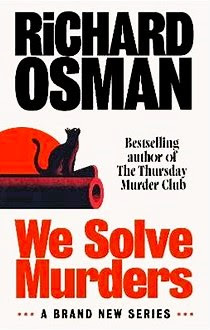
We Solve Murders: Richard Osman, Penguin, London 2024, 432 pp, Hbk £22, Pbk £9.99


Richard Osman is best known as the co-presenter of the television gameshow Pointless; however in 2020 he branched out into thriller writing with the Thursday Murder Club series.  However, the series, based around a group of elderly characters approaching eighty, may for obvious reasons have a limited lifespan.  Building on the success of his first series Osman appears to be starting a new set of novels, the first being We Solve Murders.         
The book’s main characters are a retired Met detective Steve Wheeler, now living in the New Forest, and his bodyguard daughter-in-law Amy.  Steve lives in the fictional village of Axley, which has strong similarities with the actual village of East Boldre.  Its inhabitants are mostly affluent commuters and retirees and Steve spends much of his time solving minor mysteries, such as money missing from the till in a local shop and the odd missing cat.  The highlight of his week is the pub quiz.       
Amy’s world could not be more different.  Currently working as a body-guard for an international best-selling author, Rosie D’Antonio; she inhabits a world where the higher echelons of organised crime meet the super-rich.  Is there much difference?
These two very contrasting worlds are brought together after a series of murders and an attempt by the real culprit to either frame Amy or have her murdered.  Amy is forced to ask Steve for help.   
It’s an odyssey that takes Rosie, Steve and Amy across the world starting in South Carolina and ending at the pub quiz in Axley.  Steve eventually solves the murder, bringing the guilty parties to justice.  He meanwhile manages to make the transition from the world of a quiet New Forest village to an action-adventure role including private jets, shootings and possibly the opportunity of romance.   
The novel reads more like a complicated word puzzle than a novel and the murderer was the character I suspected. Its interjections about teenage influencers, which I still wonder what they had to do with the murder, do not really help.  The characters did not immediately spike the imagination in the same way as the Thursday Murder Club series.  Meanwhile Osman missed an opportunity to provide Amy with a sufficient back story, which he managed to do with Steve.  However characters sometimes take several novels to fully develop.  The story ends with the possibility of further books. Let’s hope they are better than the first.   

Monday, January 20, 2025

On the brink of war

by Ben Soton

Precipice: Robert Harris, Penguin, London 2024, 464 pp, Hbk £22:00;Pbk £9.99

In late Edwardian London there were twelve postal deliveries a day; I learnt this from reading Precipice, Robert Harris’ latest thriller. It focuses on the affair between the Prime Minister, Herbert Asquith, and the aristocratic socialite Venetia Stanley.  It also provides an insight on the belle époque of a ruling class heading for Armageddon.  
The relationship between “Squiffy” Asquith and Venetia is by no means a Donald Trump; Stormy Daniels affair.  It consists of little more than afternoon drives and the occasional touching of hands.  However the affair soon arouses suspicion when it is discovered that Asquith has been sharing sensitive government documents with Ms Stanley.  As a result the Security Services send Detective Sergeant Paul Deemer to investigate.  Deemer plays the role of the honest everyman obtaining a glimpse into a highly elite world and it eventually transpires that the motives of his superiors are far from honest.  
 Asquith is depicted as a man out of his depth, as well as being in a loveless marriage with his wife Margot.  As a result he seeks advice on matters of state from a twenty-seven-year-old socialite, with almost no knowledge of matters of state.  As his government stumbles from one crisis to another, Asquith faces numerous plots and squabbles from those around him.  The novel starts with the inability of the Asquith government to deal the reactionary Ulster Unionists who were blocking Home-Rule in Ireland; meanwhile as Europe drifts to war new problems emerge, putting the ‘Irish Question’ on the back burner.  
As Britain enters the European conflict, something that it had avoided for a century, new problems emerge.  The Government faces problems resulting from the shortage of munitions as well as the mess caused by Churchill’s disastrous Gallipoli campaign.  The leader of the last totally Liberal Government Asquith was forced to enter into a coalition with the Tories in 1915 and later replaced by Lloyd-George as Prime Minister in 1916. 
Meanwhile Precipice is as much a coming-of-age novel for Ms Stanley.  In Edwardian Britain it was seen as unusual for a woman to be unmarried at twenty-seven.  Although nothing sexual takes place between her and Asquith she soon comes to the conclusion that she is being used as a crux for his personal issues and failings as a politician; in other words a one-sided relationship.  It is often said that power is an aphrodisiac but in this book Asquith seems to lose what little power he had and he seems as a man reacting to events rather than shaping them.    
The author, Robert Harris, has long had a sympathy for elite politicians of the liberal or conservative kind. Notably the Roman Senator Cicero; whom he wrote a trilogy (Lustrum, Imperium and Dictator) about.  But Precipice shows the failings of liberalism as an ideology, least of all its inability to deal with crises...and that’s just for starters. 

Saturday, November 09, 2024

The other Russian revolutionaries

by Ben Soton

Felix Volkhovskii – A Revolutionary Life by Michael Hughes; Open Book Publishers, 356pp, rrp £22.95

When it comes to the Russian Revolution this paper tends to give wholehearted backing to Lenin and his group, the Majority faction of the Russian Social-Democratic Labour Party (RSDLP), more commonly known as the Bolsheviks. This is not to say there were no other grouping and individuals working to bring about the end of Absolutism in Czarist Russia.  One such individual was Felix Volkhovskii, the subject of Michael Hughes’ book.      
Volkhovskii was born in 1846, in what is now Ukraine; his parents were from a minor aristocratic family and he led a privileged life.  He became involved in opposition politics whilst studying in St Petersburg and was eventually exiled to Siberia.  In 1890 he left Russia first to the United States then to Britain where, despite a brief return to his homeland around the time of the 1905 revolution, he spent the rest of his life.  Whilst in exile he was heavily involved with the Society for Friends of Russia Freedom and edited its publication Free Russia.  He died in 1914, three years before the overthrow of the Czar.        
The book gives a detailed study of the various organisations in opposition to the Czarist autocracy. These included Liberals who favoured reform but opposed any significant social change and the various revolutionary groups who supported social and political change through revolution. Meanwhile the book also explains the shift in emphasis away from the rural peasantry to the urban working class as the main revolutionary force. The strategy was ultimately taken up by the Lenin and the Bolsheviks who carried out the world’s first socialist revolution.
Volkhovskii, who later joined the Social Revolutionary Party, often referred to as SRs, favoured a broad front which include both Revolutionaries and Liberals.  History later proved this to be a pipe dream; with Russian Liberals being more fearful of the working class than the Czar. Indeed many Russian capitalists who upheld the liberal ideology had close connections with the Czarist state and the imperial court.  It took the crisis brought about by the First World War to bring an end to both the Czar and Russian capitalism, at least for a few decades.  
The book is in many ways an odyssey through the complex myriads of Russian opposition politics from the 1870s to the outbreak of the First World War.  As well as what could be described as the Russian solidarity movement in Britain.  However it gives little mention to either faction of the RSDLP and leaders such as Lenin and Stalin, or for that matter Trotsky.  Instead it features less well-known figures from the Social Revolutionary Party. The book may be an attempt on the part of certain sections of academia, motivated by either anti-communism or Russophobia to create a narrative that the Russian Revolution was essentially high-jacked by authoritarians; whilst true revolutionaries, such as Volkhovskii have been overlooked.  We know better!   


Monday, October 21, 2024

Uhuru!

by Ben Soton

African Uhuru by Roger McKenzie, Manifesto Press, London 2024, 178 pp, RRP £15.00

The word Uhuru (as well the character from Star Trek) is Swahili for freedom or independence. African Uhuru is a history of African self-liberation covering a period from the end of the First World War to the present day written by Roger McKenzie, the International Editor of the Morning Star, and a highly respected figure within the progressive and labour movement.
The book covers liberation movements both inside and outside of Africa; both movements for national independence and as well as the struggle against racism in Europe and the USA. McKenzie places considerable emphasis on the African diaspora, which he is a product of. From the 16th to the 19th centuries Africans were abducted from their homes, mostly in West Africa, and sold as slaves to work in the Americas. It was the Transatlantic slave trade which enabled capital to be accumulated in a relatively small part of the globe that led to the development of capitalism and the Industrial Revolution.
The author goes into considerable detail about the growth of anti-colonial and anti-racist movements in Britain and the United States. Whilst covering the role of key figures such as Marcus Garvey and C L R James, McKenzie also points out that African Self-Liberation and Marxism did not always sit well together. He covers the hostility of leading black figures such as George Padmore and Marcus Garvey to Marxism; which the latter described as a “white man’s thing”; as well as a possible lack of commitment of communist parties in assisting black workers. It was however Lenin and his seminal work Imperialism the Highest Stage of Capitalism that took Marxism away from its European origins and into the colonial and semi-colonial world.
The book also covers the various attempts by nations within what is now referred to as the Global South to co-operate against imperialism. The ranges from the Non-Aligned Movement in the 1950s, with its famous meeting in the Indonesian city of Bandung to the more recent rise of BRICS, the bloc formed initially by Brazil, Russia, India, China and South Africa, whose initials make up the group’s name.
McKenzie ends the book with a call to de-colonise the labour movement; a demand for the labour movement to play a greater role in fighting racism, which has its origins in the slave trade and imperialism.