Showing posts with label Communist Party of China. Show all posts

Thursday, August 24, 2023

The East is Red!

by J Sykes
 
The East is Still Red: Chinese Socialism in the 21st Century Carlos Martinez, Praxis Press Glasgow 2023, 238 pp £17:00

The book begins by acknowledging that there is a great deal of ignorance and confusion, especially in the imperialist countries, about People’s China. Martinez writes, “Even among socialists and communists, there are misconceptions and important gaps in understanding.” He addresses these issues head on.
The first chapter focuses on the continuities of the revolution in China, from the founding of the Communist Party of China (CPC) in 1921 until today. Martinez gives an overview of the history of the Chinese revolution and defends that legacy of Mao Zedong, while giving a balanced account of Mao’s more controversial initiatives, such as the Great Leap Forward and the Cultural Revolution.
For example, while acknowledging that the turmoil and disruption of the Cultural Revolution significantly impeded China’s development, he also points out that it “had a more directly useful outcome” in terms of preventing the “ideological decay that was taking place in the Soviet Union.” Martinez says it “set the parameters of how far Reform and Opening Up could go” and “laid the groundwork for Deng Xiaoping’s Four Cardinal Principles, which the CPC continues to observe today: 1) We must keep to the socialist road; 2) We must uphold the people’s democratic dictatorship; 3) We must uphold the leadership of the Communist Party; 4) We must uphold Marxism-Leninism and Mao Zedong Thought.
Furthermore, he explains that the movement to send young intellectuals down to the countryside during the Cultural Revolution “was a crucial factor in the development of a new generation of young intellectuals with a close understanding of the needs of the peasantry and the situation in the countryside.” It is noteworthy that Chinese President Xi Jinping was himself sent to the countryside as part of this movement.
Looking at the post-1978 Reform and Opening Up period initiated by Deng Xiaoping, Martinez recognises that many see this period as “a turning point in the wrong direction” but argues against this view. Instead, Martinez notes, “Deng Xiaoping’s strong belief was that, unless the government delivered on a significant improvement in people’s standard of living, the entire socialist project would lose its legitimacy and therefore be in peril.”
This is a point that Martinez returns to later arguing that the combination of economic stagnation and ideological decay in the Soviet Union led to the collapse of socialism in the USSR.
This point should be made clearer. Indeed, while the material basis of Soviet revisionism was rooted in the economic reforms of the Khrushchev period, which emphasised market reforms, profitability, material incentives, and so on, a deciding factor was the question of the class struggle in the superstructure and the abandonment of Marxism-Leninism by the Soviet leadership. Contrast China’s Four Cardinal Principles with Khrushchev’s revisionist theses of the “state of the whole people” and “party of the whole people,” negating the class character of the USSR and Communist Party of the Soviet Union, and it is easy to see the gulf that stands between the two approaches.
Martinez rightly notes that the CPC’s reform period took a “grass-roots” approach that was “patient, incremental, and results-oriented” while the Gorbachev “reforms” that brought about the final restoration of capitalism in the USSR in 1991, were undemocratically imposed on the Soviet people, rather than leveraging the creativity of the Soviet masses.
Martinez explains “although China’s reform process served to introduce market forces into the economy, the whole process was carried out under the tight control of the government and took place within the context of a planned economy.” Indeed, the commanding heights of the Chinese economy remain state owned, with state owned enterprises making up 60 per cent of the economy; and most of the value created by the working class in China is socially distributed, going towards the betterment of society. And while the revisionists in the Soviet Union attacked the history of the USSR and spent 30 years dismantling the rule of the proletariat and its party, the opposite has taken place in China, where the CPC maintains its central, leading role, based on the scientific application of Marxism to Chinese conditions. In fact, when rightists in the CPC led by Zhao Ziyang tried to restore capitalism in 1989, the CPC stood firm in its commitment to the socialist road.
A highlight of the book is a careful and thorough analysis of China’s long war against poverty. China has eradicated extreme poverty. What does this mean? 
“At the start of the targeted poverty alleviation programme in 2014,” Martinez writes, “just under 100 million people were identified as living below the poverty line; seven years later, the number was zero.” The Chinese government defines extreme poverty alleviation in terms of what it calls the “two assurances and three guarantees.” As Martinez explains, “The two assurances are for adequate food and clothing; the three guarantees are for access to medical services, safe housing with drinking water and electricity, and at least nine years of free education.” He contrasts this to the advanced capitalist countries, where nothing is promised, where profit is more important than people, and where poverty and inequality are on the rise.
Likewise, the book highlights China’s commitment to ecological development. Martinez writes that “Over the last decade in particular, China has emerged as the undisputed leader in the fight against climate breakdown, and the results of this leadership are reverberating globally.”
Against the charge from some, even on the Left, that China is imperialist, Martinez argues that “imperialism doesn’t look like this.” He explains the Leninist theory of imperialism as monopoly capitalism. According to Lenin, imperialism is based on the concentration of capital into monopolies, whereby the economy becomes dominated by a “financial oligarchy.” The export of capital takes centRE stage, and monopolist capitalist associations share the world among themselves, leading to the total division of the world among the imperialist powers. The October Revolution in 1917 ruptured this imperialist chain, and the other socialist countries, including China, followed suit.
Against the claim that China is imperialist, The East is Still Red emphasizes that China’s role in the developing world is qualitatively different from that of the imperialist countries. It acknowledges that imperialism has the function of locking in underdevelopment, while China’s role encourages development while respecting sovereignty. The book discusses this issue in terms of China’s role in “building a multipolar world.” The concept of “multipolarity” doesn’t really get to the heart of the issue, however, as Martinez himself acknowledges by saying that “the multipolar narrative doesn’t make explicit reference to anti-imperialism.”
Indeed, it would be clearer to understand the place of China in relation to the four fundamental contradictions operating on a world scale: the contradiction between the working class and the capitalists, the contradiction between the imperialist powers, the contradiction between the imperialists and the oppressed nations, and the contradiction between the imperialists and the socialist countries. Of these, the contradiction between the imperialists and the oppressed nations is primary, meaning it is the contradiction that is driving things on a world scale. What China is doing is providing aid to the countries of the developing world that allows them to avoid the liberalisation, privatisation, domination and plunder that are central to the neo-colonialist approach of the imperialist countries. While this development isn’t sufficient to bring socialism to those countries, it does serve to further weaken imperialism.
Importantly, Martinez also discusses the growing drive for war against China from the imperialist powers, especially the United States. He explains how the US attempts to manufacture consent for aggression against China, and answers the propaganda with facts. Against the “Third Camp” Trotskyites who say “Neither a Washington nor Beijing,” Martinez is clear that they are, in fact, playing right into the hands of the imperialists.
The bulk of Chapter Five is devoted to debunking the imperialist accusations that China is committing human rights abuses against the Uyghur people in Xinjiang. The book refutes the lie that the Chinese government is committing “cultural genocide” and is operating “concentration camps”. Similarly, it exposes the role of the U.S. in attempting to destabilize Xinjiang.
The book ends with a call to “unite to oppose the U.S.-led New Cold War on China,” and says that “All those that oppose imperialism must resolutely and consistently oppose the U.S.-led New Cold War in all its manifold forms.” This is certainly true, and this book makes a great contribution towards that effort.
Fightback News (USA)


Tuesday, April 04, 2023

Re-birth of a Great Nation – The Rise of China

China - the workshop of the world
by John Maryon

Millions of workers were inspired during first half of the 20th Century by the unprecedented growth of the world's first workers’ state. Under the leaderships of Lenin and Stalin the Soviet Union made many historic achievements.
    Revisionism ultimately destroyed the USSR, but the Red Banner is today carried forward by People's China, the Democratic People's Republic of Korea (DPRK), Vietnam, Laos and Cuba. I would like to examine the impact of the dramatic rise of China under the leadership of the Communist Party of China (CPC) and its role in the world today.
    The new people's governments in both Russia and China faced similar challenges with peasants and an emerging working class living in near feudal conditions with mass poverty. Each applied Marxism, adapted to their own specific conditions, to build socialism. Xi Jinping, general secretary of the CPC and chairman of the Central Military Commission, was re-elected as President of the People's Republic of China for a further five years at the 2023 National People's Congress. Xi, who comes from a humble background, has remained a man of the people and is well respected in his homeland.
    At the 2023 National Congress, Xi Jinping spoke of the challenges facing the nation and the objectives for the current development period. He said that China would unswervingly advance high quality development on the journey of building a great modern socialist country. The President called for innovation and open development that was green and would benefit everyone. Whilst rural poverty had been eliminated, further efforts were still needed to advance rural revitalisation. He also spoke of the need for self-reliance in the face of US sanctions and called for protecting the nation's security with “A Great Wall of Steel”. He stressed that Hong Kong, Macau and Taiwan were integral parts of People's China.
    China's GDP grew by three per cent during the last year to 121 trillion Yuan and is planned to rise by 5.2 per cent in the current year as the country emerges from its strict Covid restriction measures. In size its GDP is second only to that of the USA. China will soon surpass the USA, but when population is taken into consideration its per capita value is much less.
    The USA, alarmed at what they see as a challenge to their world domination, have done much to try to undermine China's economy. They have applied sanctions, disrupted supply chains and imposed selfish trade restrictions. No doubt they hoped that companies such as Huawei would be bankrupted, but the company has responded with an ambitious programme of research and development.
    It in the field of space research that China has been able to demonstrate its rapid advance in science and technology. Soil samples have been returned from the Moon and a rover vehicle soft-landed on Mars. Being banned by the USA from the so-called ‘International Space Station’ has not been a problem. They have built their own and are looking forward to working with other nations in its laboratories. Ambitious plans for the near future include the construction of a manned research station, in co-operation with Russia, at the lunar South Pole.
    China’s military expenditure is set to rise by 7.2 per cent in 2023. By comparison, Japan's rise will be over 20 per cent and Germany 17 per cent. China's defence spending remains at 1.5 per cent of GDP compared with four per cent for the USA.
    The Chinese military is being strengthened and modified to meet increased threats of US aggression. The current US spend is 855 billion dollars compared with China's 225 billion dollars. Xi Jinping said last year that China does not want war but that the era of being bullied was over.
    Unlike the USA, China accepts the fact that we live in a multi-polar world. Its Belt and Road Initiative (BRI) is designed to promote mutually beneficial co-operation and bring peoples together with investment projects that foster trade and development.
    China's foreign minister, Qin Gang, described the BRI as a “high quality public good initiated by China and jointly built by all partners, whose benefits are shared with the world”. The BRI has provided vital infrastructure, created over 420,000 jobs in countries along the route and helped to lift 40 million people out of poverty. The BRI is the world's broadest and largest platform for international co-operation and offers colossal business opportunities on a win–win basis.
    One of the great achievements of the CPC has been to lift billions out of poverty. Life expectancy in its rural regions, including Tibet and Xinjiang, has more than doubled since people's power was established in 1949. After the eradication of absolute poverty in 2020 China has continued to revitalise its rural areas, which have been left far behind the big cities. Residents of rural areas have less disposable income than urban dwellers. As called for by the People's Congress, the building of new rural homes is being accelerated and greater investment in agriculture, rural infrastructure, education, health and social care are being stepped up. Greater efforts are being made to provide greater opportunities for young people to stay in their home villages.
    The USA is stepping up its efforts to cause trouble and create tensions throughout the globe, in order to provoke wars and conflicts that support its own hegemonic ambitions.
    China on the other hand has emerged to become a powerful force for peace and diplomacy. Two important recent examples were as follows.
    Firstly, Iran and Saudi Arabia have agreed to establish diplomatic relations following a conference hosted by China. This will be a major setback for US imperialism.
    Secondly, China's peace proposals for Ukraine contained in a 12-point peace plan for the Ukraine conflict. China has called for respecting sovereignty, abandoning the Cold War mentality, ceasing hostilities and resuming peace talks. It has also called for resolving the humanitarian crisis, protecting civilians and prisoners of war, keeping nuclear power stations safe, reducing strategic risks, facilitating grain exports and the stopping of all unilateral sanctions while keeping supply chains stable. And as you would expect from China, the promotion of post-conflict reconstruction.
    China's progress in building up its infrastructure has been amazing and has become symbolic of its modernisation. Investments in civil engineering projects, the power network and expansion of the transport network, including rail, air and roads, have been impressive. The total length of China's railways now exceeds 155,000 km, of which 42,000 km are high-speed.
    A further 2,500 km of high-speed links will be added this year. The China–Laos railway, which opened at the end of 2021, has brought economic benefits to both countries, increased trade and encouraged an increase in people-to-people contacts. Regular freight services now operate between China and Europe.
    China is forging new relationships with the multi-polar world. Xi Jinping made an important speech at the recent Dialogue with World Political Party's High-Level Meeting. He called for respect for the diversity of civilizations, underlining the principles of equality, mutual learning, dialogue and inclusiveness. Stressing the importance of the common values of humanity, Xi said: “Peace, development, equality, justice, democracy and freedom are the common aspirations of all people.”
    The president urged countries to keep an open mind in appreciating the perception of values by different civilizations. He called for more people-to-people international exchanges to promote mutual understanding and friendship. He discussed China's path of modernisation and peaceful development that was at variance to the crooked path taken by others in their pursuit of hegemony in a uni-polar world.
    In People's China a great nation has been re-born. A dynamic new political force has emerged, under the leadership of the Communist Party of China, which seeks to unite all people and nations to create a beautiful, new multi-polar world. A respectful, peaceful new society based upon Marxism and equal, shared values.

Sunday, October 30, 2022

Building a fairer society

Echoes from the Chinese Communist Congress

A week after the 20th National Congress of the Chinese Communist Party drew to a close, the CMG Europe media group assembled experts from different fields to discuss key messages about the direction the world’s most populous country is heading. On this special one-hour show, CMG Europe’s Juliet Mann was joined by China’s Ambassador to the UK, Zheng Zeguang, and a host of experts from across the world to consider exactly what that new journey will look like, and how it will impact on relations with the UK and Europe. 

In any discussion about the policies that have steered China’s recent past, the topic of poverty alleviation is impossible to avoid. The numbers are well known - around 100 million rural residents lifted out of poverty in just eight years through 2020; 800 million in the past four decades; a middle class that has swollen to 400 million people. But the achievement goes far beyond incomes, into access to education, clean water, internet and transport connections.
    That is the development strategy of China, one that goes beyond economic growth and puts people first. China cannot develop in isolation from the world and the world needs China for its development. And the message from the country’s leaders in recent weeks has been a firm commitment to that path.
    The Chinese ambassador to the UK, Zheng Zeguang, shared his thoughts on how China and Europe can work together to tackle global problems. He told Juliet Mann: “China will respond to external uncertainties with its own certainty and inject positive energy into world development with its high-quality development and high standard opening up.”
    There are “several key messages that are essential for the future global order: that China vision of a fairer and more inclusive global order; a more cooperative global order; and more importantly about a global order that has a safety net for the left-behind so that everybody can benefit,” said Yin Zhiguang, a professor at the School of International Relations and Public Affairs at Fudan University.
    David Ferguson, senior translation editor at the China International Publishing Group, agreed: “A huge amount of emphasis has been placed on shared development, which means that everybody shares the fruits. That was one of the fundamental bases of the whole poverty alleviation programmje. Targeting poverty alleviation was designed to make sure that nobody was left behind. And I think that that fundamental concept of shared development, people-centered development, is something that President Xi places increasing emphasis on.”

Balanced growth

On a panel focusing on China’s economic development, guests discussed how China has ensured that its growth - powering the global economy for the past two decades - has also been sustainable. With a “trilateral, hybrid” structure built around a 60 per cent contribution from domestic private businesses, a 20 percent participation from the state and a further 20 per cent from multinational companies, China has been able to create a modern economy, says Wang Huiyao, founder and President of Centre for China and Globalisation.
    The challenge the country’s leadership is now taking on is about how to adapt governance structures designed for an economy of around $2 trillion for an economy that has now grown to closer to $20 trillion, noted Mark Ostwald, chief economist at AGM Investor Services.
    As it makes those changes, other economies will have the opportunity to learn from them, says Stephen Perry, the Chairman of the 48 Club. “We may find ourselves where we could have been several hundred years ago when we used many of the innovations from China to make our industrial revolution happen,” Perry noted. “It's important, I think, for every country around the world to participate in China in order to learn all these great innovations which are going to be, in many cases, led from China.”
    One advantage China has in the course of its development is the long-term perspectives that its political system affords. The stability offered by the Communist Party means that rather than changing tack every few years, policies can be targeted decades ahead.
    “It's astonishing to see a governance system, a governing party that's able to look forward 27 years and be able to make specific plans for what the country is going to be looking like then,” said China International Publishing’s Ferguson.
    That philosophy is exemplified in the commitments made to education at the Congress. China’s science and education strategy has been in place since 1995 and has evolved to focus on new areas of growth such as artificial intelligence and space technologies.

Environmental leadership

It is in actions, not words, that China’s impact on the global economy is being felt, said Christoph Nedopil, Director of the Green Finance and Development Center at Fanhai International School of Finance, and nowhere is that more obvious, or important, than the battle against climate change.
    “Over the past years, based on its huge size and strategic capabilities in manufacturing and research, China has seized the opportunity to innovate and to develop globally leading bases for green transport and energy, and [become the largest supplier of solar and wind power in the world. And I think this is just the beginning of a great opportunity for China to scale up infrastructure domestically and internationally,” he said.
    China’s message to the world is to take a holistic view - thinking about people first, the panellists agreed, summed up in a message to the corporate world from Fundan University’s Yin: “Business needs to include much more concerns of the society in general, the social responsibility not only in China, but also globally…engaging with stakeholders instead of shareholders.”

Saturday, October 29, 2022

A pivot for peace

The 20th Congress of the Communist Party of China is over. A new leadership with Xi Jinping at the helm will lead the 96 million-strong Party as China continues down the road of modernisation and Chinese-style socialism.
    Under Xi's leadership, People’s China has made remarkable achievements in the areas including poverty eradication, scientific and technological innovation and the fight against the Covid pandemic, which has greatly improved the living standards of the Chinese people. Now communists all over the world are looking to see how the Chinese communists and the people’s government that they lead will face the challenges of the next five years.
    China has become a beacon of hope for all the peoples of the world struggling to build their own independent economies without imperialist interference. While Anglo-American and Franco-German imperialism use their military and economic might to impose their neo-colonial rule throughout the Third World the Chinese people can, and do, provide the Third World with an alternative source of high technology and economic assistance without the odious strings attached that always go with deals with the West.
    China, whose economy is now second only to the United States, has become a pivot for peace in a world torn apart by imperialist greed and aggression. China is strong but it threatens no one. China respects the sovereignty and territorial integrity of all countries. It stays true to the principle of equality of all countries big or small, strong or weak, and rich or poor, and it respects the development paths and social systems independently chosen by all the world’s peoples. The people’s government is dedicated to promoting a human community with a shared future.
    This was a congress of victors and we are certain that there’ll be plenty more victories to come as the Chinese people march forward to build a modern, socialist China.

A focus for war


The greedy eye of American imperialism has long focused on Ukraine. In 2014 the Americans used the craven Ukrainian oligarchs and the fascist gangs that they finance to overthrow the elected government in Kiev. Determined to join NATO and tear up all the social gains made by the Ukrainian workers in Soviet days the American pawns could only rely on the rabidly anti-communist neo-nazi gangs for support whose pogroms against the Russian-speaking community led to the anti-fascist uprisings in Crimea and the Donbas.
    Eight years later the Russians were forced to intervene after repeated Kremlin efforts to end the fighting in the Donbas were spurned by the puppets in Kiev and their masters in Washington.
    The Americans armed Ukraine to the teeth. They sent in mercenaries and imposed punitive sanctions on the Russian Federation. They expected Russia to come crawling on its knees begging for mercy. But Putin is still there. The Russians are stepping up their war effort in the conflict that has brought devastation to Ukraine in its wake.
    Now under a hail of Russian missile and drone attacks the Ukrainians, and their shadowy American intelligence controllers, are believed to be planning a false flag “dirty bomb” provocation to justify direct imperialist intervention. They tried and failed in Syria. They must not be allowed to get away with it in Ukraine.
    Communists must lead the call for an end to the fighting and a just and lasting peace in eastern Europe. This can only come with a neutral and de-Nazified Ukraine that recognises the right of Crimea and the Donbas republics to join the Russian Federation and equal rights for all the people of the regions of the Ukraine.

Friday, October 21, 2022

Looking to Beijing

Communists all over the world are looking to Beijing this week. There thousands of delegates and observers have gathered for the 20th Congress of the Communist Party of China.
    A Party congress is the most important event in the life of any communist party. The 20th National Congress will chart the course of the People’s Republic of China as it faces the challenges and responsibilities of a world divided by imperialist greed while struggling to deal with catastrophic environmental changes.
    In the Great Hall of the People Chinese communists are laying down their party’s programme for the next five years. A plan that will steer the people’s government as it strives to build a modern China. An economy that is now second only to that of the United States in size and an agenda for peace and socialism that will strengthen all forces for progress throughout the planet.
    China is the pivot for the millions upon millions of working people across the world struggling for peace and socialism.
    China is a major force for peace. It has become a beacon of hope for all oppressed people. It offers economic assistance and medical aid to poor countries. The Belt and Road Initiative has brought real and tangible benefits to millions of people all over the world.
    Cities have been modernised beyond recognition. Absolute poverty has been abolished Vast investments have created new industries to face the challenge of the 21st century and China is, once again, the work-shop of the world.
    The immense wealth of the Western world remains in the hands of a tiny minority of capitalists and feudal lords. Millions upon millions live in poverty in the Third World while their resources are plundered by the big Western corporations.
    In the West millions of people scrabble to earn a living just to keep a roof over their heads, while a tiny elite live lives beyond the reach and often beyond the imagination of most workers.
    We, on the other hand, see a different picture in China. China’s wealth is being used to raise the standard of living of everyone in the people’s republic and help the development of the Third World through genuine fair trade and economic assistance.
    In China we see vast cities with modern offices and factories and equally modern housing for the workers who live there.
    Chinese astronauts circle the globe. A high-speed rail network spans the country. Container trains travel to Europe packed with the goods that fill our shops and markets. International airports link China to the four corners of the world. A growing network of domestic airline services and modern ports serve the seaborne trade that fires the global economy. And a state run education system and a dedicated health service that battled to contain the Covid plague is available to all.
    Some Western communists like to dwell on the mistakes of the past to try to explain why the Soviet Union and the people’s democracies of Eastern Europe collapsed in the late 1980s. But we have to move on – to look to the continuing successes of the people’s democracies still marching along the road to socialism – and above all the immense achievements of the People’s Republic of China.

Tuesday, June 07, 2022

China’s communists through the eyes of others

by Andy Brooks


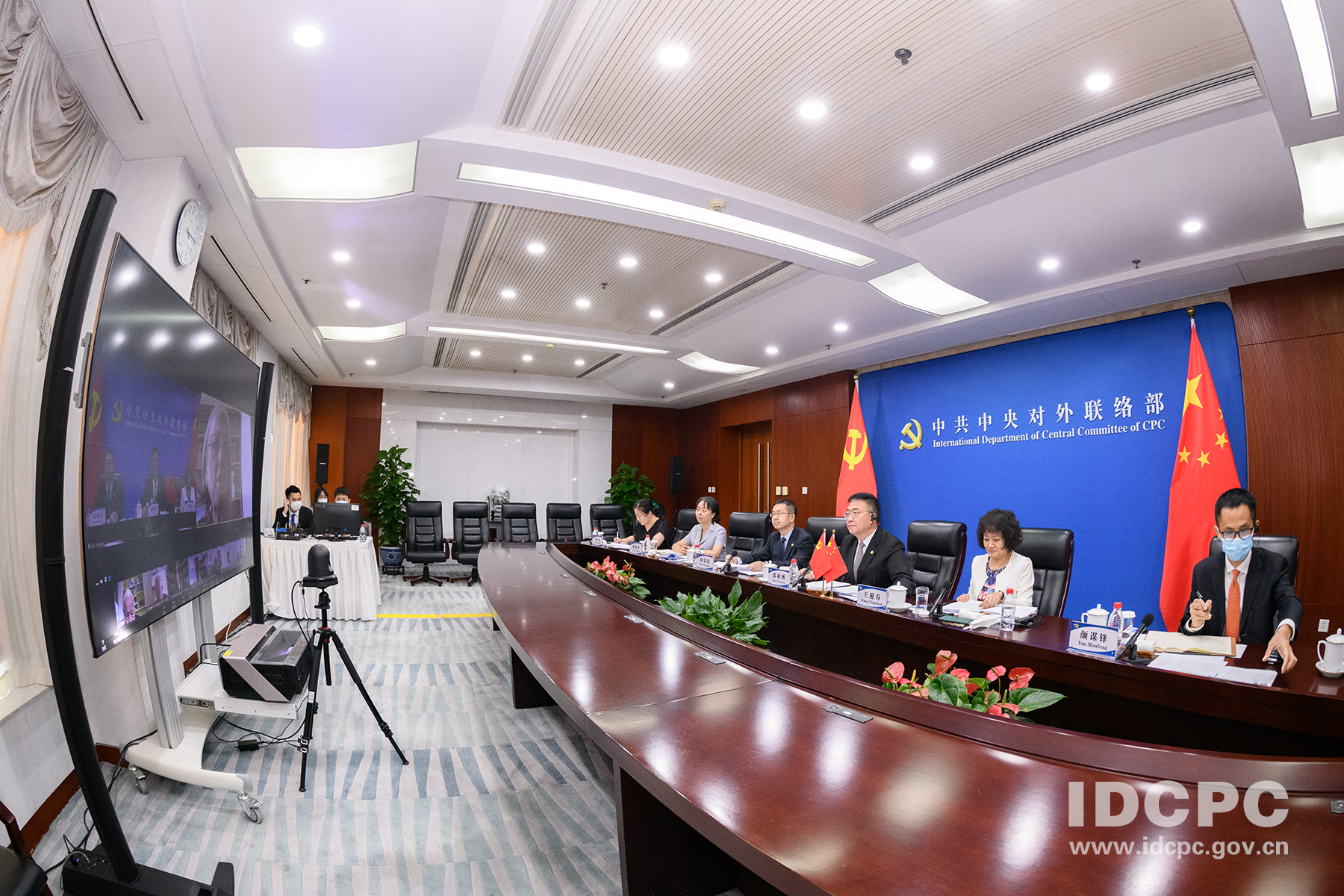
Last week a video seminar was held as part of the events organised by the Communist Party of China in the run-up to its 20th National Congress this year. NCP leader Andy Brooks joined Rob Griffiths of the CPB, Ella Rule from the CPGB-ML, Keith Bennett from Friends of Socialist China, Carlos Martinez from the No Cold War movement and a representative of the CPB’s YCL to talk on the theme of the Communist Party of China in My Eyes. This is Andy Brooks’ contribution...

First of all I would like to thank our hosts for allowing me to say a few words about my impressions of the Communist Party of China which began when I first set foot in the people’s republic as part of a New Communist Party delegation that went to study economic reforms in the new enterprise zones in China back in April 1993.
    During the course of that visit we met a veteran Chinese communist who had fought the Japanese invaders and the reactionary forces during the civil war that ended in victory in 1949. He shared his memories of Harry Pollitt, who he had met when the British communist leader went to China in 1955, and he told us about the first steps taken by the communists along the road of socialist construction following the establishment of the people’s government in 1949.
    The Chinese comrade also spoke about the great changes in the countryside that had begun in 1979 and the development of the special zones that paved the way for the economic reforms that built the socialist market economy which is now the second largest in the world. He knew that dogmatists in some parts of the international communist movement didn’t understand the reform movement. But he said “what is the purpose of the Communist Party if it can’t raise the living standards of working people”.
    I have never forgotten that point. Sadly many European communists, east and west, did – leading to the fall of the Soviet Union and its allies in 1991 in the east and the collapse of communist and workers’ parties millions strong in western Europe.
    I don’t know whether that old Chinese communist lived to see the immense changes that have transform the towns and cities of China but we certainly have in subsequent visits to China over the past thirty-odd years.
    China has become a major force for peace. It has become a beacon of hope for all oppressed people.
It offers economic assistance to poor countries and has played an important role in helping the international efforts to combat the Covid pandemic.
    Cities have been modernised beyond recognition. Absolute poverty has been abolished Vast investments have created new industries to face the challenge of the 21st century and China is, once again, the work-shop of the world.
    Of course great cities are not unique to China. Monumental designs and towering blocks can be seen throughout the Western world. Modern cities house the banks and investment houses of capitalist speculation. Huge factories build the technology and the weapons needed to maintain the global system of oppression while the power of oil has transformed small fishing ports in the Persian Gulf into millionaires’ playgrounds. But this has not benefited the workers in the heartlands of imperialism while oil riches have not helped free the Palestinians or raised living standards on the Arab street.
    The immense wealth of the Western world remains in the hands of a tiny minority of capitalists and feudal lords.
    In the West millions of people scrabble to earn a living just to keep a roof over their heads, while a tiny elite live lives beyond the reach and often beyond the imagination of most workers.
    In the Third World millions upon millions live in poverty while their resources are plundered by the big Western corporations.
    We, on the other hand, see a different picture in China. Vast cities with modern offices and factories and equally modern housing for the workers who live there.
    Chinese astronauts circle the globe. A high-speed rail network spans the country. Container trains travel to Europe packed with the goods that fill our shops and markets. International airports link China to the four corners of the world. A growing network of domestic airline services and modern ports serve the seaborne trade that fires the global economy. And a state run education system and a dedicated health service that battled to contain the Covid plague is available to all.
    China’s wealth is being used to raise the standard of living of everyone in the people’s republic and help the development of the Third World through genuine fair trade and economic assistance.
    Though the social changes that inevitably followed the establishment of a mixed economy did lead to a rise in street crime it remains remarkably low compared to the norm in Europe and nothing like US or Latin American levels.
    There are no shanty-towns and slums in People’s China and the last vestiges of colonial rule, the shameful hovels in Hong Kong, will soon be swept away by the new government of the special administrative region.
    Big city pollution is being tackled by the people’s government in a meaningful way. The smog and acrid air has gone and blue skies have returned to Beijing following the national “war against pollution”, huge investments into a new regulations and an air pollution action plan that has transformed the capital and many other cities across the country.
    Over the years exchanges of views with the representatives of the Communist Party of China have deepened our understanding of the immense problems in organising the communist movement in such a vast country with such a huge population. We have also seen the immense achievements that China has made under the leadership of the Communist Party of China in overcoming poverty, providing the basic needs of all the people and tackling the population problem to give everyone a better life and a standard of living that is constantly rising.
    This year China’s communists will gather for their national Congress to chart the way forward for the Party and the country in the immediate future. Back in 2014 Communist Party of China (CPC) leader Xi Jinping said: "The very purpose of the CPC's leadership of the people in developing people's democracy is to guarantee and support the people’s position as masters of the country.”
    We are confident that the 20th Congress of the Communist Party of China will set the agenda for the people of China for many years to come. We wish the comrades success in their work and look forward to studying their conclusions in the future.


Saturday, January 22, 2022

China's Democracy that Works

by John Maryon

The outstanding economic growth and progressive political development of People's China have been impressive and dramatic. With a civilisation extending back over 5000 years the country has entered a period of rapid development. It is now just over 100 years since the Chinese Communist Party was formed and 73 years since Mao Zedong was able to proclaim the People's Republic of China at an historic gathering in Tiananmen Square. The Communist Party of China (CPC) has given the leadership to transform what was one of the poorest counties in the world from a semi-feudal society into a modern socialist state. The CPC has now successfully eradicated the last vestiges of poverty for the people. Also with its Belt and Road initiative, based upon infrastructure development and fair trade practices, the developing world will be in a better position to rid itself of the effects of neo-colonialism.
    China has become a major force for peace. It can be said to have taken over the role formally held by the Soviet Union in becoming the most powerful socialist state. It offers economic assistance to poor countries and has played an important role in helping the international efforts to combat the COVID‑19 pandemic. People's China has become a beacon of hope for all oppressed people.
    The USA sees People's China as a threat to its world hegemony and attempts with sanctions, trade embargoes and military threats to weaken and obstruct their progress. It is against this background that the USA and its craven allies have embarked upon a new cold war against the People's Republic. Outrageous lies are told to support allegations of genocide against ethnic minorities in China, to allege that the country is preparing for war and is undemocratic with widespread abuses of human rights. With its own dismal record and images, still in people's minds, of a black man being choked to death, the USA is in no position to lecture others.
    Today's reality is that the past centuries of feudal autocracy in China, made worse by the 1840 opium wars, held back a great nation. Under the leadership of the CPC one could say that the dragon has awakened as all the people of China can now work to build a new free and prosperous society. The State Council of the CPC has issued an important White Paper entitled China Democracy that Works, which shows the true situation in modern China today.
    The document defines what we mean by democracy, examines the various types, and shows that it is a relative quantity that requires some qualification. It explains that democracy is a growing process that can take diverse forms as it develops along the paths chosen by different nations.

To judge a democracy the following areas are considered important:

  • Is the succession of the leadership orderly and in line with the law?
  • In conformity with legal provisions, can the public express their wishes without hindrance?
  • Can all sections of society, including ethnic minorities, participate in political life?
  • Can people of high calibre be part of the national leadership?
  • Do people have the right to vote and to hold their elected representatives accountable?
  • Are the people really masters of their own destiny or are forces linked to wealth, corruption and greed in control as in much of the western world?
People's China ticks all the right boxes.

The point is made that democracy is not just a useless decorative ornament that hides reality and masks the truth without offering any real choice. This could be the case with many bourgeois democracies where the election of Tweedle Dum or Tweedle Dee changes nothing. The National People's Congress is the highest state body in China. It has the power to appoint or remove the President and other senior government officials. Election of its over 2,980 members takes place every five years. China's constitution stipulates that all power belongs to the people and the political system includes local people's congresses.
    China's democracy thrives in a wise nation with a long history. A nation that under the leadership of the CPC has been transformed into an advanced socialist state with a mixed economy. The CPC co-operates with eight other smaller parties representing various ethnic, religious and social groups in a Broad Patriotic Front. The National Congress of the CPC takes place every five years, at which representatives of its more than 95 million members can appoint the central committee and General Secretary. The CPC represents the people – not the vested interests of a privileged elite.
    The period 1949–1978 was a time of consolidation of state power and of socialist transformation of the means of production, including the abolition of private land. After 1978 a process of opening-up and socialist modernisation was undertaken. It has, however, remained fundamental that China would always stick to a socialist political process with Chinese characteristics. The CPC has led the people to become masters of their own country. It important to realise that CPC objectives to build a full Communist society are intended to take place over an extended period of time. The creation of a new society will result from gradual changes of both a quantitative and a qualitative nature, and with changes of direction to cope with new conditions as they arise.
    The White Paper points out that civilizations are enriched by exchanges and mutual learning. The Chinese people are willing to work together with all peoples of the world to carry forward the common values of humanity: peaceful development, fairness, justice, democracy and freedom.
    An important factor that can adversely affect the democratic process is corruption. President Xi Jinping has made it an important priority during his tenure to tackle all forms of corruption. The CPC spares no effort to build trust and respect between officials and the people.
    The White Paper concludes that there is always scope to improve the system of democracy and suggests that humanity’s quest for improving the process will never end. Today the world is experiencing change on a scale unseen in the past, creating new opportunities, hopes and challenges. The CPC seeks to pursue peaceful development, increased democracy and improve the people's well-being.

Saturday, January 08, 2022

China, democracy, justice and the communist movement

 Last month a number of communist parties including the New Communist Party took part in an online conference organised by the Communist Party of China around the theme of Democracy, Justice, Development and Progress. This is the contribution from NCP leader Andy Brooks.

First of all I would like to thank the organisers of this conference for giving me the opportunity to say a few words about our Party’s views on democracy, the issue of the day that the imperialists are once again trying to use as a smokescreen to mask their plans for world domination.
    Their latest stunt has been to hold an online Summit for Democracy, organised by the USA to provide a platform for a new propaganda offensive against People’s China and the rest of the world that refuses to submit to Western economic and political control. Whilst this virtual summit posed as a forum for free debate on democracy and human rights, the participants were all hand-picked by the White House and the outcome was therefore totally predictable.
    The attendees, including some of the worst human rights abusers in the world, such as Israel, Ukraine and, of course, the USA itself, are closing ranks around a new anti-communist campaign to prop up the austerity regimes of the ailing capitalist system that is floundering in a world-wide slump that began in 2008.
    American politicians like to pose as defenders of what they call the “free world”. During the Cold War they portrayed their country as some sort of capitalist utopia and claimed that their “American dream” summed up the hopes of working people throughout the world. It wasn’t true then and it certainly isn’t true now.
    The ruling circles in the USA rejoiced when the counter-revolutions that they had worked so long to achieve took place in the Soviet Union and Eastern Europe. They told us that socialism was finished and that history was dead. They preached about the superiority of the capitalist system. But now they cannot point to a single country where it works – least of all the USA, whose cities, where millions live in abject poverty, are plagued by drugs and crime.
    They say that socialism means dictatorship and that capitalism stands for freedom. But it is freedom only for the exploiters to continue to rob and plunder working people across the globe to ensure that a tiny handful of parasites can live the lives of Roman emperors on the backs of the millions upon millions of working people.
    They claim that they stand for intellectual freedom – but it is the freedom of the straitjacket and the dungeon. They preach this freedom with their bombers and drones, their special forces and blockades against all those who dare to stand up for themselves. We see what the ruling class mean by freedom in occupied Palestine, Yugoslavia, Iraq, Libya, Syria and Ukraine.
    They talk of peace whilst spending billions upon billions on weapons of mass destruction to back up their blockades, embargoes and trade wars on countries striving to develop their own independent economies.
    They say they have free speech and democracy, but it’s democracy and freedom only for themselves. If the Western powers really were democratic, we would expect to see the majority of representatives in their bourgeois parliaments and assemblies drawn from the majority of the population – the working people. In fact, outside the ranks of the communists, you could count the number of workers in parliament on your fingers.
    Bourgeois democracy is democracy only for the exploiters. It’s dictatorship in all but the formal sense for the exploited. Bourgeois elections are used so that the smallest number of people can manipulate the maximum number of votes. Parliaments may reflect the divisions in the ruling class but ultimately all these assemblies are a fraud to mask the fact that bourgeois government rests on the bourgeois state, which exists solely to serve the interests of the ruling class. Whether it’s bogus bourgeois democracy or open bourgeois dictatorship depends on the economic situation and the balance of forces in any given country.
    We meet today in a world where the primary contradiction is between US imperialism and the rest of the world it seeks to dominate. But a new economic and political counter to US‑led imperialism is being built by China, whose Belt and Road initiative provides an alternative to imperialism’s so‑called free trade agreements and “partnerships” that solely serve the interests of the trans‑national corporations of the imperialist world.
    In the past China’s wealth was the preserve of a ruthless, feudal ruling class. These days China’s wealth is being used to finally eradicate the last vestiges of poverty, raise the standard of living of everyone in the people’s republic, and help the development of the Third World through genuine fair trade and economic assistance.
    The Chinese revolution that established the people’s government on 1st October 1949 has transformed the country that was then the poorest in the world. Since then China has risen from being a weak semi-feudal, semi-colonial country to become a force for peace in the global arena with the second largest economy in the world.
    People’s China, the fifth permanent member of the United Nations Security Council, is the only veto-power actively supporting proposals for multilateral nuclear disarmament. Pledging never to be the first to use nuclear weapons in any conflict, China stands for the complete prohibition and total destruction of all atomic weapons.
    China, backed by many other countries, has repeatedly challenged the West to implement the entire non‑proliferation treaty, which was signed in 1968 not only to halt nuclear proliferation but also committed the signatories to work towards universal nuclear disarmament. In the meantime China calls on all the major nuclear‑weapon states to abandon their policy of nuclear deterrence.
    The struggle to abolish nuclear weapons is crucial for the survival of humanity. But central to averting a Third World War is the need to eliminate the causes of war. And that is why communists have always understood that the struggles for peace and socialism are indivisible.
    Whilst millions of people scrabble to earn a living just to keep a roof over their heads, a tiny elite live lives beyond the reach and often beyond the imagination of most workers. Only socialism can end this. Only through socialism can the will of the masses, the overwhelming majority of the people, be carried out. Only socialism and mass democracy – not the sham democracy of the bourgeoisie – can end the class system and free working people from their slavery.
    The great socialist philosophers, Marx and Engels, spent much of their creative lives in Britain as practical revolutionaries. They knew they would never see socialism in their own lifetimes, but they never doubted the inevitability or the necessity for change. And the torch of freedom that fanned the fires of the Paris Commune lit the flames of the 1917 Russian Revolution that continues to blaze in Democratic Korea and Cuba, and the people’s democracies in Laos. Vietnam and above all, the People’s Republic of China.
    After 70-plus years of practice and development, China has successfully charted a path of democracy with Chinese characteristics, which suits China’s national conditions and meets its people’s aspirations. It is called the whole-process people’s democracy.
    In People’s China we see mass democracy at work. Back in 2014 Communist Party of China (CPC) leader Xi Jinping said: "The very purpose of the CPC's leadership of the people in developing people's democracy is to guarantee and support their [the people’s] position as masters of the country.”
    The people administer state affairs and manage economic, cultural and social affairs through various channels and in various ways. In practice, more than 99 per cent of Chinese citizens over the age of 18 have the right to vote and stand for election.
    Voter turnout is around 90 per cent in every direct election of deputies to the county- and township-level people’s congresses. The will of the overwhelming majority of the people is fully reflected in the election results. Apart from democratic elections, people have the right to participate in the management of national and social affairs in day-to-day political activities.
    This is the people’s power that enables the Chinese people to improve their lives in a concrete and realistic way. Democracy is not an ornament used for decorative purposes. It should be used to address concerns of the people.
    Whole-process people’s democracy favours substance over form. It is genuine democracy and not the shameful charade that passes for it in the West. It is, in fact, the will of the people.
    Or as the Chinese communist leader Xi Jinping says, whole-process people's democracy in China is "the broadest, most genuine, and most effective socialist democracy" safeguarding the fundamental interests of the people.

Friday, December 17, 2021

Joint statement on democracy and common development


Joint Statement of World Political Parties, Social Organisations and Think Tanks on making Independent Efforts to Explore the Path Toward Democracy and Working Together to Promote Common Development

The New Communist Party of Britain, together with 355 other political parties as well as social organizations and think tanks from 140 countries endorsed this statement at video conference organised by the Communist Party of China in Beijing this week

I. We are of the view that the world we live in is a diverse and colorful one. Diversity is what defines the fascinating feature of human civilisations, and indeed the source of vitality and dynamism for the development of the world. The ways and means of realising democracy are varied. Since different countries and regions may not necessarily share the same history, culture, social system and development stage, there does not exist any system of democracy or pattern of development that is applicable to all countries. The practice of judging the rich variety of political systems around the world by a single yardstick, or observing the colorful political civilisations of the humanity from a monochromatic sight, is in itself undemocratic. Nor is it conducive to development.

II. We are of the view that the best way to evaluate whether the political system of a country is democratic and efficient is to observe whether the succession of its leading body is orderly and in line with the law, whether all people can manage state affairs and social, economic and cultural affairs in conformity with legal provisions, whether the public can express their requirements without hindrance, whether all sectors can efficiently participate in the country’s political affairs, whether national decisions can be made in a rational, democratic way, whether professionals in all fields can be part of the team of national leadership and administrative systems through fair competition, whether the ruling party can serve as a leader in state affairs in accordance with the Constitution and laws, and whether the exercise of power can be kept under effective restraint and supervision.

III. We are of the view that the judgement on whether a country is democratic hinges on whether the people can become the real masters of the country. While it is necessary to observe whether the people can enjoy the right to vote, it is even more important to observe whether their right of extensive participation is guaranteed. While it is necessary to observe what verbal promises the people get during election campaigns, it is even more important to observe how many of the promises are fulfilled after elections. While it is necessary to observe what political procedures and rules are stipulated in regulations and laws, it is even more important to observe whether these regulations and laws are rigorously enforced. While it is necessary to observe whether the exercise of power follows democratic rules and procedures, it is even more important to observe whether the exercise of power is truly subject to the supervision and restraint by the people.

IV. We are of the view that democracy is the right of all peoples, rather than an exclusive privilege of the few. The judgement on whether a country is democratic or not should be made by their people. We stand opposed to acts that interfere in the internal affairs of others in the name of democracy.

V. We are of the view that the point of departure as well as the goal of the development of human society should be to improve people’s wellbeing and to achieve well-rounded human development. The promotion of democracy should focus on the continuous realisation of people’s aspiration for a better life and the upliftment of their sense of fulfillment, happiness and security. Currently, countries need to especially strengthen cooperation in the fields of poverty alleviation, food security, COVID-19 response and vaccines, development financing, climate change and green development, industrialisation, digital economy and connectivity, and to accelerate the implementation of the UN 2030 Agenda for Sustainable Development, so that concentrated efforts are devoted to solve problems of the greatest, most immediate and most practical concern to the people. All countries and all peoples of the world deserve the opportunity and right to development. Efforts need to be made to promote inclusive development and ensure that no country is left behind.

VI. We are of the view that to make international relations more democratic is the trend of the times and the only way to realise this lies in putting true multilateralism into practice. As mankind is faced with various challenges and global issues, the effective response thereto can only be found in more inclusive global governance, more effective multilateral mechanism and more proactive regional cooperation. Better performance in the practice of multilateralism can always lead to better answers to the common problems facing humanity.

VII. We are of the view that efforts to build a human community with a shared future point the right direction to the development and progress of civilisation. The shared human values of peace, development, fairness, justice, democracy and freedom must serve as guidance in the endeavour to build such a community with a strong sense of responsibility for the future of humankind, so that countries with different social systems, ideologies, histories, cultures and levels of development can share interests, rights and responsibilities in international affairs and work together to build a better world. Deeply aware of the joint mission placed on our shoulders to promote democracy and improve people’s livelihood, we undertake to work hand in hand to rise above all kinds of differences, promote exchanges and mutual learning, enhance mutual understanding and build broad consensus, so that we continue to make our due contribution to the people’s wellbeing, national development, world peace and human progress.

Sunday, December 05, 2021

Socialism, the Choice of the Chinese People

Ambassador Zheng Zeguang opens the seminar


On 23rd November, the Chinese Embassy in London held an online symposium on the Sixth Plenary Session of the 19th Communist Party of China Central Committee, where Ambassador Zheng Zeguang delivered a keynote speech. Andy Brooks, General Secretary of the New Communist Party of Britain, Robert Griffiths, General Secretary of the Communist Party of Britain, Ella Rule, Chair of the CPGB (ML), Martin Jacques, a renowned expert on China, and Stephen Perry, Chair of the 48 Group Club, spoke at the event.
    Also present were Professor Martin Albrow, a fellow at the Academy of Social Sciences in London; Sir Martin Davidson, Chair of the Great Britain-China Centre; and representatives of various other political parties, experts, scholars and representatives from the International Liaison Department of the Chinese Communist Party. This is Andy Brooks’ contribution to the discussion.


First of all, I would like to thank the organisers for allowing me to say a few words at this seminar focusing on the major achievements and historical experience of the Communist Party of China (CPC) over the last 100 years of its existence.
    For a communist party to have survived for 100 years is, in itself, something to celebrate. To have led the Chinese people to victory is another. To raise the millions upon millions of the Chinese people out of poverty to build the modern socialist society that we see today is a third. And this is only the beginning of the march of progress in the 21st century.
    Feudal China was once the workshop of the world. When the people’s government was established in 1949 China had the lowest standard of living in the world. Today China can now not only feed, clothe and educate its people, but also provide consumer goods and living standards for working people unimaginable before liberation. China has a modern expanding economy that has withstood the current global capitalist crisis to once again become the workshop of the world and is sharing its prosperity through the Belt and Road Initiative that spans the globe.
    One-hundred years have passed since the foundation of the CPC on 23rd July 1921. China has risen from being a weak semi-feudal, semi-colonial country to become a force for peace in the global arena with the second largest economy in the world.
    In the past China’s wealth was the preserve of a ruthless, feudal ruling class. These days China’s wealth is being used to finally eradicate the last vestiges of poverty, raise the standard of living of everyone in the people’s republic, and help the development of the Third World through genuine fair trade and economic assistance.
    This is the glorious achievement of the CPC which led the resistance that defeated the Japanese imperialists and the reactionary Chinese warlords and politicians in the pay of American imperialism, to establish the people’s government on 1st October 1949.
    Discussion is a luxury communists can afford and as we join our Chinese comrades in celebrating their hundred years of victory, we can ask ourselves many questions.
    The collapse of the Soviet Union and the people’s democracies in eastern Europe led to calls in some communist quarters for a new communist international – calls that are still made from time to time in some parts of the movement. But we cannot restore what has gone before us without first understanding why it failed in the first place. And that understanding cannot come from reading books or simply trying to transpose one experience to another.
    Chinese communists always stress that socialism with Chinese characteristics cannot be exported and that their revolution is not a model for others to copy slavishly. But we very rarely, at least in Western Europe, ask ourselves why?
    The answer in part is based on the struggle of the Chinese communists to overcome dogmatism and sectarianism to eventually build a people’s democracy in their own way, to serve the needs of the working people of China.
    Commenting on the rise of the bourgeoisie in France, Marx famously said that history repeats itself, first as tragedy, second as farce. Communists too can make mistakes, but unlike the bourgeoisie we consciously try to learn from past mistakes in order to avoid future ones.
    In Europe, the mistake was clearly to elevate slavishly what was believed to be the ‘Soviet model’, even though few Western communists even really understood what the Soviet Union actually was. The Soviet Union wasn’t a ‘people’s democracy’ in the sense we understand it now. It was a unique state based on Soviet power, and whilst its economic structures could be imitated – as they were after a fashion in eastern Europe – the Soviet political system could not.
    Following the Soviet victory in the Second World War, the revolutionary upsurge that followed led to the establishment of people’s democracies throughout Eastern Europe on the same basis as the people’s democratic dictatorship was established in China in 1949. The question was how long would this transition take?
    In the beginning, people’s democracy was seen as a lengthy process. Initially it was believed that the length of the road to socialism would depend upon the development of social and economic factors in each individual country. But Cold War tensions led to the rapid incorporation of most of the European people’s democracies into a Soviet economic and military bloc, which later proved incapable of withstanding the counter-revolutionary pressures of the 1980s. The Chinese communists clearly believe that the transitional period, at least as far as their immense country is concerned, will be a lengthy process. But it is a socialist process.
    Any hopes that imperialists held that China was ‘going down the capitalist road’ were dealt a severe blow at the 2019 Congress of the CPC, where Xi Jinping reminded delegates that: “Socialism with Chinese characteristics is socialism, not any other ‘ism’. Both history and our present reality tell us that only socialism can save China – and only socialism with Chinese characteristics can develop China. This is the conclusion of history, the choice of our people.”

Wednesday, July 28, 2021

1921 – A vivid panorama of revolution

  by Keith Bennett

The 100th anniversary of the founding of the Communist Party of China has been the occasion for many grand and impressive events throughout July. 1921, which has also been playing in selected cinemas in Britain and Ireland, and doubtless elsewhere, is the film for the centenary.
    A feature film, with special effects worthy of any Hollywood blockbuster, it also features some documentary footage, skilfully heightening the sense of both drama and realism.
    Whilst 1921 is focused on that momentous year, it deploys flashbacks as far as the 1850s, showing China’s degradation to a semi-colonial and semi-feudal ruined nation and then at its conclusion a potted but vivid historical reconstruction of subsequent years, which culminates in Chairman Mao proclaiming the founding of the People’s Republic on October 1st 1949, as well as Young Pioneers visiting the restored site of the first party congress 100 years later.
    A similar historical technique is deployed to depict aspects of some of the key characters, including such pioneering Chinese communists as Li Dazhao, Chen Duxiu, Li Da and, of course, Mao Zedong. Particularly moving is the depiction of the tragic and heroic fates of some of the key early martyrs of Chinese communism, including Yang Kaihui, Mao’s first wife and great love. This provides a raw and poignant contrast to the youthful idealism, frenetic activity and infectious optimism of many of the key characters as they throw themselves into the preparations for the founding of the party whilst simultaneously immersing themselves in the surging movement of the young but extremely militant Chinese working class along with the youth and students. Shanghai, in particular, where the party was founded, is accurately depicted as a playground for wealthy Chinese and above all for foreign overlords, but as a living hell for the masses of Chinese people.
    Whilst the leading characters are presented in a more all-round, nuanced and ‘human’ way than was typical of an earlier period of Chinese revolutionary cinema, the film successfully combines action and romance with skilful expositions of key political questions. Quite lengthy readings from the Communist Manifesto highlight the young revolutionaries’ wholehearted embrace of the need for class struggle leading to the establishment of the dictatorship of the proletariat, and their rejection of the reformism of the Second International, whilst the question of whether communists should hold office in a progressive bourgeois government, such as that of Dr Sun Yat Sen, is touched on in the case of Chen Duxiu. And in one short but highly significant scene Mao Zedong raises the importance of the peasant question, to the initial scepticism of his comrades. It was, of course, Chairman Mao’s grasp of the peasant question, and of the role that the peasants could play in the revolution in a country such as China, that created the conditions for victory and secured his eternal place as one of the greatest and most original leaders and theoreticians of the global communist movement.
     Also central to the political thrust of the film is the role played by the Communist International (Comintern). The two representatives from the Comintern who attended the CPC’s founding congress are rightly portrayed as heroic and selfless individuals, with some nail-biting scenes worthy of any genre of action movie. And the need to follow the path of the Russians, of the victorious October Revolution, is consistently highlighted. But there are also some pretty heavy hints of future tensions between the CPC and the Comintern, focused on the Chinese communists’ determination to forge an independent path as something intrinsic to their nation-building project.
    The role of the Comintern representatives in liaising with the fledgling Japanese Communist Party in Shanghai is also featured.
    The panoramic sweep of this film also takes us beyond China – to the Kremlin in Moscow, where we see Lenin addressing a congress of the Communist International, and to Paris, where we see the struggles of the Chinese workers and students to get organised under the banner of Marxism and to build support for China’s struggle among the French public. Here we are introduced to a 17-year-old Deng Xiaoping, with the affectionate name his comrades gave him at the time, Doctor of the Mimeograph, for his skill and diligence in producing revolutionary literature under difficult conditions.
    1921 is a touching, exciting and profound film – both great entertainment and a great education. It needs to be widely viewed, whether in China or around the world: for young Chinese people so that they might better know the struggles and sacrifices of their forebears that have made possible today’s increasingly strong and prosperous socialist China; and for those of us in the non-socialist world, who may sometimes feel daunted by the enormity of attempting to transcend the outmoded system of capitalism, to be reminded that a better world is indeed possible and that even a small number of people, with no resources to speak of, can really help to make it happen, so long as they have the spirit, in Marx’s words, to “storm heaven”.
    Or as Chairman Mao put it in his poem Chingkangshan Revisited: “Nothing is hard in this world if you dare to scale the heights”.

Tuesday, July 20, 2021

JOINT STATEMENT OF PROPOSALS OF THE
CPC AND WORLD POLITICAL PARTIES SUMMIT

We, the 10,000-plus delegates representing more than 500 political parties and organisations from over 160 countries, attended on 6 July 2021 the CPC and World Political Parties Summit hosted by the Communist Party of China (CPC) via video link. Focusing on the theme of “For the People’s Wellbeing: The Responsibility of Political Parties”, we had in-depth exchange of views at the Summit. As a result, the Summit has been brought to a successful conclusion with broad consensus.

We note that the world today is undergoing complex and profound changes, as the trend of economic globalisation continues to surge ahead, science and technology develop at an amazing speed, and interactions among civilisations become increasingly frequent. The pursuit of wellbeing of people of all countries is getting closely intertwined as never before, coupled with both historic opportunities and risks and challenges. The onslaught of COVID-19 has once again taught us that humanity lives in one and the same global village which is evolving into an inter-linked community with a shared future. The difficulties and challenges confronting humanity can only be resolved through solidarity and cooperation. Political parties, as the fountainhead of national policies and proponent of people’s interests, play an important role in the political life of countries. Under the new historic circumstances, it is the shared responsibility and common objective for political parties to ensure the wellbeing of their own people in a true sense and enable the attainment of wellbeing of all people towards the harmonious vision of prosperity for all.

I. We propose that political parties of all countries be committed to building consensus on values. Efforts must be devoted to promoting values shared by all mankind, i.e., peace, development, fairness, justice, democracy and freedom. The historical trend towards greater democracy in international relations must be followed and multilateralism must be upheld so that relations are based on common ground, mutual respect and mutual learning. The principle of mutual respect, fairness, justice and win-win cooperation must be adhered to as a guidance to interactions between and among countries. A common, comprehensive, cooperative and sustainable approach to security must be pursued. There must be concerted efforts to build an open, inclusive, clean and beautiful world that enjoys lasting peace, universal security and common prosperity. Hence the international community will move forward in the endeavour to build a shared future and stronger political strength will gather for human development and progress.

II. We propose that political parties of all countries be committed to promoting common development. Proactive measures must be taken to implement the United Nations 2030 Agenda for Sustainable Development, to dovetail development strategies, coordinate macroeconomic policies, and strengthen global cooperation on technological innovation, and to promote the sharing of knowledge and technologies. The multilateral trading system with the World Trade Organisation playing a central role must be safeguarded to promote liberalisation and facilitation of trade and investment. Infrastructural and industrial cooperation must be deepened to ensure the stability and smooth functioning of industrial chains, supply chains and financing environment, toward higher level of inter-connectivity. Hence economic globalisation will become more open, inclusive, balanced and beneficial for all and global development will be fairer, more efficient and coordinated.

III. We propose that political parties of all countries be committed to building our Mother Earth into a hospitable homeland. Political parties must take the realisation of “intergenerational equity” as the aim and mission in achieving the vision of harmony between man and Nature. The principles of prioritising resource conservation, and environmental protection, and letting nature restore itself must be observed. Green, low-carbon, circular and sustainable ways of life and production must be pursued to create an eco-system where all elements coexist in harmony. Active support must be provided to developing countries in the form of, among others, capital, technology and capacity building so that combined strength can be built up to address climate change, marine pollution, biological conservation and other global environmental issues. Hence a global environmental governance system featuring fairness, equity and win-win cooperation will take shape together with a human-Nature community of lives with a shared future.

IV. We propose that political parties of all countries be committed to safeguarding people’s life and health. The philosophy of putting the people and their lives first must be applied by placing people’s life and health on top of the development agenda and ensuring full consideration of health factors in policy making. With the objective of life-cycle health services for all, people’s growing need for safe, effective, convenient and affordable health services must be satisfied. Science and cooperation must be identified as the reliable means to defeat the virus and extricate ourselves from diseases. Politicisation of the pandemic and stigmatisation of the virus must be opposed. Developing countries with vulnerable public health systems must get necessary assistance to enhance their response capacity. Hence, the global governance system of public health will get improved together with progress in building a community of health for all.

V. We propose that political parties of all countries be committed to facilitating exchanges and mutual learning among civilisations. The principles of equality, respect, openness and inclusiveness must be observed to rise above differences among civilisations and ideologies for the protection of diversity of world civilisations. All civilisations must and can find their rightful place in humanity’s intellectual treasure-house. Inter-civilisational dialogues and exchanges must be promoted through intensive people-to-people interactions and cooperation in the fields of education, science and technology, culture and art, sports, tourism and among think tanks. Interactions among various social groups of all countries must be encouraged to enhance better understanding and appreciation among various civilisations and to draw insight and inspiration. Hence, different civilisations will co-exist in harmony together with innovative development of individual civilisations.

VI. We propose that political parties of all countries be committed to improving the wellbeing of their own people. Issues of immediate concern to the people must be responded to effectively by promoting the establishment of institutions and the rule of law in the society, improving social policies and public services, and promoting judicial justice and equality in income distribution. Redoubled efforts must be taken to combat corruption, enhance international anti-corruption cooperation and promote the building of clean and competent governments. Various measures must be adopted to improve conditions for the development of the poor, including fiscal and financial policies, education and training and industry-specific support. Hence, poverty alleviation will become more self-driven, well-targeted and results-oriented. In the meantime, greater attention and input must be devoted to international cooperation on poverty alleviation. More emphasis and support must be directed towards poverty reduction and alleviation in all countries, particularly developing countries.

VII. We propose that political parties of all countries be committed to raising their level of governance. Adequate attention must be paid to address challenges for party-building brought about by the wave of digitisation and IT application by enhancing experience sharing and cooperation on governance and constantly exploring effective ways to improve party-building under the new circumstances. The efficacy of social governance must be uplifted to ensure holistic and coordinated performance thereof. Hence, the governance ability from participation, deliberation and delivery perspectives for the wellbeing of the people will improve. A greater contribution will be made to the resolution of development conundrums facing mankind.

VIII. We propose that political parties of all countries be committed to devising better rules for global governance. The philosophy of extensive consultation, joint contribution and shared benefits must be upheld. Joint efforts are needed to safeguard the UN-centred international system, preserve the international order underpinned by international law, and to uphold the basic norms governing international relations based on the purposes and principles of the UN Charter. The status and role of international law in the global governance system must be elevated. International rules must be effectively observed and practiced so that the rule of law is exercised in the international domain. Joint efforts must be devoted to exploring the establishment of policy and institution systems that are tailored to the new technological revolution and industrial transformation so that technological innovations can be accessible to, shared and utilised by more countries and their people. Hence, the reform process for the global governance system will become more equitable, open, transparent and inclusive and the sovereignty and people's interests of all countries will be fully guaranteed.

We wish to thank the Communist Party of China for what it has done to make this Summit possible. We undertake to further strengthen exchanges and cooperation with the CPC and contribute our wisdom and strength to enhancing mutual understanding and common development among people of all countrie


Sunday, July 04, 2021

China: 100 fighting years

 By Andy Brooks

Speech given by NCP leader Andy Brooks at the online} Symposium on the Centenary of the Founding of the Communist Party of China and China's Future Development {on 22nd June 2021, organised by the Chinese embassy in London

One hundred years have passed since the foundation of the Communist Party of China on 23rd July 1921. China has risen from being a weak semi-feudal, semi-colonial country to become a force for peace in the global arena with the second largest economy in the world.
    It is a mixed economy – but any hopes that the imperialists held that China was going down the capitalist road were dealt a severe blow at the recent Congress of the Communist Party of China (CPC) where Xi Jinping reminded delegates that “what we are building is Socialism with Chinese characteristics, not some other -ism”.
    China has now regained its rightful place in the world. In the 13th Century China was ahead of Europe in per capita income terms. China was still the workshop of the world in 1820 when it accounted for one-third of the world’s GDP. It was a global economic power during 18 of the last 20 centuries, and it is now regaining the ground it lost because of imperialist intervention in the 19th Century.
    Of course, in the past China’s wealth was the preserve of a ruthless feudal ruling class. These days China’s wealth is being used to finally eradicate the last vestiges of poverty, to raise the standard of living of everyone in the people’s republic, and to help the development of the Third World through genuine fair trade and economic assistance.
    This is the glorious achievement of the CPC that led the resistance that defeated the Japanese imperialists and the reactionary Chinese warlords and politicians in the pay of American imperialism, to establish the people’s government on 1st October 1949.
    This year communists are commemorating a century of struggle. But the focus for Chinese communists and, indeed, for communists all over the world is fixed firmly on the future of Marxism, the future development of People’s China and its role within the global communist movement.
    Chinese communists always stress that socialism with Chinese characteristics cannot be exported and that their revolution is not a model for others to emulate slavishly. But we very rarely, at least in Western Europe, ask ourselves why?
    The answer in part is based on the struggle of the Chinese communists to overcome dogmatism and sectarianism to eventually build a people’s democracy in their own way, to serve the needs of the working people of China.
    Commenting on the rise of the bourgeoisie in France, Marx famously said that history repeats itself, first as tragedy, second as farce. Communists too can make mistakes, but unlike the bourgeoisie we consciously try to learn from past mistakes in order to avoid future ones.
    In Europe, the mistake was clearly to elevate slavishly what was believed to be the ‘Soviet model’ even though few Western communists even really understood what the Soviet Union actually was. The Soviet Union wasn’t a ‘people’s democracy’ in the sense we understand it now. It was a unique state based on Soviet power, and whilst its economic structures could be imitated – as they were after a fashion in eastern Europe – the Soviet political system could not.
    Following the Soviet victory in the Second World War, the revolutionary upsurge that followed led to the establishment of people’s democracies throughout Eastern Europe on the same basis as the people’s democratic dictatorship was established in China in 1949. The question was how long would this transition take?
    In the beginning people’s democracy was seen as a lengthy process. Initially it was believed that the length of the road to socialism would depend on the development of social and economic factors in each individual country. But Cold War tensions led to the rapid incorporation of most of the European people’s democracies into a Soviet economic and military bloc, which later proved incapable of withstanding the counter-revolutionary pressures of the 1980s.
    The Chinese communists clearly believe that the transitional period, at least as far as their immense country is concerned, will be a lengthy process.
    In China, the people’s government initially followed the Soviet-led example of Eastern Europe but that failed to take into account the concrete conditions in the country – the poorest in the world in 1949. Subsequent attempts to use exhortation to boost production during the Great Leap Forward and the Great Proletarian Cultural Revolution also failed in the long-term, so the decision of the CPC to adopt a policy of reform and opening up was perhaps the only alternative left in the late 1970s. Forty years later we can assess what has been achieved.
    The reform process has accelerated industrial growth, technical innovation and scientific knowledge whilst improving the social and cultural conditions of the people.
    China has made poverty eradication a key task in achieving its first centenary goal. Millions upon millions of people have been lifted out of poverty, whilst the opening up has given China access to the high technology needed to develop their electronics and computer industries as well as the broader manufacturing base that has enabled China to provide concrete assistance to the peoples of Africa, Asia and Latin America. In this spirit, China sent help to COVID-19-affected countries throughout the world, including Britain and other parts of Western Europe.
    The CPC has becoming a rallying point for the world communist movement. We welcome it. Although calls for the re‑establishment of a formal Communist International are premature, a co-ordinated international communist response is needed to rally working people against the imperialists and oppressors.
    We must work to restore the momentum for revolutionary change; strengthen co-operation and united action with communist and workers parties around the world; build solidarity with the global anti-war movement and forces for liberation in the Third World to unite the class and march towards a new tomorrow – the world Marx and Engels predicted and a world that will surely come. We see it in China today. We will all surely see it tomorrow.