Showing posts with label fascism. Show all posts

Sunday, October 26, 2025

Ukraine: A Search for Identity and Freedom

October 1944 - Red Army liberates Kiev
 by John Maryon

Russians, Ukrainians and Belarusians are predominantly from the East Slav sub-group of the Slavic people.  Crimean Tatars form an important ethnic group of the population of Crimea.  The fertile lands of mineral rich Ukraine were for centuries shared between the Poles and the Mongols.  By 1500 the Ottoman empire had expanded and taken over South East Ukraine and Crimea.  In 1654, following years of conflict with the Polish Lithuanian Commonwealth, the Cossack leader of Ukraine pledged allegiance to the Czardom of Russia in exchange of protection. Russian influence increased and in 1797 Catherine the Great established the port city of Odessa and the region became an important part of the Russian Empire. 
Today most people have heard of the Crimean War, Florence Nightingale, Balaclava and the Charge of the Light Brigade.   It was an imperialist conflict for Middle East influence between Russia and an alliance of France, Britain and Turkey.  Russia lost the war and with it influence in the region and now had only a limited access to the Black Sea. However there were two other significant impacts.  One saw the break up of European alliances and the other was that it forced Russia to become modernised. 
Following the 1917 Great October Revolution in Russia Ukraine became a Soviet Republic, the Ukrainian SSR.  A majority of those in Eastern Ukraine spoke Russian while in the western areas the people spoke Ukrainian.  The  Ukrainian language is very similar to Russian and considered by some to be a dialect. In the Crimea, Tatar and other ethnic languages were secured by decree. A devious  Kruschchev was to later cede Crimea to the Ukrainian SSR. 
To understand the Ukraine of today it is important to consider some developments during the pre World War 2 period. The Congress of Soviets had proclaimed Soviet Power in 1917 and elected Soviets were established in the towns, villages, work places and military units. The new young republic started on the road to building socialism. But the peaceful life was soon to be shattered.  Counter-revolutionary forces led by former Czarist officers and the feudal lords of Central Asia waged a civil war against the Soviet republic. They were to be supported by forces of intervention. British, French, American and Japanese forces in the Far East invaded the Soviet Union. An undeclared war of intervention was underway and Britain occupied Odessa while Germany took control of a large part of western Ukraine. 
The Soviet forces were united and soon built an alliance with workers and peasants and established the Red Army. A war economy was established. The counter-revolutionary military superiority was short lived as conflicting interests emerged. The White Guards, as the alliance of foreign backed fighters was known, depended upon foreign finance and was essentially a mercenary army.  When the money stopped during the major capitalist economic crisis they fell apart. The imperialist powers however continued to occupy western parts of the country.  The imperialist powers used former Soviet territory to establish a cordon sanitaire from which they could carry out attacks on the young republic. 
Collectivisation of agriculture enabled farms to be modernised. The days of the horse-drawn wooden plough were over and Ukraine started to become an important grain growing area.  The process of change was not an easy one. The years 1932-1934 saw the worst drought in living memory.  A typhoid epidemic ravaged the Caucasus.  Many agriculture experts and cadres sent from Moscow were murdered by fascist gangs.  Some kulaks slaughtered all their animals and invading forces burned crops. Many people died of starvation. However by the late 1930s Ukraine had become the bread-basket of the Soviet Union while the industrial regions of Eastern Ukraine became known as the Soviet Ruhr. 
At 0400 on 22 June 1941 Hitler attacked the Soviet Union. Of the 27 million Russians who were killed during the war, five million were from Ukraine plus 1.5 million Jewish people who lived in the region.  Nationalists from the former ruling class in Western Ukraine supported Hitler and the Nazis. The leader of the Halychyn SS Division , Stefan Bandera, was held responsible for many atrocities.  Jews, communists, socialists, the mentally ill and the disabled were slaughtered in the death camps. Under the leadership of Joseph Stalin the Soviet Union fought courageously  and was able to smash the Nazi war machine. The battle of Stalingrad is considered to be the turning  point of the Second World War which ended in victory in 1945, But after the war many Ukrainian Nazis were made welcome in the USA and Britain. 
During the post-war era industry quickly developed and agriculture flourished. Then came the collapse of the Soviet Union. Oligarchs took over in Russia and Ukraine grabbing the wealth that had been created during people's rule with former officials changing sides to get their noses in the trough. Living standards fell and unemployment reappeared after an absence of 50 years. With the fall of the Soviet Union the Russians were promised that NATO would not expand eastwards.  The gullible Russian leadership believed this but the imperialists saw it as an opportunity to expand their malignant influence, gain access to Russia's rich resources and to threaten China. 
The United States is notorious for its never-ending wars and coups for regime change. The long list includes Korea, Vietnam, Yugoslavia, Iraq, Afghanistan and Chile.  In February 2014 it was Ukraine's turn. In a coup planned, financed and supported by the USA, the democratically elected government of Yanukovych was overthrown. Opposition parties were banned, politicians arrested and demonstrators murdered in Odessa by being driven into the trade union building which was then set on fire. The new pro-Nato and pro-European Union puppet regime embarked on widespread repressive measures against Russian speakers, including a ban on the Russian language. Strong resistance in Eastern Ukraine led to the establishment of independent states which were recognised by Russia and later along with Crimea voted to join the Russian Federation. Between 2014 and 2022 some 8,000 civilians were killed by shelling from regime held areas.
In 2022 Russia commenced its special military operation to defend those regions under attack, prevent the expansion of Nato eastwards and rid the Ukraine government of supporters of the infamous Nazi collaborator, Stefan Bandera. The civil war became a proxy one as the Americans and their Western allies poured in money and weapons. Negotiations, such as the Minsk agreements to end the conflict have been repeatedly sabotaged by Western leaders. The Western powers are losing their war and Ukraine is tragically being destroyed in scenes similar to those left in Vietnam and Korea. Instead of bringing the tragedy to an end Western leaders, including, Macron of France, Merz of Germany and Starmer of Britain, have become obsessed with keeping the war going. They continue to pour in money to keep the conflict going while their own economies face collapse. 


Monday, April 14, 2025

21st Century Fascism: Fascism Today

Ukrainian fascist militia glorifies their Nazi past
By Wevergton Brito

Wevergton Brito is vice president of the Brazilian Centre for Solidarity with Peoples and the Struggle for Peace (Cebrapaz)

 
The fascism of the 21st century took a long time to mature, and its gestation began as soon as the fascism of the past century suffered a politically, ideologically, and historically demoralising defeat in 1945. 
The epithets "fascist", “national socialist” or "Nazi-fascist" once worn with pride, became a disgrace. Even the most brutal right-wingers began to renounce fascism, which had become synonymous with crime. 
The USSR and the communist movement, which were the most important forces in the anti-fascist struggle, emerged politically strengthened from the Nazi-fascist defeat. 
To mitigate this threatening influence, imperialism reacted on multiple fronts. In the ideological sphere, it resorted to all kinds of distortions to conceal the fact that fascism was a capitalist phenomenon, supported by capitalists. The Theory of Totalitarianism by Hannah Arendt was, in this regard, a valuable asset for the bourgeoisie. However, Hannah Arendt’s convenient theory failed to explain why "Western democracy," supposedly anti-totalitarian, supported until their very last days the two remaining fascist dictatorships in Europe: Franco's in Spain and Salazar's in Portugal (both of which survived for three decades after the fall of the Third Reich thanks to such support). 
Not to mention the support for the Apartheid regime in South Africa, McCarthyism as well as the organisation and financing of military coups in Brazil, Argentina, Uruguay, and many others, of which I will cite just one more example. 
In Indonesia, an anti-communist purge carried out by the military with CIA backing killed, in 1965, an estimated one million people. That’s right: one million people. The massacre installed General Hadji Mohamed Suharto in power, who would rule the country dictatorially with full U.S. support from 1967 to 1998. 
The truth is that fascist ideas have never ceased to be an instrument in the service of imperialism, one way or another. 

Neo-liberalism and the Unipolar Power of the USA

The late 1980s and early 1990s marked the dismantling of the USSR and the socialist bloc in Eastern Europe. It was the time of the temporary triumph of bourgeois ideals. Before that, the bourgeoisie had already been conducting advanced experiments in neo-liberalism – an aggressive imposition of capital aimed at destroying any social control that could create obstacles to unbridled exploitation and speculation on a global scale. 
One of the most important theorists of neo-liberalism, Wilhelm Röpke, explicitly advocated the need for a certain level of authoritarianism to overcome popular resistance to neo=liberalism: “It is possible that my view on a 'strong State' (a government that governs) is even ‘more fascist’ because I would really like to see all economic policy decisions concentrated in the hands of a vigorous and entirely independent State, unweakened by pluralist forces of a corporatist nature…people need to get used to the fact that there is also a presidential democracy, authoritarian, yes, and even – horrible dictum – a dictatorial democracy”. 
The end of the dispute between the socialist bloc, led by the USSR, and the capitalist bloc, led by the USA, with the emergence of the latter's unipolar power, radically changed the conditions of political struggle – to the detriment of the working class. 
The global imposition of neo-liberalism was a powerful expression of the bourgeoisie's ideological victory. From that point on, in terms of social representation, at best, only thematic and atomised organisations (such as NGOs) that played a passive and subordinate role in non-threatening issues would be tolerated. Collective emancipation projects would be a thing of the past. 
However, more than 30 years after the dissolution of the Soviet Union, bourgeois democracy is widely discredited. How did this happen? The two main promises made after the fall of the Berlin Wall were never fulfilled. What were these promises? 

First: A World of Peace – With the end of the USSR and the socialist bloc, a world of peace and peaceful resolution of conflicts based on the United Nations Charter would be established, they claimed. Yet, the destruction of Yugoslavia and Libya, the invasion of Iraq and Afghanistan, the attacks on Syria, etc., quickly shattered this illusion.
 
Second – A World of Economic Prosperity
– Neo-liberal globalisation would bring economic and social progress within everyone’s reach, they asserted. Instead, in capitalist countries, wealth concentration sky-rocketed and phenomena associated with hunger and misery (begging, homelessness, etc.) emerged even in imperialist core nations. 
In 2015, a study by the Economic Policy Institute (USA) found that the purchasing power of American workers had been practically stagnant since 1978. The report introduction stated: 
“The wage stagnation of the vast majority of workers was not caused by abstract economic trends. On the contrary, wages were suppressed by policy choices made in favour of those who hold more income, wealth, and power”.
 
In the USA and Europe, new generations struggle to maintain the standard of living their parents enjoyed, which has profoundly affected the middle classes. This recalls Umberto Eco’s warning: “One of the characteristics of historical fascisms was the appeal to frustrated middle classes, devalued by some economic crisis or political humiliation”. 
Work has become precarious and devalued. Social mobility has drastically declined, and studies by non-Marxist economists, such as the French economist Thomas Piketty, highlight the growing trend toward the formation of a global financial oligarchy. 
On the other hand, especially in Europe, communist parties, which for decades were the main references for the most combative sector of the proletariat and the channels through which anti-system opinion was expressed, either dissolved in the face of the collapse of the socialist bloc or followed the path of transformation into parties of the Establishment. Some changed their names, programmes, and objectives. Others preserved their identities, though in some cases making serious ideological concessions and, in almost all cases, being strongly impacted by the defeat of the socialist bloc. This resulted in a sharp decline in political influence, during a phase of strategic retreat for the revolutionary movement. 
Within the broader left-wing spectrum, social-democratic parties – some of which even retained the designation "socialist" – fully embraced the neo-liberal and Atlanticist agenda. In Portugal, France, and Italy, to name just a few examples, it was social democracy that dismantled much of the welfare state, degraded labour conditions, and blindly adhered to the dictates of NATO and the United States. 
Disillusionment and discontent are gripping the masses. This phenomenon, with its own nuances and characteristics, has been repeated across the globe, leaving part of the proletariat and middle strata without viable alternatives on the horizon, leading to a sense of political and ideological orphanhood, making them easy prey for the falsely anti-system demagoguery of the far right. 
In Italy, in the 2022 election, the "Regioni Rosse" (Red Regions) –  historically the electoral stronghold of the communists of the former Communist Party of Italy – voted overwhelmingly for the fascists of the Fratelli d'Italia (Brothers of Italy) party, led by current Prime Minister Giorgia Meloni. The motto of  "Brothers of Italy" is "God, Homeland, and Family," and their symbol is a tricolour flame representing the fire rising from Mussolini's tomb. 
Here, we must highlight the different political developments of European social democracy compared to some sectors of Latin American social democracy after the Second World War. 
While in Europe, social-democratic parties generally became direct representatives of capital and imperialism, in Latin America, many parties of this tradition maintained anti-imperialist orientations and commitments to progressive popular causes. Examples include the Socialist Party of Salvador Allende in Chile and, much later in Brazil, the Democratic Labour Party (PDT) of Brizola, and more prominently, the Workers' Party (PT) of Lula. 
This is one of the factors that may help explain why Latin America became a global bastion of resistance to the hegemonic neo-liberal agenda starting in the 1990s. 
At the beginning of the 1990s, there was only one left-wing government in Latin America and the Caribbean: Cuba. From Mexico to Argentina, neoliberalism was triumphant. However, the neo-liberal project sparked waves of popular discontent. 
Resistance and struggle arose in every corner of the region. After the initial shock of the collapse of the socialist bloc – and despite the various interpretations of the causes and significance of that downfall – the committed Latin American left, with the active participation of communist parties, understood the need to find broad forms of action, demonstrating mobilisation and organisational capacity. 
In 1998, Hugo Chávez won the presidential elections in Venezuela. In successive years, progressive forces won elections in Brazil, Uruguay, Argentina, Chile, Bolivia, Nicaragua, Ecuador, Paraguay, Honduras, and El Salvador. 
Public policies were implemented to combat hunger and social injustices. The sovereign integration of Latin America and the Caribbean gained unprecedented momentum, with the creation or strengthening of mechanisms such as Mercosur, Unasur, CELAC, and ALBA. 
For the first time in nearly 100 years – since the early 20th century, when they consolidated continental hegemony – the Americans could no longer treat the region as their backyard. They had to watch as the continent as a whole gravitated increasingly toward China, and to some extent, Russia.
 
the "end of history" 
 
The victory over the socialist bloc in the late 1980s convinced capitalism that its model of bourgeois democracy was destined to be the mandatory and eternal standard. "It is the end of history," proclaimed one of its ideologues, Francis Fukuyama. 
Such was their confidence that fascist ideas and methods were relegated to a secondary role, as a tactical reserve. Even in the most developed capitalist countries, there was some progress on cultural and social issues that posed no real threat to the bourgeoisie's class power. But that phase, in historical terms, lasted only a blink of an eye. 
A growing challenge to US unipolar dominance, led by the People's Republic of China and the Russian Federation, began to take shape, making the emergence of a multipolar world an undeniable reality. In 2009, the presidents of Brazil, Russia, India, and China met in Moscow, and two years later, with South Africa's inclusion, the BRICS bloc was born. 
In 2013, China launched a new proposal for economic globalisation: the "Belt & Road Initiative" also known as the New Silk Road. This project challenges neo-liberal globalisation, which seeks to perpetuate relations of subservience, as it is based on the Chinese President Xi Jinping’s thesis of "shared development for humanity." 
Faced with powerful geopolitical shifts –including movements in Asia, Eurasia, and Africa that began contesting US unipolar power, the anti-neoliberal resistance in Latin America, and the growing discontent of workers and the middle classes in Europe—the "tactical reserve" arsenal of fascism was once again activated. Anti-communist, authoritarian, racist, misogynistic, and irrationalist rhetoric gained new momentum. 
In Latin America, which we will discuss further, the experience of progressive governments was constantly under attack. There were periods of greater stability, but never of a truce. 
What was once hidden in the sewers has begun to emerge, aided by imperialism and the traditional right wing, which, it must be noted, skilfully exploited the limits, mistakes, and shortcomings of the progressive camp. 

The Return of the Big Lie 
 
A close reading of the book in which Hitler laid out his profession of faith, Mein Kampf, reveals that the Nazi leader was deeply fascinated by the use of lies as a mass manipulation technique. According to Hitler, the use of a colossal, absurd lie would always leave the public with some doubt that there must be some truth in a "Big Lie," because no one would be crazy enough to invent such nonsense unless there was some real basis for it. 
Using the pretext of “denouncing” the so-called “Jewish and Marxist lies” Hitler could not conceal what was, in fact, a strategic proposal for his movement and his main propaganda technique, which became known as the “Big Lie” method “… in the big lie there is always a certain force of credibility; because the broad masses of a nation are always more easily corrupted in the deeper layers of their emotional nature …and thus, in the primitive simplicity of their minds, they fall more easily victim to the big lie than to the small lie…t would never enter their heads to fabricate colossal untruths, and they would not believe that others could have the audacity to distort the truth so infamously. Even though the facts that prove this may be clearly brought to their minds, they will still doubt and waver and continue to think that there might be some other explanation” (Hitler, in Mein Kampf). 
And indeed, this method was applied with resounding success by the Nazis, convincing millions of Germans that communism was a Jewish invention and that Germany lost the First World War due to the betrayal of Jews and communists. 
The journalist William Shirer, a staunch conservative, witnessed first-hand the Nazis' rise to power and reports in his book The Rise and Fall of the Third Reich: “Many times in a German home or office, or sometimes in casual conversations with a stranger in a restaurant, a beer hall, a café, I came across the most exotic statements from seemingly educated and intelligent people. It was evident that they were repeating some absurd excerpt heard on the radio or read in the newspapers. Sometimes I was tempted to point out certain truths, but on these occasions, I was met with such a look of disbelief, such shocking silence, as if I had blasphemed against the Almighty, to the point that I understood the futility of trying to reach a mind that had been perverted and for whom the facts of life had been transformed into whatever Hitler and Goebbels, with their cynical disdain for the truth, said they were”. 
Shirer’s account is shockingly relevant today, as it reflects the experiences of any anti-fascist engaging with friends and family who support 21st century fascism, regardless of the country in which they operate, with few exceptions. 
Without a doubt, the Trumpist Steve Bannon and his acolytes have studied this technique. With the rise of social media, the effectiveness of the “Big Lie” has been amplified and deployed on a global scale, with the undisguised complicity of mainstream media when it served their interests. Often, by the time it ceased to be convenient, the damage was already irreparable. The monster had taken on a life of its own. 
Millions of Americans firmly believe that Joe Biden is a communist and that communists rigged the 2020 US election. During the last US election, I saw on TV a Trump supporter declaring to a reporter that Democrats control hurricanes and tornadoes, directing them toward areas with more Republican voters. This claim circulated on social media before the election and was “confirmed” by a Trumpist Congresswoman, Marjorie Taylor Greene, who stated, “Yes, they can control the weather”. Perhaps not even Hitler could have imagined such a degree of insanity. 
(

Monday, April 07, 2025

21st Century Fascism: Legitimate Concerns

  by Wevergton Brito

Vice President of the Brazilian Centre for Solidarity with the Peoples and Struggle for Peace (Cebrapaz) 

 
Nazi-fascist ideas were so powerful, so influential, and caused so many traumas and disasters in the 20th century that they continue to strongly impact today's far-right currents. One of these strands has once again taken command of the world's leading imperialist power, the United States, under the leadership of Donald Trump. 
However, the legitimate concern for theoretical rigour raises an important question: is it correct to label the most significant elements of the modern far-right as fascist? 
Clearly, not all conservative or right-wing movements can be lumped into the category of fascism. Such a mistake would lead antifascists to commit tactical errors, such as failing to exploit contradictions that could weaken and isolate the enemy, distancing them from potential temporary allies. Nevertheless, it is vital to correctly understand what we are facing; otherwise, there is a risk of adopting insufficient measures. 

What is fascism?
 
The core definition of fascism, as formulated by the International Communist Movement and particularly by Georgi Dimitrov in his famous report presented at the 7th Congress of the Communist International in 1935, remains strikingly relevant. It was summarised in the Short Philosophical Dictionary (Rosental & Iudin), published by the Soviet state: "Fascism is the most reactionary and openly terrorist form of the dictatorship of financial capital, established by the imperialist bourgeoisie to crush the resistance of workers and all progressive elements in society. The rise of fascism is proof that the bourgeoisie can no longer impose its interests through the routine means of normal bourgeois democracy". 
For Brazilian Marxist Leandro Konder, in his book Introduction to Fascism (1977), some of the main characteristics of fascism include: anti-communism, charismatic leadership, authoritarianism, militarism, chauvinism, massive propaganda,irrationalism, and the use of violence as a political method. 
Greek theorist Nicos Poulantzas, on the other hand, argues that the defining aspect of fascism is the existence of a politically mobilised mass base, differentiating it from other authoritarian expressions such as military dictatorships, which rely on occasional mass support, or Bonapartist dictatorships, which also depend on a charismatic leader and have a mass base but do not evolve into an organised social force. 
Even considering the most well-known definitions of fascism, it is almost impossible to separate fascism from contemporary far-right movements, as we inevitably find in their platforms and/or practices some – if not all – of the essential elements of fascism. The only significant exception today is anti-Semitism, which has become residual among fascists, largely because Israel has become one of the global capitals of the far right. 
From a political standpoint, attempting to separate the most significant elements of today’s far right from 21st-century fascism – or, as some prefer, neo-fascism – is a futile effort. The modern far right and fascism are, at best, Siamese twins, connected by the brain and the heart, both born from the same “bitch” as Brecht would put it: capitalism in its imperialist stage. 
What we are facing today, embodied in the leadership of Donald Trump, is 21st century fascism. A fascism that does not dare to speak its name, yet fascism nonetheless, as it possesses all the essential attributes of classical fascism. This will be explored in this series of three articles. 
Expecting today’s fascism to be identical in every respect to what we might call the “original” fascism reflects a schematic mindset, one that Lenin had already criticised: "The phenomenon is always richer than the law…and therefore, any law is limited, incomplete, and approximate”.
Let us turn to history to understand, in broad strokes, how this phenomenon has evolved up to the present day. 

Yesterday’s Fascism
 
The term “fascist” gained prominence in 1919 when Benito Mussolini created his armed militias, the Fasci Italiani di Combattimento, a merger of two groups that had referred to themselves as "fascists" since 1915. The Fasci Italiani di Combattimento later gave rise to the National Fascist Party, which seized power in 1922. 
The word fascio (plural: fasci) means "bundle," referring to the fasces – an ancient symbol of power in the Roman Empire. This symbolism was part of Mussolini’s mythological narrative to make Italy relive the grandeur of Ancient Rome. 
Mussolini had been a socialist activist before radically changing his stance at the outbreak of the First World War. He enthusiastically supported Italy’s participation in the war and increasingly adopted a virulent anti-Marxist, chauvinist, and reactionary position. 
The “founding fathers” of fascism, Mussolini and Hitler, clearly defined the foundational purpose of fascism: the fight against communism. 
Mussolini declared that anti-communism was the soul of fascism, but he did not consider that sufficient. To mobilise the masses, he cynically argued, it was necessary to create a myth: "Denying Bolshevism is necessary, but something must be affirmed. We created our myth. A myth is a faith, it is a passion. It does not have to be a reality....our myth is the nation, our myth is the greatness of the nation!"  
What was happening in Italy was closely followed in Germany by Adolf Hitler, a young man with a deeply prejudiced and conservative mentality. In 1921, he assumed the leadership of a party founded the previous year: the National Socialist German Workers' Party, abbreviated as NAZI from the first two syllables of Nationalsozialistische in German. 
Hitler idolised Mussolini and Fascist Italy. It was a beacon to follow. In 1925, he enthusiastically stated in his book Mein Kampf that "the struggle being waged by Fascist Italy against the three main weapons of Judaism...the banning of secret Masonic lodges, the persecution of the internationalist press, as well as the constant battle against international Marxism, on the other hand, the constant consolidation of Fascist doctrine, will enable, over the years, the Italian government to increasingly serve the interests of its people without fear of the Jewish hydra". 
In the context of the great economic crisis triggered in 1929, known as the New York Stock Market Crash or the Great Depression, the fascist movement gained momentum worldwide, and Hitler rose to power in 1933. 
Dimitrov characterised Nazism as follows: "The most reactionary form of fascism is the German type. It has the audacity to call itself National Socialism, despite having nothing in common with socialism. Hitlerian fascism is not just bourgeois nationalism; it is brutal chauvinism. It is a system of government based on political banditry, a system of provocations and torture against the working class and the revolutionary elements of the peasant masses, the petty bourgeoisie, and intellectuals. It is medieval cruelty and barbarism, unbridled aggression against other peoples and countries". 
In Hitler’s case, the mobilising myth of national greatness was combined with the myth of the "Jewish conspiracy" widely spread through the first "fake news" produced on an industrial scale: the book The Protocols of the Elders of Zion, which allegedly revealed Jewish plans for world domination. The difference between him and Mussolini was that Hitler genuinely believed in his myths. 
The Nazis' antisemitism was far more virulent than that of Fascist Italy, which only adopted anti-Jewish laws 16 years after Mussolini came to power, and even then, due to some degree of German pressure. However, aside from a few nuances (such as this one), Hitler shared almost everything with the ideology of Italian fascism: the concept of Lebensraum (spazio vitale in Italian) to justify the invasion of sovereign countries, as well as fierce anti-communism. Marxism, for Hitler, was the "weapon" of Judaism: "Over the brain and soul of decent people, the fear of Judaism, the weapon of Marxists, gradually descends like a nightmare." (Mein Kampf
The rebirth of Germany was only possible by eradicating Marxism: "Invincible, however, seem the millions who oppose national resurgence due to political convictions, invincible as long as their Marxist ideas are not combated, torn from their hearts and minds." (Mein Kampf
So why the red colour in the Nazi flag? Hitler himself responds with unusual cynicism (cynicism, by the way, is one of the timeless characteristics of fascism): "The red colour of our posters was chosen by us after precise and deep reflection, with the aim of provoking the Left, of enraging it and inducing it to attend our assemblies; all of this, if only to allow us to come into contact and speak with these people." (Mein Kampf
This also indirectly reveals why the word "socialism" was in the name of his party, which 
becomes clear in another passage of the same book: "Only the red colour of our posters made them flock to our meeting halls. The bourgeoisie was horrified that we had also adopted the red of the Bolsheviks, suspecting behind this some ambiguous attitude. The nationalist circles of Germany whispered among themselves the same suspicion, that deep down, we were nothing but a kind of Marxists, perhaps simply masked Marxists or, rather, socialists… How many good laughs we had at the expense of these idiots and cowards". (Mein Kampf
Revealing once again the genesis of his ideology, Hitler, as early as 1925, foretold the defeat of Bolshevism, saying that Germany "casts its gaze to the lands of the East": "Destiny itself seems to indicate the direction to us. By abandoning Russia to Bolshevism, fate has stripped the Russian people of the educated class that created and ensured its existence as a state. The organisation of a Russian state was not the result of the Slavic political capacity in Russia but a marvelous example of the efficiency 
of Germanic elements as state-builders within an inferior race." (Mein Kampf
In other words, according to Hitler, by expelling the "educated class" from power, the communists purged Russia of its "Germanic elements," making it an easy prey. 
Exactly 20 years after the publication of Mein Kampf, in April 1945, the Nazi leader, then confined in his bunker, with the Red Army of the "inferior race" occupying almost all of Berlin, confided in his followers, lamenting not having secured an alliance with England, as such an alliance would have allowed him to fully pursue "the objective of my life and the reason for the rise of National Socialism: the extermination of Bolshevism".

  imperialism without a mask
 
Another common point between Mussolini and Hitler: both rose to power with the support of massive movements and the enthusiastic backing and financing of the economic and political elites of Italy, Germany, and other parts of the world. Nazism, for example, garnered the admiration of the magnate Henry Ford, who became one of the financiers of the Nazi party and was decorated by the German government with the Order of Merit of the German Eagle on 30th July 1938. 
Regarding international politics, fascism has innovated in relation to other forms of expansionism. The Europeans sought to justify colonialism as an expedition to convert pagans to Christianity and civilise the savages. Manifest Destiny, the ideology behind US expansion across the Americas, conveyed more or less the same idea: that Americans, as legitimate Anglo-Saxons, were destined by God to civilise the continent. Fascism, on the other hand, virtually dispensed with global legitimising justifications. The invasion of territories previously belonging to free peoples was justified solely by Italy’s and 
Germany’s particular interests in securing their spazio vitale and lebensraum period. 
This is precisely how one of the most famous historians of Nazism, Joachim Fest – a conservative of the old school – defined it: “What made Hitler a new phenomenon in history was the fact that he never had any civilisational notion. The world’s conquering powers – from ancient Rome to the Holy Roman Empire, Napoleonic France, or the British Empire – always claimed, however tenuously, the promise of peace, progress, and freedom for humanity. Hitler, on the  contrary, abandoned any ornamentation in his conquest and expansion of power, considering it unnecessary even for mere theatric”. 
Recently, Donald Trump simultaneously threatened the sovereignty of three allied countries: he wants to take the Panama Canal from Panama and Greenland from Denmark. As for Canada, Trump wants the entire country. The American magnate also made no pretense, justifying annexation simply, in his own words: “We need them for our economic security”. 

Saturday, May 27, 2023

Poland: the road to tyranny

 by Konrad Rękas

Some scholars describe Poland's current political system as “illiberal”, i.e. as preserving the external appearances of neo-liberal parliamentary democracy, but with a limited level of human and civil rights. This analysis seems incomplete. Poland is not an exception to the Western system, some relic of an own authoritarian past or a freak of local populist authoritarianism. On the contrary, the example of Poland can be used to trace the evolution that will almost certainly be shared by other countries subject to the neo-liberal domination of the United States and the UK.

Dismantling the last vestiges of parliamentarism and the rule of law is an inherent feature of the present stage of imperialism. They become redundant, as historically they only secured the smooth functioning of capitalist mass production, which is no longer needed today in the realities of global financialised capitalism. The ruling class now has no need for social consensus or the acceptance of left-wing parties and trade unions that give a certain scope of freedom of expression and organisation.

Poland shows that in the next phase of imperialism there will be an attempt to strengthen it through authoritarianism – a mono-party system (now poorly concealed by the false division into ‘ruling party / parliamentary opposition’) and possible references to populist and outright fascist content, while of course maintaining neo-liberal slogans and phraseology.

Nazism

In Poland, these processes have been accelerated, especially as a result of the Russian-Ukrainian war, when surveillance, censorship and repression are carried out under the pretext of “fighting against Russian influence”. The Polish prosecutor's office and courts willingly refer to the law penalising “incitement to hatred on the basis of national, ethnic and racial differences” while recognising that it prohibits also criticising the Banderite ideology, which is only the Ukrainian form of Nazism.

These days the Polish courts regard “Banderite” as synonymous with “Ukrainian”. People are prosecuted for recalling the Volhynian Massacre (the mass genocide perpetrated by the Ukrainian Nazis on Poles, Jews and Ukrainian anti-fascists during the Second World War). They include Katarzyna Sokołowska and Andrzej Łukawski, who have been campaigning to commemorate the victims of Nazi crimes. Four residents on the Polish-Ukrainian borderland were arrested for trying to organise civic patrols to protect neighbours from attacks of aggressive Ukrainian immigrants bearing Nazi symbols. Although formally Nazi signs are prohibited in Poland, neither the courts nor the police react to their increasing presence, claiming that they are currently “justified by the Ukrainian defence against Russian aggression”. Protesting Poles face up to two years in prison.

peace prohibited

“Praising Russian aggression against Ukraine” now considered a crime in Poland and it’s used to stifle the anti-war campaigners like Henryk Mikietyn a 72-year-old pensioner and one of the former leaders of the Communist Party of Poland (KPP).

The KPP is banned in Poland, and the mere use of communist emblems can be punished. Groups referring to the heritage of communist Poland have taken part in anti-war actions under the banner the Polish Left Movement (PRL). This probably prompted the Court in Legnica to sentence Comrade Mikietyn to three months imprisonment conditionally suspended for a probationary period of two years. His mobile phone was confiscated as a “crime tool”. And under the supervision of a probation officer Mikietyn has to now do six months “voluntary service” in “an entity providing assistance to residents of Ukraine affected by the effects of the war”.

The blogger Najjjka was sentenced to five months restriction of freedom (ordered to do unpaid social work by the Court) for saying, quoting the Bible, that she would not allow Ukrainian Nazis into her home.

Similar judgments have been handed down in other cases in Krakow, Wrocław, Świdnica and in many other Polish cities. The prosecutor's office is now focusing on activists of the Polish Anti-War Movement (PRA), such as Piotr Panasiuk from Lublin, who describing the alleged “Bucha Massacre” as a Ukrainian hoax.

In addition to the police and the prosecutor's office, critics of Poland's unilateral involvement in the Ukrainian conflict are pursued by numerous non-governmental organisations, mostly financed by the Polish government and its Western sponsors.

Neither Amnesty International nor the Helsinki Foundation for Human Rights took any action to defend those convicted and detained for criticising Nazism. On the contrary, the Helsinki Foundation publicly praised the new practice of the Polish Government as an example of the "fight against hate speech”!

the fight intensifies

Mateusz Piskorski PhD, a former MP and then founder and leader of the anti-imperialist, left-wing CHANGE party was arrested in 2016 and for three years he was held in prison without trial on charges of “cooperation with the Russian and Chinese intelligence”. He was released after intervention of the United Nations Working Group, which investigated the lack of rule of law in Poland. To this day, however, Piskorski is under strict police surveillance, he cannot leave the country, and his court case is pending.

Janusz Niedźwiecki, a human rights activist, has been in prison for the last two years accused of “espionage for China”.

Further amendments to the Polish Penal Code are on the cards including introducing criminal liability for the “unintentional form of espionage” (up to five years in prison), as well as for the crime of “disinformation involving the dissemination of false or misleading information” (up to eight years in jail). The scope of the Internal Security Agency (ABW), a branch of the secret police, will be significantly expanded.

It can therefore be assumed that the number of political prisoners in Poland can only increase in the coming months.


Tuesday, October 19, 2021

Fighting the fascists in the Swinging Sixties

by Ben Soton

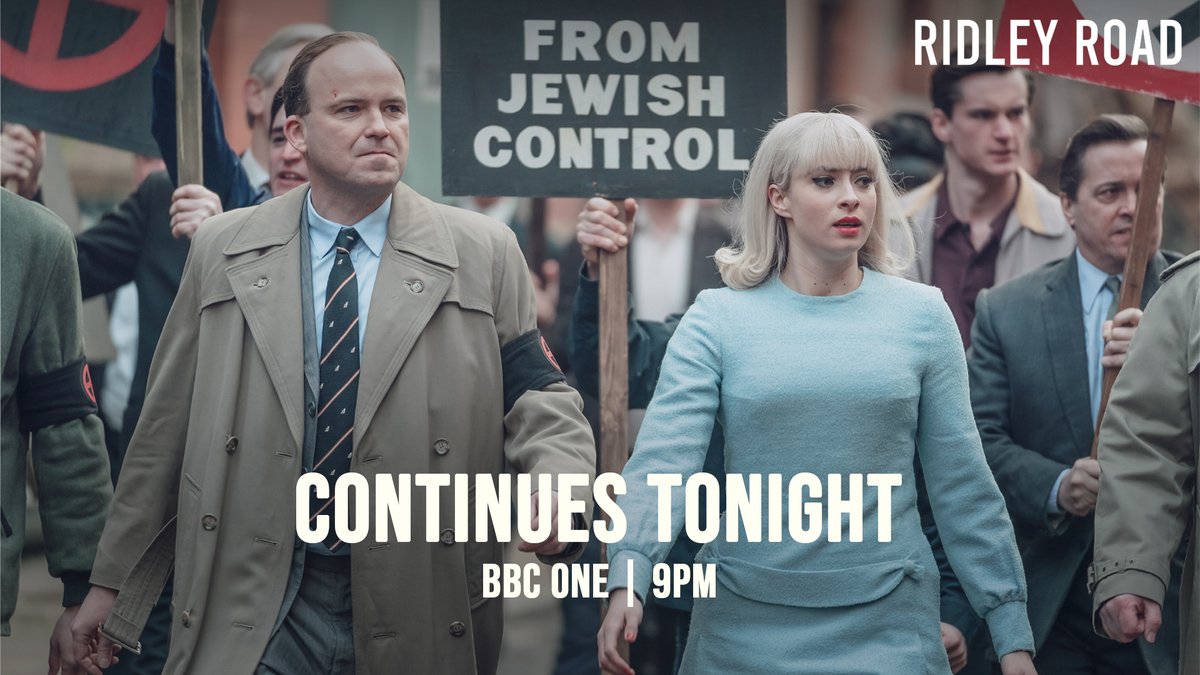
Ridley Road. A four-part mini-series adapted by Sarah Solemani from Jo Bloom's 2014 novel of the same name. Currently showing on BBC1, Sundays at 9pm. Also available on BBC iPlayer.

Set in 1962, a young Jewish woman, Vivian Epstein (played by Agnes O’Casey), leaves her comfortable life in Manchester in search of her boyfriend. She finds work as a hairdresser and on her afternoon off wanders into a fascist rally in Trafalgar Square only to find her lover, Jack Morris (played by Tom Varney), masquerading as a far-right thug.  The organisation in question was the National Socialist Movement (NSM) led at the time by Colin Jordan and John Tyndall and campaigning in Ridley Road in London’s East End, from where the drama takes its name.
    The drama has three areas of focus: those opposed to fascism, the fascists themselves and those naïve individuals fooled into supporting it. After Jack is injured in a street-fight Vivian becomes involved with a group of Jewish anti-fascists for whom he is working undercover. The group, led by Jewish cab driver Solly Malinovsky (played by Eddie Marsan), have fresh memories of the Holocaust and Cable Street and are determined to get this poisonous ideology crushed for good. Vivian infiltrates the NSM to discover Jack’s whereabouts.
    Ridley Road also shows how fascism prays on people’s fears and even legitimate concerns.    Fascists fraudulently claim to be opposed to capitalism and often promote an opposition to modernity.
    In one scene a covert fascist sympathiser talks of the closure of corner shops due to competition from supermarket chains. For most readers under 70 it is difficult to recall a time when most shopping was not bought in supermarkets but in the early 1960s they were an innovation. The same demagogues often hark back to an imagined past when apparently everyone knew their neighbour and looked out for each other – a dog whistle reference to immigration. From personal observation, the death of community spirit is grossly exaggerated just as is the notion that it was somehow better in the past. Meanwhile, the street I live on still has a corner shop, only it is open for much longer than it would have been in the 1960s.
    Colin Jordan (played by Rory Kinnear), the leader of the NSM, is portrayed as calm and collected, as well as a doting father.  He is not a one-dimensional, spitting fanatic, the classic cartoon fascist. The rank and file, referred to as his men, are portrayed as thuggish and drawn from the lower end of the working class. The wife of one of them points out that the stately home, used by the NSM, has been donated by a wealthy aristocrat. A reminder that fascism is not about looking after the little people.
    Ridley Road intertwines newsreel footage between scenes, which gives it a documentary feel.    It contains several sub-plots, giving the drama an added suspense. Meanwhile, it also makes reference to the treatment, or should I say mistreatment, of women – both by the fascist movement and ironically also within the Jewish community. This multi-layered and largely accurate historical drama is definitely a must in terms of Sunday night viewing.

Wednesday, November 30, 2016

Resisting the fascist junta in Kiev

By Theo Russell
Campaigners for solidarity with those resisting the fascist junta in Ukraine have seen some minor but important victories recently.
Last month Andrei Sokolov, a Russian left activist and political prisoner, who was kidnapped by unknown assailants in Ukraine and disappeared after leaving a courtroom in April, was released from a secret prison after 8 months.
Also last month, Alla Aleksandrovskaya, the 68 year-old head of the now banned Communist Party of Ukraine Kharkov district and ex-people’s deputy, was released from prison and placed under house arrest. She has been in poor health since her arrest on ‘separatism’ charges in June.
But there is no room for complacency. Vadim Troyan, deputy commander of the openly Nazi Azov Battalion has been appointed chief of police the capital Kiev by Interior Minister Arsen Avakov, who also has close connections with the Azov Battalion.
Meanwhile, totally ignored by the ‘free and democratic’ Western mass media, the war in the Donbas and deliberate shelling of civilians by the Ukraine Armed Forces and fascist battalions continues day after day. Dozens of civilians are being killed and wounded every month, without a whisper from the BBC, whose network extends to virtually every country in the world including Ukraine.
Another threat to the Donbas people’s republics of Donetsk and Lugansk is the possibility of an armed ‘police’ mission by the Organization for Security and Co-operation in Europe (OSCE). OSCE has had a mission monitoring the war in eastern Ukraine for some time and is involved in attempts to implement the two failed ceasefires under the Minsk agreements, which is why Russia has continued to participate in it.
But it is still essentially an extension of European Union imperialism, and has long been accused of biased reporting by the representatives of the Donbas republics. Earlier this year large demonstrations took place in the Donbas after rumours of such a mission, which its leaders declared would be “foreign intervention”.
There is no realistic prospect of such a force in the immediate future, but at the meeting of the ‘Normandy Four’ last month in Berlin Vladimir Putin, and the presidents of France, Germany and Ukraine, signalled “potential” support for an armed OSCE mission.
Last week Dr Yevgenii Gerasymenko, a barrister based in Kiev, told a meeting in London organised by Liberation that in today’s Ukraine “trade unions exist legally, but effectively they don’t exist”.
They have been forced to sell off buildings and Soviet-era assets such as holiday camps and clinics, and “are now in fact ‘owned’ by wealthy individuals”. Some have even held joint actions with the armed fascist groups. Anyone protesting against rocketing unemployment, corruption or lost savings are labelled criminal, ‘separatist’ or “the hand of Putin”.
OSCE has declared every election in Ukraine since the February 2014 fascist coup legitimate. And earlier this year Britain doubled its military assistance to Ukraine, to provide training for an army which now incorporates 84 fascist battalions.There is absolutely no democracy in Ukraine, and its working people are being ruthlessly crushed. International solidarity with Ukraine’s citizens resisting this dictatorship must go on. 

Friday, August 08, 2014

Communists in Britain and the fight against fascism in 2014


By Daphne Liddle

The most significant fascist and racist groups active in Britain at the moment are the British National Party, the English Defence League, Britain First, the English Volunteer Force, Traditional Britain and a number of regional Infidel and alliance groups – and of course the United Kingdom Independence Party.
The British National Party is now just a shadow of its former self after its election wipe-out in 2010 and the collapse of its electoral strategy. But it still exists. It has enormous debts and financial problems and has lost its main former financier, Ulster businessman Jim Dowson, but it is still getting money from somewhere and cannot be totally written off.
Jim Dowson himself recently told a [Channel Four News] documentary on Britain First, who are Dowson’s new protégés, that although he had broken with the BNP he had previously given them a total of around £4 million and he considered this well spent because BNP public activity during elections had “moved the whole British political spectrum several degrees to the right”.
And we should note a coincidence that the National Front’s dramatic collapse and splintering into umpteen warring factions in 1979 also coincided with a general election that swept Labour from power and brought in a very hard-line anti-working class, anti state-welfare Tory regime.
 The NF at the time had also just lost one of its main sources of income – money from the US-based World Anti-Communist League (which was funded from US, Saudi and Brunei sources and initiated by former Ukrainian Nazis) that was channelled via Lady Jane Birdwood. WACL’s new director, John Singlaub redirected the money from Birdwood to extreme right-wing Tory fringe groups. These groups included the notorious Federation of Conservative Students, which ran a campaign to hang Nelson Mandela.
In 1979 The NF was also wracked with internal strife after Special Branch leaked to anti-fascists the information that Martin Webster, second in command of the NF, had regularly supplied them with information on the NF in return for money. He considered himself seriously underpaid by the NF.
But like the BNP in 2010, the NF had done its job of diverting and dividing the working class to allow for the election of a right-wing Tory government with a strong anti-working class agenda and was no longer needed by those who had been financing it.
The English Defence League is also now just a shadow of its former self. A few years ago it could attract thousands of assorted football hooligans, former squaddies, neo-Nazis and general thugs looking for something to fight about on the streets. Its declared anti-Islamicist policies were a thin cover for its general racism and demonization of immigrants. They would bring terror to the streets of the towns targeted for their marches and they deliberately picked areas with a large Muslim community.
The tide of success for the EDL turned with massive anti-fascist mobilisations in Tower Hamlets, Brighton, Walthamstow and other places where large numbers of local residents took part in blocking the paths of the intended EDL march routes, sheer numbers and mobility making it impossible for police to control. When this happens police can, with difficulty, clear a stretch of road but it fills up again immediately with more anti-fascists.
            Anti-fascist photographers, being close to the EDL ranks, witnessed the intense anger and frustration of EDL members when their marches were blocked in this way. They were most furious to see the numbers of white working class people among the anti-fascist ranks because they have a delusion that the majority of white working class people share their racist outlook. “You’re not English anymore!” is the chant they hurl at such people.
When their marches were blocked repeatedly EDL supporters drained away. Their commitment to the cause is weak and their political understanding very shallow. Many have just come along for the opportunity of a fight. If they cannot fight immigrant communities or anti-fascists they will fight the police. And if they cannot fight the police they will fight each other.
In May 2013 the brutal murder of Drummer Lee Rigby in Woolwich by two Muslims caused a new wave of anti-Muslim hysteria that revived the fortunes of the EDL briefly. They organised dozens of marches and rallies but found, as before, they were still being blocked by anti-fascists and no one wanted them and the numbers began to fall away again.
This was when their leader, Stephen Yaxley-Lennon commonly known as Tommy Robinson, decided to quit. He claimed to have suddenly realised that people of different faiths can and should live in harmony and mutual respect and from now on this was going to be his mission – as though no one had ever thought of it before. There was no word of apology to the many multi-faith groups whose influence he and the EDL had tried to smash.
Nor was there any word of apology to his former followers who had dutifully trudged up and down the high streets of England on what he now realised was a mistaken cause.  He also claimed to have only just realised that the organisation he built attracted thugs, racists and neo-Nazis. He teamed up with a dubious state-funded think-tank known as Quilliam, which claimed to specialise in the redemption of Muslim extremist would-be terrorists.
The EDL had already begun to splinter into various more extreme “Infidel” groups – some of whom spent more time attacking Catholics than Muslims – and regional alliances. Paul Pitt from Essex emerged as the leader of the South East Alliance and is also a leading member of the English Volunteer Force. Last year he was seen outside the Lord Moon pub in Whitehall chatting with Jim Dowson.
Another small group of unashamed Nazis arising from the splintering of the BNP and the EDL is Britain First, led by Paul Golding. They charge around in an armoured Land Rover trying to intimidate Muslims, invading mosques with bibles and bottles of alcohol reminding the Muslims of what they probably most despise about traditional English manners.
But Britain First does seem to have won some funding from Jim Dowson. And from the behaviour of those vying for Dowson’s money it would seem they are competing to “kick their way into the headlines” – the tactics that Martin Webster of the old National Front boasted about. The old National Front is still around, just, and has benefitted a little from the fall-out from the shrinking BNP and EDL. In spite of its small size the NF is currently divided into three warring factions.
The Traditional Britain Group is evolving to take the place of the old Monday Club – an amorphous meeting and mingling place between fascist and racist “intellectuals” and the right-wing of the Tory party.
The EDL has shrunk but, like the BNP, is still there with a small core of hard-liners. It is still putting on marches in towns around the country: Slough, Peterborough, Rotherham, Newcastle, Stevenage and Middlesbrough.
There is a pattern to these events. The EDL turnout is low – usually fewer than 150 but the local police put on a huge and expensive show to guard against clashes with the local communities and with organised anti-fascists.
The police order the EDL to assemble outside the town so that they can enter the town accompanied by a lot of police, either by train or in special coaches laid on by the police. They allow the EDL to march noisily through the centre of town offending local residents, to a prepared pen where they make speeches. These invariably focus on the theme of Muslims and paedophilia and the grooming of young girls. There is no rationality to this – such activity is just as abhorrent to most Muslims as it is to anyone else and the paedophilia practised by various celebrities, politicians and some Catholic priests is never mentioned. It just plays to tabloid sensationalism and is the modern equivalent of the Victorian “white slave trade” scaremongering.
The EDL also boast about how much their marches are going to cost local council tax payers for policing.
There is invariably an anti-fascist counter demonstration, usually organised by the local trades council. These counter demonstrations are usually much bigger than the EDL effort but police route them around the outskirts of town so only those who participate really know they have happened. This is sad because it allows the EDL to feel they have triumphed over anti-fascist opposition and gives them a little boost. Their numbers have started to grow again a little.
There is no substitute for blocking their path with massive numbers, even if the police do not like this.
So it goes without saying that on the streets and facing the fascists there must be maximum unity between anti-fascists of all political shades. We must remember that the biggest and most successful anti-fascist alliance of all time comprised Stalin, Churchill and Roosevelt and they managed to work together in spite of having very little else in common, until the threat of Nazism was smashed. If they can work with each other then we can too – communists, socialists, anarchists, Tories, Liberals, Labour supporters, young, old, male, female and every gender nuance in between, atheists, Christians, Muslims, Sikhs, Jews, Buddhists and every other world view and every ethnic shade possible.
            AS COMMUNISTS, working with other anti-fascists of all kinds also gives opportunities for friendly dialogue as we stand shoulder to shoulder against fascism and it in no way implies our support for the political views on other matters of the people we are standing next to. Those are matters for peaceful argument during the lulls in fighting the fascists. This is the only way to achieve the mass turn-outs necessary to stop the fascists. And it happens naturally on the streets. Anti-fascists of all shades will defend one another regardless where there is a threat of attack by fascists or by police.
The traditional tactics of Unite Against Fascism and the more anarchic tactics of the energetic young people of Antifa are both needed and should be co-ordinated for maximum effect. Some trade unions do a good job of mobilising their members for anti-fascist work from the workplace – but we must find a way to mobilise workers in places that are not unionised (yet). We need to knock on doors and talk to working people in their communities, countering the lies that the fascists and racists promote. This is what was most effective in wiping out the BNP vote.
And this is the best way to defeat Ukip. Ukip has undoubtedly had an enormous amount of free publicity from the media and the state. It is performing a function for one section of a ruling class that is divided over Europe. That function is not to win a majority in Parliament but, again, to shift the whole political spectrum even further to the right and to persuade the working class to accept even further draconian anti-working class measures – the total dismemberment of state welfare, the trade union movement and all working class rights that have been won over the last 200 years by diverting attention into racism and xenophobia and an obsession with immigration.
The media never disclose any other aspects of Ukip policy so few people are aware that Ukip wants to abolish the NHS and privatise all medical care and all free education; ultimately they would like to abolish all taxes. It is the task of the anti-fascist and anti-racist movement to make up for this deficit in general awareness and it is the task of communists to give a lead in prioritising this work. And we do not give a lead from the rear, telling others what to do. We do it by being in the front line of activity.
We communists are great ones for meetings, conferences, debates and committees – theoretical work that is usually done sitting down. This is all essential work but it is only half the struggle. If all those great resolutions and clarifications of the line are just left hanging we might as well not bother. We must stand up, get out and about and be at the forefront of implementation – on the streets, in the workplaces, in the communities, on the housing estates putting our line into practice and communicating directly with workers and raising levels of political awareness and class consciousness. And we must do this most of all among the masses who are currently disillusioned, politically unaware and sceptical of the value of left political activity.
We must ensure that the hardship and suffering caused by the austerity measures and attacks on working class living standards turn into anger and not into despair and resignation. To do that we need some successes in struggle, we need to set at first modest, achievable goals to build morale and awareness. And defeating fascist and racist activity is one area where we can do this.
Historically the poll tax was defeated by mass non-compliance that made it impossible to implement. The Save Lewisham Hospital campaign won because, through an enormous effort, it achieved a truly massive level of active involvement and support. It can be done. Some say in both cases there have been subsequent reversals – the council tax system is also unjust and the Government changed the law so that in future cases like Lewisham hospital will not be able to succeed. But both campaigns did succeed in their main immediate goals and set a powerful example for others. Under capitalism there is no such thing as a permanent victory that does not have to be defended again and again but with good morale and mass involvement that is achievable.
And on the anti-racist anti-fascist front there have been a steady level of successes in anti-discrimination laws and the Stephen Lawrence family campaign led to big changes in policing. There is still a long way to go in achieving policing that is really free from racism and the progress achieved is always under threat. But that is the fluid nature of political struggle; we can never let up but we know we can win.
It is down to a critical mass of involvement but to achieve that we have to make a public political stand that people can and will rally to. Three times this year different fascist groups – Britain First and then the ex-EDL’s South East Alliance – have tried to stage events in Cricklewood, north London.
 In the first instance in February the anti-fascist picket line was quite modest – the local trades council, members of the Labour Representation Committee and a few others – seemed quite modest in number. But when the fascists turned up it was heartening to see the anti-fascists numbers quadruple at least as local passers-by joined in and it turned into a major success. But it would not have happened if the trades council comrades had not bothered to make a stand in the first place.
In the second instance in June it was the young, mobile and daring comrades of the Antifa movement who totally blocked the street – and also won a lot of support from local passers-by. The fascists were unable to do anything and their leader Paul Pitt exploded with rage and frustration. No violence was involved – just a critical mass of people able to block and road and with the courage to do so.
In the third instance, Paul Pitt’s South East Alliance again tried to march in Cricklewood but the effect of their previous defeat was that Pitt could muster only 17 supporters – and three of them were so embarrassed by the low turnout they did not march with the others but hung about on the sidelines. Pitt protested to the police again – but this time it was very half hearted. Meanwhile the number of anti-fascists had multiplied again and, with a line of big banners right across the street, they barred the way again. 
Back in the 70s and 80s the presence of Anti-Nazi-League pickets, however small, at every fascist and racist public activity had a true mass impact on the fascists’ and racists’ morale. It led them more or less to give up street activity. And it was always a very welcome sight to an anti-fascist photographer to know they were not alone. Now Unite Against Fascism and other anti-fascist groups are keeping up that tradition.
In Europe there is a much more serious situation developing with new Nazi parties blatantly displaying fascist and Nazi symbols, calling for pogroms against immigrants, Jews and Roma people.
And in the Ukraine, with the backing of US finance they have seized power from the weak democratic government of Yanukovich as part of a western strategy to bring Ukraine under the political and economic control of Nato and the European Union.
Once again the fascists are being used to divert and divide the working class while the most draconian cuts in wages, pensions and services are being imposed on them as the giant western companies try to seize Ukraine’s agricultural and mineral wealth.
The West had tried before to destabilise Ukraine and supported pro-western and anti-Russian puppets but the people soon saw through them and threw them out. This time they used the pro-EU Maidan Square protesters as a cover to seize power.
Ukrainians are a people who can remember living under socialism and they are putting up a mighty resistance and in the east are attempting to set up breakaway republics. Crimea broke away altogether and reverted to becoming part of Russia, denying the important Russian Naval base at Sevastopol to the Kiev Nazis.
But a full scale war is being fought by Kiev against the peoples of eastern Ukraine.
There is also strong resistance to the Nazi putsch in western Ukraine but it is being dealt with very brutally. Outspoken opponents of the junta are being murdered, communist party offices have been looted and burned, Russian language books are being burned and the language is being outlawed. All to divert attention from the huge drop in living standards being imposed on all the people by western imperialism.
Russian leader Vladimir Putin, a right-wing nationalist and pro-capitalist but opposed to western imperialism, was quick to accept Crimea back into Russia but is avoiding further Russian involvement. He can clearly see the hand of Washington behind the Kiev junta and he has no desire to escalate the conflict into a third world war. He knows there are hawks in Washington who would like to do that.
Meanwhile he is securing economic agreements with China and other Brics (Brazil, Russia, India, China and South Africa) countries to reduce the power of the US dollar globally and to defuse the American threat that way.
There are also strong Nazi movements in Greece, Hungary, Poland and in Russia itself. But they tend to be divided from each other by their extremist nationalism. Polish, Hungarian, Ukrainian and Russian fascists all lay claim to parts of each other’s territories and despise each other as lesser breeds of human.
And there are also strong anti-fascist movements growing up. The memory of the Red Army is growing stronger and communism is remembered once more as the force that succeeded in smashing fascism. It is our strength that we can unite internationally and work together with mutual respect.
 We have every reason to get ourselves into the front line of this struggle and show the world that communists still know how to organise, how to recover from initial defeats and setbacks and how to win the war and destroy fascism.