Showing posts with label BBC1. Show all posts

Tuesday, October 19, 2021

Fighting the fascists in the Swinging Sixties

by Ben Soton

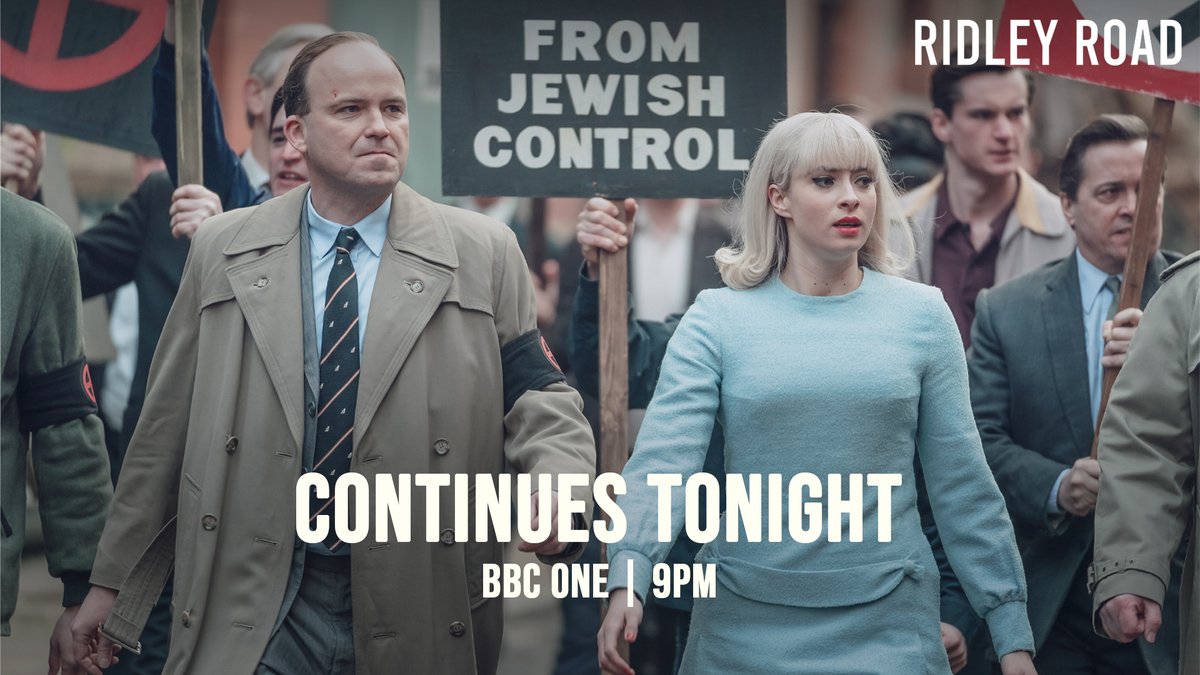
Ridley Road. A four-part mini-series adapted by Sarah Solemani from Jo Bloom's 2014 novel of the same name. Currently showing on BBC1, Sundays at 9pm. Also available on BBC iPlayer.

Set in 1962, a young Jewish woman, Vivian Epstein (played by Agnes O’Casey), leaves her comfortable life in Manchester in search of her boyfriend. She finds work as a hairdresser and on her afternoon off wanders into a fascist rally in Trafalgar Square only to find her lover, Jack Morris (played by Tom Varney), masquerading as a far-right thug.  The organisation in question was the National Socialist Movement (NSM) led at the time by Colin Jordan and John Tyndall and campaigning in Ridley Road in London’s East End, from where the drama takes its name.
    The drama has three areas of focus: those opposed to fascism, the fascists themselves and those naïve individuals fooled into supporting it. After Jack is injured in a street-fight Vivian becomes involved with a group of Jewish anti-fascists for whom he is working undercover. The group, led by Jewish cab driver Solly Malinovsky (played by Eddie Marsan), have fresh memories of the Holocaust and Cable Street and are determined to get this poisonous ideology crushed for good. Vivian infiltrates the NSM to discover Jack’s whereabouts.
    Ridley Road also shows how fascism prays on people’s fears and even legitimate concerns.    Fascists fraudulently claim to be opposed to capitalism and often promote an opposition to modernity.
    In one scene a covert fascist sympathiser talks of the closure of corner shops due to competition from supermarket chains. For most readers under 70 it is difficult to recall a time when most shopping was not bought in supermarkets but in the early 1960s they were an innovation. The same demagogues often hark back to an imagined past when apparently everyone knew their neighbour and looked out for each other – a dog whistle reference to immigration. From personal observation, the death of community spirit is grossly exaggerated just as is the notion that it was somehow better in the past. Meanwhile, the street I live on still has a corner shop, only it is open for much longer than it would have been in the 1960s.
    Colin Jordan (played by Rory Kinnear), the leader of the NSM, is portrayed as calm and collected, as well as a doting father.  He is not a one-dimensional, spitting fanatic, the classic cartoon fascist. The rank and file, referred to as his men, are portrayed as thuggish and drawn from the lower end of the working class. The wife of one of them points out that the stately home, used by the NSM, has been donated by a wealthy aristocrat. A reminder that fascism is not about looking after the little people.
    Ridley Road intertwines newsreel footage between scenes, which gives it a documentary feel.    It contains several sub-plots, giving the drama an added suspense. Meanwhile, it also makes reference to the treatment, or should I say mistreatment, of women – both by the fascist movement and ironically also within the Jewish community. This multi-layered and largely accurate historical drama is definitely a must in terms of Sunday night viewing.

Sunday, August 15, 2021

Another French connection

 by Ben Soton

Baptiste Series 2, currently showing on BBC1, Sundays at 9pm; also available on BBC iPlayer. Created by: Harry Williams, Jack Williams. Written by: Harry Williams, Jack Williams, Kelly Jones, Catherine Moulton. Stars: Tchéky Karyo, Anastasia Hille, Barbara Sarafian.

BBC1 is currently screening the second and final series of Baptiste, a gripping drama in which the retired French police officer Julien Baptiste (played by Tchéky Karyo) tracks down missing persons, those whom the regular police are incapable of locating. The drama emerged from an earlier series, The Missing, originally shown in 2014, in which the main character played a prominent role. The French detective was later revived when the first Baptiste series was launched in 2019.
    In the current series the family of the British Ambassador to Hungary, Emma Chambers (played by Fiona Shaw), goes missing and she uses Baptiste to find them. The search leads them to a Hungarian far-right party and its links to an even more sinister terrorist group known as Gomorrah. In episode three a Hungarian far-right politician uses a children’s story as the basis for a speech she is about to make, showing the simplistic and childlike nature of their arguments. At face value, the programme dismisses the view that the European Union  is an oasis of enlightenment, and that Brexit Island is a bastion of ignorance.
    Episodes so far have been dominated by flash-backs between past and present. The purpose of this technique is to keep the viewer focussed but equally it can also cause confusion.
    The event that separates past and present to us is a massacre by the fascist terror group Gomorrah, in which Chambers is seriously injured and Baptiste has a nervous breakdown. As the series progresses it appears that Gomorrah is the key to the disappearance of Chambers’ family. Meanwhile, the sub-plots based around Baptiste’s chaotic personal life also feature.
    Baptiste raises the issue of why people go missing. An estimated 170,000 go missing every year, an equivalent to one person every 90 seconds. Around 70,000 of these are children, many of whom are in local authority care – known as ‘Looked After Children’.
    Previous series of Baptiste and The Missing have focussed on the global sex industry and the trafficking that accompanies it as a possible reason why many of the people, particularly women and children, disappear.
    A television series set in Hungary, involving the British ambassador with a French police officer, is a reminder that we live in an interconnected world. The Hungarian police are portrayed as incompetent, corrupt and possibly in league with the far-right. Ironically, the British police, who would normally be involved with such a high-level disappearance, are nowhere to be seen. Is this part of the BBC’s Remainer agenda, which views this country as being left isolated after Brexit?
    When it transpired that the British husband of the Hungarian extremist leader is the mastermind behind Gomorrah my fears came to light. The narrative promoted by the series is as follows: Britain has left the EU, whilst the far-right are gaining ground in Hungary. The two events are connected. The British ambassador, left disabled after a shooting, represents Britain isolated and weakened after Brexit. The saviour is a retired Frenchman, acting out of good will.
    The series is soon to reach its climax. I am anticipating a dramatic ending as well as a resolution of Baptiste’s personal problems. When watching the BBC, however, beware false narratives.

Tuesday, September 22, 2020

Striking the middle road

by Ben Soton


Strike: Lethal White by J K Rowling (writing as Robert Galbraith). Adapted for TV by Tom Edge. Director: Susan Tully. Stars: Tom Burke, Holliday Grainger, Kerr Logan, Natasha O’Keeffe and others. Recently shown on BBC1 and still available on BBC iPlayer.

JK Rowling, author of the Harry Potter series, recently stated the bleeding obvious, namely that there is a link between biological sex and gender. A number of Trans-activists blew their gaskets over this issue, accusing her of being the devil incarnate. Rowling, who is often wrong on key issues such as the European Union (EU), is also the author of the Cormorant Strike novels, writing under the name of Robert Galbraith. Lethal White, the recent BBC Sunday night drama, features Tom Burke as the Private Detective Cormoran Strike and Holly Grainger as his assistant Robin Ellacott.
    For the last few series, they have kept viewers wondering if romance is on the cards. Meantime, Strike has had numerous partners and Ellacott has married. At the end of the third episode however, Ellacott left her adulterous and boring husband whilst Strike was dumped by his girlfriend.
    The story has two distinct themes: corruption in high places and law breaking in low places. Ellacott, who with a slight northern accent comes from a neither particularly high nor low background, is able to infiltrate both places. In one episode with a new hairdo she passed as an intern for a Government Minister whilst faking a posh accent. In another episode and a change of clothes she posed as a teenage political activist whilst exaggerating her own Yorkshire accent. It is probably true that those in the middle are best apt at impersonating those at the bottom as well as those lower down the social scale.
    The narrative that Rowling is promoting forms the basis of a myth; namely that decent people in the middle are the victims of both a corrupt elite and social scum at the bottom. The drama actually gives an example of well-heeled types cavorting with petty criminals because they have access to class A drugs.
    Depending on where the middle actually begins and ends, this argument can appear convincing. Working people have little time for drug dealers and petty criminals; during the last election whilst campaigning for the Labour Party I was inundated with complaints of drug dealing around council estates on top of Labour’s failure to honour the Brexit Referendum. Although convincing, the argument is still flawed.
    Ultimately, who really holds state power in the country? Which group owns the greater proportion of the nation, or for that matter the world’s wealth? Who is responsible for numerous world wars, the slave trade and imperialism?
    Most petty criminals earn less than the minimum wage and live chaotic lives, few drive BMWs. Obviously under socialism these people would be subject to re-education and if this did not work, they would face the full force of the law.
    The notion of decent people in the middle being equally oppressed by those above them has been used by centre-right politicians for years and a narrative promoted by the likes of Tony Blair. Ultimately it lets the real enemy off the hook; although unlike others scapegoated these people are not totally faultless.

Friday, November 29, 2019

The Martians are coming…


 by Ben Soton

The War of the Worlds (2019). Three-part mini-series on BBC1, from Sunday 17th November, 2019 at 9pm. Also available on BBC iPlayer.
Mini-series written/adapted by Peter Harness from the original story by HG Wells. Stars: Eleanor Tomlinson, Rafe Spall, Robert Carlyle and Rupert Graves.

A good way to start the week ahead is a decent Sunday night of television viewing. With this in mind, BBC1’s adaptation of HG Wells’ War of the Worlds is worth watching. First published in 1898, War of the Worlds taps on the then popular belief that Mars was covered by canals built by Martians desperately trying to save their ‘dying’ planet. It was also probably the first book to take on the issue of ‘contact’ with extra-terrestrial life that inspired a tranche of ‘alien invaders’ stories in the years to come.
In this case it’s Martians in tripods blasting late Victorian London and the Home Counties with lasers; parasites intent on using the human race as food. Wells created a blueprint for future sci-fi stories including the Terry Nation’s Daleks, featuring heavily in Dr Who and 20th Century Fox’s Independence Day franchise.
Herbert George Wells was writing during the ‘belle epoque’; the bourgeois ‘golden age’ between the last years of Queen Victoria and the First World War when the British Empire seemed to be supreme. The plunder of empire brought great riches to the ruling class as well as rising class tensions at home, in an era that saw the carve-up of Africa by Britain and the other European powers as well as technological change based on continued scientific development. These events inspired Wells’ novels including The Time Machine and The Island of Dr Moreau.    This War of the Worlds adaptation is, in many ways, an analogy of European imperialist culture and the colonisation of Africa that was taking place when the book was written. Khaki-clad riflemen are ineffective against the tripods with laser-firing death rays and poison gas – like spear-throwing natives against soldiers armed with Gatling guns and a hint at horrors still to come in the 20th century.
Government ministers, used to ruling over an Empire, appear as impotent as tribal chiefs dealing with European invaders whilst the Martians’ desire to consume human beings is a possible reference to the parasitic nature of imperialism. The Martians land on 12th August – the ‘Glorious Twelfth’ which marks the start of the grouse-shooting season and is possibly a reference to the upper-class obsession with shooting at things that can’t shoot back.
This is the first attempt to present the story as a television series. It has seen two film adaptations, made in 1953 and 2005, a spoof send-up in 1996 as well as a musical, and the legendary Orson Welles radio broadcast that led some American listeners believe a Martian invasion was really taking place.
Unlike previous adaptations this television series is set in the Edwardian era, which is much closer to the original story. All three films were set in the USA, with the 1953 version containing a Cold-War anti-communist theme.
It is good to see a classic novel told in its original form, whilst benefiting from the use of CGI to show the destruction caused by the Martian imperialists. The scene showing the destruction of London resembled the Kuwaiti oil-fields after the US-led invasion of 1991.
This mini-series does seriously depart from the book, however. There’s a sub-plot concerning the marital situation of the main characters. Amy (played by Eleanor Tomlinson) and George (played by Rafe Spall) are an unmarried couple, which was considered scandalous in Wells’ day. George had previously been married to his cousin, ironically considered acceptable, who refused to grant him a divorce.
Ostracised from polite society the couple move to Woking, where news of their situation soon twitches a few curtains. This aspect of the story is a critique of the morality of the period and an argument for reform of divorce law. The implicit homosexuality of their neighbour and scientist friend Ogilvy (played by Robert Carlyle), who describes himself as a “well turned out bachelor”, is reference to the draconian treatment of Oscar Wilde who was imprisoned in 1895.
All of this has come under fire from ‘traditionalist’ TV critics, who cannot see that it is pointless simply to retell a story whose ending everybody knows and which ignores the fact that all previous adaptations have also strayed dramatically from the original. Take no notice. If you’re not already watching it catch it now on BBC iPlayer!

Saturday, October 19, 2019

World on Fire


review


by Ben Soton

World on Fire. Season one (2019) by Peter Bowker. Starring: Jonah Hauer-King, Julia Brown, Zofia Wichlacz. Produced by BBC One and Mammoth Screen.

BBC1’s latest Sunday night drama covers the age-old themes of love and war.  The war is World War II; the love themes include love across the divides of class and nationality.
The main characters are Harry Chase, played by Jonah Hauer-King, an interpreter at the British Embassy in Warsaw and Lois Bennett, a factory worker and part time singer played by Julia Brown. Both share a common opposition to fascism and are keen to support the war against Germany in 1939. This pro-war sentiment is not shared by Julia’s father, Douglas Bennett played by Sean Bean. Douglas Bennett, a committed pacifist, sees all war as inherently bad, a result of his experiences in the First World War.
The drama views the Second World War as an exception. US journalist Nancy Campbell, played by Helen Hunt, compares the German invasion of Poland in 1939 to the plight of Republican Spain. A poor comparison, Republican Spain was a democracy whilst inter-war Poland was a semi-fascist military dictatorship and a thorn in the side of the Soviet Union. Meanwhile Campbell, who makes regular broadcasts to the USA, acts as the drama’s narrator. The Second World War did, however, have an anti-fascist character, which became more pronounced after 1941 with the German invasion of the Soviet Union. The question is will Douglas Bennett’s attitude change over time?
As the drama continues, we begin to see an inter-connected web of characters that spans the obvious divides of wartime. I am reminded of the 1980s drama The Winds of War or the more recent Century Trilogy by Ken Follett. The Century Trilogy has a strong anti-communist theme; although it may be early days to make this comparison. It may, however, be disturbing to know that the drama’s inception comes at a time when the European Parliament passes a motion blaming the Second World War on the Soviet Union and effectively exonerating Nazi Germany. So far, the Soviet Union has not been mentioned in the series – which is not far off the mark considering it was neutral at this point in the conflict.
World on Fire does make good Sunday night viewing. The war scenes, which include the aerial bombing of Danzig, are well put together, which in this day and age means the CGI [computer-generated imagery] is not obviously apparent. The brutality of the Nazi invaders is shown when they refuse to follow the normal conventions of war.
My advice to viewers is to watch the drama but look out for inaccuracies and historical lies.

Saturday, October 05, 2019

Northern lights


By Ben Soton

Scarborough; BBC1 Friday 9.30pm. Written and directed by Darren Little. Starring: Stephanie Cole, Catherine Tyldesley, Jason Manford.

Although Scarborough is billed as a comedy, this new BBC1 30-minute sitcom feels more like a kitchen-sink drama. It’s written and directed by Darren Litten, the creator of Benidorm, who has a talent for generating comedy from everyday situations.
I will take this opportunity to tell Party members that my non-attendance at last year’s October Revolution Commemoration was due to my wife purchasing tickets for Benidorm at Southampton’s Mayflower Theatre – sorry comrades but I hope to be there this year!
The main characters are an unmarried couple in their late 30s, Mike and Karen, who have a history, somehow drifted apart and now find themselves together. Karen, a hairdresser played by Katherine Tyldesley, spends much of her free time looking after her elderly mother, played by Stephanie Cole.  Interestingly, Stephanie Cole, now aged 77. has been playing elderly characters for the last 30 years; it seems her age has finally caught up with the roles she plays. Mike, played by Jason Manford, works in an amusement arcade and has returned home from life in a band. In this day and age their situation is not unusual; a lifestyle once associated with 20-somethings is not untypical of those nearing 40.   
The star of the show is the town itself, with panoramic views between scenes. I have often wondered how a resort on the edge of the North Sea has for the last 150 years or so been a major tourist destination. It has suffered as a result of cheap and accessible air travel; but concerns over climate change and the low value of the pound may provide new opportunities for Scarborough and places like it.
Scarborough was also one of the east coast towns that voted heavily for Brexit. This might be because the people of Scarborough are the bunch of stupid ignorant racists the Remainiacs would have us believe, or it may be the result of lack of job opportunities in the town combined with the declining fishing industry.
Some of these issues come across through the minor characters in the series. Lisa-Marie, a young woman who works in the same salon as Karen, shows her frustration at her lack of prospects and zero-hours contract by quitting the hair-salon; the only problem being other prospects in the town are limited.
More interestingly Mike shares a flat with his friend Bigsy, played by Steve Edge.  Bigsy is a fantasist who claims to be some kind of secret agent. One of the sad truths about austerity Britain is the stigma of unemployment forcing its victims to concoct elaborate fantasies rather than admit to being out of work. On one level it may appear that Bigsy, who has trouble keeping up with the rent, is using Mike; is this relationship that straight forward however?  Does Mike, who at least has a job, benefit from Bigsy who is able to make his life look successful.
With series one coming to an end I am hopeful of it not being the last. Scarborough is an example of what can be described as Comedy Realism. The show contains a combination of both factors in varying degrees. Meanwhile a show based around a location, as with Benidorm, enables it to continue for successive series even with different characters.