Thursday, April 20, 2006

1926 -- The General Strike


by Ken Ruddock

THIS YEAR is the 80th anniversary of the General Strike of May 1926, a momentous event in the history of British trade unionism – one with lessons for today’s trade unions and the labour movement in general.
To understand why the General Council of the Trades Union Congress came to call a general strike starting on midnight of 3rd May 1926, with the support of 3,600,000 workers, it is necessary to go back in time to the years of the First World War 1914-1918 and even before.
During the years running up to 1914 there was growing unrest in Europe. The Socialist International agreed that in the event of war, it should be opposed. On the eve of war, mass demonstrations took place up and down the country. Trafalgar Square saw a huge demonstration addressed by labour leaders Keir Hardy and Arthur Henderson in opposition to war.
Before the month was out, the Labour Party decided to support the Tory government’s war, and along with the TUC, decided that “an immediate effort be made to terminate all existing disputes, whether strikes or lock-outs, and wherever new points of difficulty arise during the war a serious attempt should be made by all concerned to reach an amicable settlement before resorting to strikes and lock-outs.”
This left the workers defenceless against the employers’ attacks on wages and conditions, and was soon followed by the “patriotic” Labour leaders signing the “Treasury Agreement” which neutralised the unions for the duration of the war. It brought with it, in some industries, a complete ban on strikes and compulsory arbitration.
However this did not deter the workers entirely and there were a number of unofficial strikes when employers took advantage of the war to break agreements.
During the many struggles in defence of workers’ conditions, a new form of militant unionism grew: that of the shop stewards who, elected as workshop representatives and leaders, became the answer to collaboration with the state machine.
Examples of the strength of this movement are illustrated by the Clyde strike in June 1915, which arose from an anomaly in rates of pay. The Glasgow district committee of the Amalgamated Society of Engineers made an application for an increase of two pence an hour. This was refused with an offer of a halfpenny and the engineering workers in 15 establishments ceased overtime working.
This was opposed by the ASE executive, who, whilst siding with the employers, organised a ballot on the employers’ offer. It was rejected by 8,927 to 829, resulting in an increased offer of one penny and an increase in piece rates was won.
In July 1915 the South Wales miners, part of the Miners’ Federation of Great Britain who had refused to be a party to the “Treasury Agreement”, made demands for a new agreement on wages and conditions from the mine owners, who were taking advantage of the war to improve their own position.
When the employers rejected the demand out of hand, the Miners’ Federation decided by a majority of 42,850 to strike. Despite threats from the Government 200,000 miners stood firm. In less than a week this resulted in the Government over-riding the mine owners and conceding the main demands.
There were other disputes but it was the Clyde strike that had marked the emergence of the shop stewards as the backbone of a new form of workshop organisation. Out of the strike the Clyde Workers’ Committee was formed, with William Gallacher as chairman (Willy Gallacher became a Communist MP after the war).
Workers’ committees sprang up in London, Sheffield and in other centres of industry and in 1916 a national Shop Stewards’ Movement was formed. The shop stewards became the effective defenders of the workers in the face of the inactive union executives.
The Government had introduced a Munitions Act, under which workers virtually lost all rights of protest. In July 1916 over 1,000 workers were convicted under this Act. It was not only in the industrial field that workers were becoming more militant. Rents strikes against rapacious landlords grew.
In 1917 the news of the Russian Revolution added to the revolutionary spirit of the workers.
With the end of the war in 1918, the Labour Party withdrew its Labour Ministers out of the coalition government and won what became known as the Khaki election, because of the returning soldiers taking part.
The change of government did nothing to improve conditions for the workers. It was again left to the workers to fight their own battles with the employers.
On the Clyde the strike was for a shorter working week. The national officials of the unions failed to support it and it ended in a fortnight. Then came the miners, the MFGB demanded a 30 per cent increase, a six-hour day and nationalisation of the mines.
The Government had continued to control the mines after the war and was now facing a strike with exhausted stocks of coal. The miners had formed the “Triple Alliance” with the railway and transport workers, who had also made claims. The Government was faced with a general strike.
The Prime Minister, Lloyd George, offered the miners a Royal Commission on the one hand, and a threat of armed force on the other. The MFGB president, Robert Smillie, caved in to the threat and won a narrow majority for acceptance of the offer.
The commission, presided over by Mr Justice Sankey, subsequently recommended nationalisation. But the Government, despite the promise to implement the commission’s recommendations, refused to comply and provoked a strike in the Yorkshire coalfields during July and August 1919.
The years that followed deserve an article for themselves. The Lancashire cotton workers won a strike for a 48-hour work and a 30 per cent increase in wages when 300,000 of them came out. The railwaymen struck for a week against threatened wage cuts and won improvements against threats from the Government. And it is worth noting that it was only the conservative influence of JH Thomas that prevented the strike widening into a general move forward. Other sections of the labour force, including dockers, made gains.
All these were during the post-war boom, which was coming to an end, bringing with it a rise in unemployment of two million in the slump of 1921. This inevitably brought with it a general attack on workers’ wages and conditions.
The first sections to come under attack from the employers, with the support of the Government, were the coal miners. They had rejected the coal owners’ demands and were locked out. The Miners’ Federation invoked the aid of the Triple Alliance, which called for a strike on 12th April.
Whilst the workers were prepared to take action, the leaders of the Triple Alliance were not enthusiastic and postponed the strike to 15th April. During this delay Frank Hodges, secretary of the Miners’ Federation, took it upon himself to offer a temporary settlement at a meeting of MPs. The following day his unauthorised action was disowned by his executive.
But the damage had been done and the alliance leaders withdrew their support. This day became known as “Black Friday”. The result was catastrophic. Workers felt they had been betrayed. Three of the four leading personalities associated with Black Friday deserted to the other side. Frank Hodges became a director of the Bank of England; JH Thomas left public life, Robert Williams became a spokesman for the National Government. The fourth member was Ernest Bevin.
During the next three years the effect of Black Friday was to undermine the morale of the workers who were left to fight defensive actions. The miners were defeated and six million workers suffered wage cuts. The employers used lockouts to break any resistance. The effect on trade union membership was dramatic.
But by the end of 1923 there were signs of recovery and workers started to regain their fighting spirit with strikes – many unofficial – of builders, agricultural workers, boilermakers, dockers and seamen.
January 1924 saw the election of the first Labour government under the leadership of Ramsay MacDonald. During an official strike of railwaymen that was taking place at the time, MacDonald showed no sympathy with Aslef, the union leading the strike. This action eventually won some concessions in spite of disunity from the National Union of Railwaymen, which instructed its members to continue working.
The year continued with more unofficial disputes in the shipyards and railway shops. In London the tramway workers struck for higher wages; the busmen joined them and the Tube men were considering sympathetic action. McDonald declared he would invoke the Government’s Emergency Powers Act, which empowered him to declare a state of emergency. Only the simultaneous ending of the strike prevented military intervention.
For some time militant workers had been moving to the left. They had created the National Minority Movement at a conference in London in August that year, with the veteran Tom Mann as president and Harry Pollitt – who had gained a reputation representing the boilermakers as a delegate to Labour Party conferences – as secretary.
By this time Harry Pollitt had become secretary of the Communist Party. The movement had grown in the South Wales and Fife coalfields and had secured the election of AJ Cook as secretary of the MFGB, replacing Hodges after his forced resignation.
In September a new spirit could be seen in the trade unions. Whilst the Labour government had been defeated in the October election, the September TUC congress adopted an Industrial Workers’ Charter; gave the General Council new powers to intervene in disputes, and to draft a scheme for linking the unions into a united front for improving workers living standards. The council was also instructed to call a special congress to decide on industrial action if there was a danger of war.
By 1925 the British capitalists were facing a desperate economic struggle to regain their world position. Prime Minister Baldwin had declared that “all workers in this country have got to take reductions in wages to help this country get on its feet”.
The Miners’ Federation, always the first to come under attack, refused the mine-owners’ demands and received the “complete support” of the TUC General Council, which appointed a special committee to cooperate with the miners in resisting this attack.
The committee, with the support of the railway and transport workers, drew up plans for an embargo on all coal transport in the event of a miners’ lockout. A special conference of union executives endorsed the plan on the day before the mine-owners’ deadline: 30th July.
The Government, unprepared for such action, retreated and announced a nine-month subsidy to enable a Royal Commission to conduct an inquiry. The mine-owners withdrew their proposed lockout. That day is now known as Red Friday.
The General Council declared that the defeat of the Government was “an immense stimulus to every trade unionist”. But communists warned that “the capitalist class will prepare for a crushing attack on the workers” and continually called for preparations to repel such an attack.
The capitalist state had, following its setback on Red Friday, started preparations for a counter attack by forming an “unofficial” Organisation for the Maintenance of Supplies” with a Central Council made up of high-ranking admirals, generals and retired officials of the state, for the purpose of organising strike-breaking “black legs”, special constables and fascist elements.
This organisation, known as OMS, became an official arm of the state, supporting the capitalist employers. Winston Churchill, at the time Chancellor of the Exchequer, made it clear that their action on Red Friday had only been intended to give the Government time to prepare its counter attack.
There was little reaction to all of this from the TUC’s General Council. But the September congress in Scarborough showed the fighting mood of the workers with a vote of 3,082,000 to 79,000 in favour of revolutionary opposition to British imperialism. The conference declared that the aim of the unions, in conjunction with the Labour Party was for the workers’ overthrow of capitalism and pledged itself to strengthen workshop organisation.
Despite these brave words, the congress saw the election of two men associated with Black Friday – JH Thomas and Ernest Bevin. They were joined by WM Citrine as General Council secretary following the death of Fred Bramley. This moved the balance of force on the General Council to the right.
At the following Labour Party conference Thomas and Bevin associated with MacDonald in a counter demonstration to the Scarborough congress. Pressure was put on the unions not to elect communists to the Labour Party.
The Government saw the green light and within a fortnight had jailed 12 Communist Party leaders after the biggest state trial since the Chartist days.
The Miners’ Federation, concerned at the turn of events, made efforts to form an industrial alliance of key unions to prepare for the conflict, which were wrecked by the withdrawal of Thomas’s NUR.
The Royal Commission on the coal industry headed by Sir Arthur Samuel, later to become a lord, produced a report in March 1926, which was vague in its view on recognition of the coal industry under state control. But it was strong in its view that miners should accept longer hours and lower wages.
The miners’ delegate conference on 10th April disillusioned the General Council by standing firm and so did the Minority Movement conference held in late March, attended by 883 delegates representing a million trade unionists, supporting their fight.
The mine owners immediately declared they would only negotiate on a district basis, and gave notice of a lockout for 20th April. They demanded wage reductions so severe that even their president, Evan Williams, admitted the resulting wages would be “miserable”.
In response the TUC General Council regained its backbone in support of the miners and on 27th April decided at last to draft plans for large scale action if necessary.
Negotiations continued the following night of 29th April and the following day. But it became clear that the Government, having completed its preparation, was determined to provoke a conflict. The General Council’s negotiators, of which Thomas was a leading member, reported to union executives the following morning and a vote was taken endorsing a General Strike order by unions representing over 3,600,000 members to fewer than 5,000.
They announced that specified unions would strike as from midnight Monday 3rd May.
They planned that specified trades would be called out in two sections. The first included all transport, printing, iron and steel foundries, heavy chemicals and building workers (except those working on housing and hospitals). The maintenance of food and health services was to be covered by the unions concerned.
Whilst these preparations were going ahead, the General Council still maintained that they had a right to negotiate for the miners, even if it meant a reduction in wages.
But when the Natsopa members refused to print an anti-union leading article in the Daily Mail and went on strike, Baldwin demanded that if negotiations were to continue, the General Council should withdraw the notice of a General Strike. This he made impossible, and despite the misgivings of the General Council, the dye was cast and at midnight on Monday 3rd May an army of a million workers struck.
The next day the TUC communiqué said: “We have from all over the country reports that have surpassed our expectations. Not only the railwaymen and transport men, but all other trades came out in a manner we did not expect immediately. The difficulty of the General Council has been to keep the men in what we might call the second line of defence rather than call them out.”
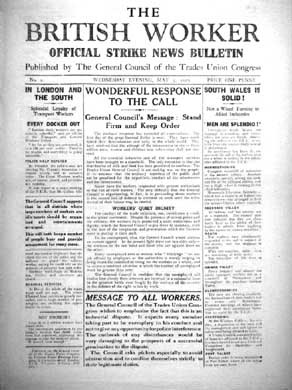
There were no passenger trains, no newspapers. The Communist Party issued a typewritten Workers’ Bulletin. The General Council, always on the defensive, only produced its own news-sheet, the British Worker, after the Government had produced an official British Gazette.
The trades councils and councils of action speedily organised in many parts of the country, so effective that in some major towns nothing moved without a permit from the trades council. The International Federation of Trade Unions declared its moral and financial support if needed.
The second day of the strike, the London taxi-drivers stopped work. The National Union of Journalists (Glasgow) refused to Blackleg. The National Unemployed Workers’ Committee Movement – already suffering from the employers’ attacks – offered assistance to the trades councils and strike committees.
The Independent Labour Party called on its branches to support the strike. The Communist Party issued a statement in the British Worker with the slogans:
1) All together behind the miners;2) Nationalisation of the mines3) Resignation of Baldwin; formation of a Labour government.
By this time the police were more aggressive with baton charges against strikers in crowds in the streets and making summary arrests. Communist MP Saklatvala was sentenced to two months imprisonment for a speech on May Day.
Days four and five of the strike saw all electrical stations in London on strike, with the withdrawal of electricity from the House of Commons. The Government issued an indemnity to troops for any action considered necessary to maintain order.
There were more battles with police in many towns such as Liverpool and Hull. In London there were 36 arrests. Local strike committees made arrangements with the Cooperative organisation for the supply of food. Communist Isabel Brown was sentenced to three months imprisonment.
On day six, Purcell, the leader of the General Council’s strike organising committee, declared that the Government had issued warrants for the arrest of himself and Ernest Bevin, who was then secretary of the Transport Workers’ Union and a member of the General Council. Other sources reported that the Government had decided to arrest members of the General Council and local strike committees, to call up the army reserve and to repeal the Trades Disputes Act.
At a high mass, Cardinal Bourne declared the General Strike to be a sin against God.
JH Thomas said: “I have never disguised that I did not like the principle of a General Strike.”
On day seven the General Council negotiated with the Cooperative Wholesale Society for credits to the trade unions. It also called for a five per cent levy on all workers not yet on strike.
Day eight saw the General Council issue the strike order for all engineering and shipbuilding workers not yet affected by the strike. Despite increased arrests – 100 in Glasgow and another 25 in Hull – the BBC announced: “There is as yet little sign of a general collapse of the strike.”
And yet on the same day the General Council accepted a rehashed Royal Commission report by Sir Herbert Samuel and called off the strike without any guarantees of any kind, and in the face of miners’ opposition. The General Council of the TUC presented itself at Downing Street at 12 noon on 12th May and informed Baldwin that “the General Strike is being terminated today”.
The General Council had not only treacherously abandoned the miners but had left the trade unions individually to negotiate their members’ return to work, with only a vague understanding from Prime Minister Baldwin that they would return to work on the same conditions as at the start of the General Strike.
The result was a Government official communiqué saying that they would not compel employers to take back workers who had taken part in the in the strike and that the Government had not taken on itself any such obligation.
The individual unions instructed their members to stay out until agreement with employers was reached, which took another four days. The miners refused to accept defeat and fought on until December.
Despite its defeat, the General Strike was the greatest act of defiance against the British capitalist class. It showed a unity of the working class never seen before and which could be built again, provided the lessons of the fallibility of social democratic leadership are understood.

Friday, April 14, 2006

Gay in China

by Ray Jones

On 16th December 2005 gay men and lesbians held their first national celebration in People’s China. Gay bars, clubs, spas, bathhouses and other meeting places are thriving in the large cities and there is a strong on-line gay community.
Gays in China have adopted the rainbow flag and call each other tongzhi (comrade - people who share the same ideals).
Things have certainly come along way since 1997 when gay behaviour in public places ceased to be legally classed as hooliganism. And it was only in April 2001 that homosexuality was deleted from the list of mental disorders.
In effect homosexuality has been legalised but the situation is still far from perfect. The Government has not yet accepted the need for official gay partnerships, although many expect them to do so before long, and prejudice against gays is still strong.
Opinion on gays in China is contradictory. China has been depicted as on a par with ancient Greece in its acceptance of homosexual activity and it seems the case that they have rarely been systematically persecuted there as they have been in other countries.
Chinese literature has many examples of homosexual love stories and poetry – which horrified the Jesuit missionaries when they arrived. Almost all the emperors of the Western Han dynasty (206 BC-25 AD), for example, are reported to have had male lovers.
In China people generally think that sex is sex and that the gender of the partners makes little difference. There has traditionally been no concept of homosexual activity being sinful from a religious perspective as we have had in the West.
But the Confucian tradition pulls in the other direction. At the heart of Confucianism is devotion to the family and therefore it’s three main crimes are, disobeying your parents, not supporting your parents and, the worst, not continuing the family line.
This last point is of course particularly relevant to gays. Many gay men and lesbians can’t face telling their parents and are overwhelmed with guilt. In a sense the pressure for small families may compound the problem – if you only have one child and they turn out to be gay?...
Most gay people feel forced to try to live a heterosexual life style which often results in misery. And with a gay population estimated to be between 39 million and 52 million that’s a lot of misery.
Sadly it was during the Cultural Revolution (1966-76) that gays in China faced their worst persecution and were labelled mentally ill and hooligans. But today homosexuality is becoming more accepted again and their life-style actually fits in with the government’s drive to reduce the population.
As China continues to move forward, as parents become less dependant on their children in old age, as the gay movement grows and as the government continues to listen, things will continue to improve.

Friday, March 31, 2006

Peace in an Irish town

by Theo Russell

At Sinn Féin’s Ard Fheis in Dublin last month the New Worker interviewed Gerry Machlochlainn, a Sinn Féin councillor in Derry City and former Sinn Féin representative in Britain, about the changes Derry has seen with the end of the conflict and the impact of the Good Friday Agreement in the north of Ireland. The following is his assessment of the changes seen in recent years:

MAJOR ADVANCES have taken place in Derry, such as the removal of British troops and military paraphernalia from the streets. There are still some listening and observation posts in the Rosemount district as well as a British army barracks but the military presence is far less visible.
Sinn Féin is much stronger in Derry and in the local elections in May 2005 achieved its largest ever vote. Although the party emerged with the same number of council seats, it closed the gap with the Social Democratic and Labour Party (SDLP), for whom Derry is their main base in the Six Counties.
Sinn Féin now has ten councillors against 14 for the SDLP and six unionist seats (the overwhelming majority of Derry being Catholic and nationalist).
Under direct rule Derry suffered from a lack of investment and poor infrastructure and was very low in spending priorities. Sinn Féin is pushing an all-Ireland development agenda and a balanced regional approach in the northwest of Ireland, involving the counties of Donegal in the Republic and Derry, Limavady and Strabane in the Six Counties. The party has received a very positive response to its development policies.
Now the SDLP is also supporting "north-south development", and the government in Dublin is also talking about developing the northwest. Levels of poverty in Derry neighbouring and Donegal are still unacceptably high.
While the Irish Republic is one of the wealthiest countries in the world, with a GDP second in Europe to Luxembourg, it is also the most unequal in Europe.
The impact of globalisation has meant the export of traditional jobs such as clothing, textiles and other more recent industries to developing countries.
The "race to the bottom" and the cheapest labour mean that the future lies in building a high skills and highly paid economy, by developing educational and intellectual structures and developing a social response.
Currently economic development is reliant on multi-national companies. What is needed is to develop an indigenous economy with some contribution from foreign direct investment.
One area where reform has not been delivered is policing. The SDLP is now paying the price for accepting the new Police Service of Northern Ireland (PSNI) and joining the policing board. People can see how the PSNI engage in blatant acts, carrying out very public raids on republicans under the guise of investigating "serious crime", and can see their provocations against young people leading to confrontations.
In the summer of 2005 The PSNI decided to issue charges for the annual march commemorating the 1981 Hunger Strike, saying that a 20-minute procession through a republican area was illegal.
Thirty people, including several Sinn Féin councillors, face being convicted of an offence for walking down their own street. All this because the deadline for requesting permission had been missed!
This is in comparison to the PSNI setting up road-blocks and sealing off nationalist areas to allow Orange Order marches in Belfast and other towns.
Communities in Derry are vulnerable without an acceptable police service. Petty criminals are tolerated by the PSNI and used as paid informers. Republicans and nationalists are very angry about this.
Poverty and degradation are a legacy of the conflict, Irish drinking culture, drugs, these need a multi-faceted approach. Community restorative justice structures are active in the city but there’s still a huge gap to be filled.
The voluntary community sector is very active and there is a thriving social economy with projects including community-based enterprises, a shopping centre and leisure centre set up by ex-prisoners.
More children are learning the Irish language than ever – several hundred at Irish schools and Conradh na Gaeilge is building a £2 – £3 million Irish language and cultural centre serving Derry.
But there are still interface problems. Young people on both sides take part in "recreational rioting" and in the Unionist community they are being exploited by loyalists. A Catholic family on the protestant Fountain estate and a protestant family who were friendly with Catholics have had bomb attacks.
Young people in both communities are also involved in disgraceful behaviour and this is a challenge for Sinn Féin – we need to ensure that the Fountain doesn’t feel under siege. This involves a fast response to confrontations, and trying to mobilise the communities and get people to take responsibility to end the dangers to young people and to the political situation in Derry.
The unionist community has five Democratic Unionist Party councillors and one Official Unionist Party councillor, all of them anti-Good Friday Agreement. There is no effective challenge to the rejectionists, but civic unionism – business, the church and non-political – is engaging in a very significant way with nationalists.
On the issue of marches, the Apprentice Boys of Derry have entered into negotiations with others, including nationalists, and agreements have been reached to allow marches to happen without major disruption.
There is an important lesson for other parts of Ireland that agreement can be reached through talking. But there isn’t yet a permanent long-term solution and the marches still cause major disruption for residents and businesses, and the business community is pressing for changes.
There is no significant support for "dissident" republicans in Derry. There is a range of opinion in the nationalist community on the recent changes and Sinn Féin’s policies, but there is overwhelming support for taking the process forward through political and democratic measures.
These micro-groups are not representative and are totally discredited, and they are in effect disrupting their own community.

Wednesday, March 29, 2006

End the Occupation -- Solidarity with the Iraqi people (update)

Statement of Communist and Workers’ Parties on the occasion of the 3rd Anniversary of the War against Iraq

End of occupation - Solidarity with the Iraqi people


The war against Iraq, launched by the US imperialism and its allies has been going on for three years now.

Around the 18th March, on the occasion of the anniversary of the war, there will be demonstrations and protests all over the world against the ongoing occupation.

We call upon the working people to strengthen their struggle and solidarity with the Iraqi people and to stop the threat of new military imperialist interventions in the region.

As communist and workers' parties struggling for peace, social justice, progress and socialism, we support the legitimate right of the Iraqi people to resist occupation.

We reiterate our firm solidarity with their struggle for the end of occupation, for the restoration of the sovereignty and independence, for the liberation and integrity of their country.

We demand the immediate withdrawal of all occupation forces as a prerequisite for a democratic and sovereign Iraq, legal action against the crimes of the invaders and full compensation for the damage they caused.

The parties
Communist Party of Albania
Algerian Party for Democracy and Socialism
Communist Party of Argentina
Communist Party of Armenia
Communist Party of Australia
Communist Party of Bangladesh
Communist Party of Belarus
Workers' Party of Belgium
Communist Workers' Party of Bosnia and Herzegovina
Brazilian Communist Party
Communist Party of Brazil
Communist Party of Britain
New Communist Party of Britain
Bulgarian Communist Party Georgi Dimitroff
Communist Party of Bulgaria
Communist Party of Canada
Communist Party of Cuba
AKEL, Cyprus
Communist Party of Bohemia and Moravia
Communist Party in Denmark
Communist Party of Denmark
Communist Party of Estonia
Communist Party of Finland
Communist Party of Macedonia
Unified Communist Party of Georgia
German Communist Party
Communist Party of Greece
Hungarian Communist Workers’ Party
Communist Party of India
Communist Party of Ireland
Workers’ Party of Ireland
Communist Party of Israel
Party of the Italian Communists (PdCI)
Jordanian Communist Party
Workers Party of Korea
Socialist Party of Latvia
Socialist Party of Lithuania
Communist Party of Luxembourg
Party of the Communists of Mexico
Popular Socialist Party of Mexico
Communist Party of Malta
New Communist Party of the Netherlands
Palestinian Communist Party
Philippine Communist Party (PKP-1930)
Communist Party of Poland
Portuguese Communist Party
Communist Party of Romania
Socialist Alliance Party Romania
Communist Party of Soviet Union
Communist Party of the Russian Federation
Communist Workers' Party of Russia - Party of the Russian Communists
New Communist Party of Yugoslavia
Communist Party of Slovakia
South African Communist Party
Communist Party of Peoples of Spain
Communist Party of Sweden
Communist Party of Syria
Syrian Communist Party
Communist Party of Tadjikistan
Communist Party of Turkey
Communist Party of Ukraine
Union of Communists of Ukraine
Communist Party of Venezuela

24th March 2006

Plunder at Home, Plunder Abroad

The world's leading imperialist powers, Britain and the United States, are fond of accusing other governments and institutions of corruption.

Recently it was Kenya, before that the Palestinian Authority, Zimbabwe and the whole of Africa. US senator Paul Volcker led the onslaught on the United Nations over the oil for food programme.

Kofi Annan, his son, and even our own George Galloway MP were targetted, but the real aim was to undermine the UN itself as a body speaking on behalf of the world's nations.
But what is the record of the two guardians of democracy and freedom?

US journalist Ed Harriman has exposed corruption and criminality In Iraq on a staggering scale.The US-run Coalition Privisional Authority (CPA) handed huge contracts to a handful of US firms with no competition. The CPA's inspector general found that $8.8 billion spent by the Iraqi Interim Government was not properly accounted for - more than the Mobutu stole from Zaire in 32 years. Millions simply disappeared from the Iraqi Central Bank, and $800m was handed out to US commanders without even being counted. A US contractor was overpaid by $2,825,755, another given $25 million in cash with no record.

Nineteen billion new Iraqi dinars turned up on a plane sent to Lebanon by the Iraqi interior minister, and $1.4bn was flown to the Kurdish regional capital Irbil where it vanished. Ministers and officials distributed millions in cash to their friends, relatives or private militias. No records were kept of Iraqi oil exports, and in flagrant breach of Security Council Resolution 1483 oil income was not placed in development accounts. Christian Aid protested that the distribution of Iraq's money should have been subject to international oversight, but nobody listened. $18.4 billion approved by the US Congress for Iraq ended up being spent on fighting the resistance. Reconstruction funds went on the war, while in Iraq hospitals and schools were derelict, electricity intermittent, and water supplies polluted.

The war in Iraq cost Britain and the US £105 billion, paid for by the working people of those countries. But this figure is dwarfed by the estimated £3 trillion in Iraqi oil wealth.In 1972 Saddam Hussain nationalised the oil industry and the US and British oil giants were excluded from the country. After the occupation, executives from BP, Shell, Exxon Mobil and Halliburton gathered in London to share out the oil contracts.The 2005 Iraqi constitution, written by the US occupiers, requires major sectors of the economy to be privatised, and guarantees foreign companies a major role.

This is the real reason for the invasion and occupation, and why the occupiers had to search desparately for a just cause.And what about Britain itself? New Labour and the Treasury are overseeing 'legal' corruption involving billions in public funds. A BBC investigation has revealed billions being wasted on management consultants in the public sector.These companies and civil servants have lied to MPs and the punlic, while in almost every case leaving a worse financial situation than they found. In 2004 consultants across the public sector cost almost £2 billion. In recent years Surrey and Sussex Healthcare Trust has been overrun by consultants from Quo Health, McKinseys and Secta. A chief executive from Quo Health was appointed at a salary of over £300,000, but the trust's deficit grew to £62m. The contract was terminated early.McKinseys carried out "a holistic financial and activity diagnostic." Then consultants from Secta were "franchised" by the Department of Health to run the trust under a new Chief Executive.A deficit of £3m became £11.5m. The former trust chairman said "the whole process of the franchise failed completely." But according to Secta, "services were substantially improved."Secta's contract also was terminated early, but the company refused to say how much they were paid off on grounds of "commercial confidentiality".

Members of the Patients Forum were told that £150,000 was spent on private operations, but found under the Freedom of Information act the true figure was £2.8m.Local MP Mike Penning said Secta "goes around in circles to try and make sure you do not get the facts," and the government was "ploughing more and more and more into Trusts to oversee the management, which we're already paying for in the first place."An HM Revenue and Customs employee told the BBC 'advisors' had been doing his job for much higher pay. "When you look at the car park, you see expensive cars and clearly they can't belong to civil servants - you know, Mercedes, BMWs and Porsches."The National Audit Office questioned the use of consultants at the Department for Education and Skills, citing "ineffective outcomes, cost overruns, poor value for money and lack of propriety."

When Labour MP Austin Mitchell, a member of the Public Accounts Committee, asked the DfES how much was spent on consultants, he was told "about £4.4m a year." But an internal audit he was refused access to gave the true figure: £20-£30m.Mitchell says "the estimate they gave me was really untrue and they were trying to con me. They lied."The BBC investigation reveals corruption, waste and dishonesty involving billions in taxes paid by working people, and the contempt with which elected and public representatives are treated by the Whitehall mandarins overseeing this 'legal' robbery.

Such corruption and injustice is endemic. NHS hospitals are now among the dirtiest in the whole of Europe, east and west. The number of hospital cleaners has fallen by half since contracting out started in 1979.

Private lobbyists operate at every level of parliament & government, and research bodies on GM crops are packed with representatives of agribusiness and food retailers. The NHS, teaching and local government are subject to endless monitoring and restructuring overseen by consultants.

Of course corruption is rife in many developing countries, where the most respectable British companies openly admit to handing out lavish bribes. There is just as much corruption in Britain and the rest of Europe, where it is more effectively hidden.

But this corruption pales into insignificance when set against the vast wealth plundered from the developing nations by imperialism, through debt, privatisation, unequal trade, and now though war and re-colonisation.

Thursday, March 23, 2006

Reg Birch -- a life remembered

Review

by Ken Ruddock

Reg Birch:Engineer, trade unionist, communist by Will Podmore, Bellman Books, London 2004. Pbk, illus, 308pp, £8.00.

There are many books written about the history of the trade unions and the working class covering the period up to and during the Second World War, but there are very few that deal with the ongoing struggle that many of us took part in and who remember the part that Reg Birch took – a leading part.
The sub-title says it all – engineer, trade unionist, communist. He was all three in one.
Leaving school at the age of 15 in 1929, he became an apprentice toolmaker and joined the Amalgamated Engineering Union (AEU). Ten years later he became a shop steward.
He joined the Communist Party of Great Britain in 1939 but parted company with it in 1968. By that time the CPGB had drifted away from its revolutionary principles, downgraded the importance of the industrial struggle and had adopted The British Road to Socialism (BRS) as its programme. Reg, like many other militant comrades, had long opposed the BRS as a left-social democratic programme and the style of work that followed, which in his words divided the CPGB into “thinkers” and “doers”, of full-time officers and passive dues payers.
Reg had great faith in the industrial working class, in its ability to defeat the capitalist employers in struggle, given the right leadership. He served the union as a branch officer, branch president, shop stewards’ convenor, and member of its London District Committee. Then he became its district organiser, executive councilman, and secretary of the Confederation of Shipbuilding and Engineering Unions.
Much of his time was spent in conflict with employers in the aircraft industry, in which the unions were militant and well organised in those days and this is covered at length in the book.
In 1968 Reg decided that it was necessary to form an “honest” communist party, a Marxist-Leninist party. And so the Communist Party of Britain (Marxist-Leninist) was formed, with himself as chairman, a post he held until he retired in 1985.
Some communists in engineering joined its ranks. Others, who later helped found the New Communist Party of Britain in 1977, felt that Reg’s move was premature.
But, under Reg’s leadership, the London North district committee of the AEU was not only concerned with national problems. It also had an international outlook and went on record in opposition to the repression of the Palestinian people.
It opposed the United States aggression against Vietnam – in fact Reg was in Hanoi during the bombing of Vietnam in December 1972. He had made many friends in his travels: Chou En-Lai in China and Enver Hoxha, leader of the Party of Labour of Albania amongst them.
Whilst the book of 308 pages is the story of Reg Birch, there is also included a chapter devoted to his wife Dorothy, a fighter in her own right and a great support to Reg. It is packed with anecdotes and stories about industrial struggle including a hilarious account of the AUEW’s presentation to the Trade and Industry Sub-Committee of the House of Commons in 1975.
Reg Birch was an outstanding union leader who fought for the class all his life which is why he is remembered with affection by many who knew him but did not necessarily agree with everything he said. His controversial decision to form the CPB (ML) in 1968 and the political line it subsequently developed can be studied in this text which includes some key Birch speeches and CPB(ML) pamphlets.
This is invaluable reading for all interested in the history of the class and the British communist movement. It can be bought in any bookshop or directly from: Bread Books, PO Box 1806, Coventry, CV6 1YJ. Please add £2.00 for p&p if ordering it directly.

Monday, March 20, 2006

End the Occupation -- Solidarity with the Iraqi People

Statement of Communist and Workers’ Parties on the occasion of the 3rd Anniversary of the War against Iraq


End of occupation - Solidarity with the Iraqi people


The war against Iraq, launched by the US imperialism and its allies has been going on for three years now.
Around the 18th March, on the occasion of the anniversary of the war, there will be demonstrations and protests all over the world against the ongoing occupation.
We call upon the working people to strengthen their struggle and solidarity with the Iraqi people and to stop the threat of new military imperialist interventions in the region.
As communist and workers' parties struggling for peace, social justice, progress and socialism, we support the legitimate right of the Iraqi people to resist occupation.
We reiterate our firm solidarity with their struggle for the end of occupation, for the restoration of the sovereignty and independence, for the liberation and integrity of their country.
We demand the immediate withdrawal of all occupation forces as a prerequisite for a democratic and sovereign Iraq, legal action against the crimes of the invaders and full compensation for the damage they caused.


Communist Party of Albania
Algerian Party for Democracy and Socialism
Communist Party of Argentina
Communist Party of Armenia
Communist Party of Australia
Communist Party of Bangladesh
Communist Party of Belarus
Workers' Party of Belgium
Communist Workers' Party of Bosnia and Herzegovina
Brazilian Communist Party
Communist Party of Brazil
New Communist Party of Britain
Bulgarian Communist Party Georgi Dimitroff
Communist Party of Bulgaria
Communist Party of Canada
Communist Party of Cuba
AKEL, Cyprus
Communist Party of Bohemia and Moravia
Communist Party in Denmark
Communist Party of Denmark
Communist Party of Estonia
Communist Party of Finland
Communist Party of Macedonia
Unified Communist Party of Georgia
German Communist Party
Communist Party of Greece
Hungarian Communist Workers’ Party
Communist Party of India
Communist Party of Ireland
Workers’ Party of Ireland
Communist Party of Israel
Party of the Italian Communists (PdCI)
Jordanian Communist Party
Workers Party of Korea
Socialist Party of Latvia
Socialist Party of Lithuania
Communist Party of Luxembourg
Party of the Communists of Mexico
Popular Socialist Party of Mexico
Communist Party of Malta
New Communist Party of the Netherlands
Palestinian Communist Party
Philippine Communist Party (PKP-1930)
Communist Party of Poland
Portuguese Communist Party
Socialist Alliance Party Romania
Communist Party of the Russian Federation
Communist Workers' Party of Russia - Party of the Russian Communists
New Communist Party of Yugoslavia
Communist Party of Slovakia
South African Communist Party
Communist Party of Peoples of Spain
Communist Party of Sweden
Communist Party of Syria
Syrian Communist Party
Communist Party of Tadjikistan
Communist Party of Turkey
Communist Party of Ukraine
Union of Communists of Ukraine
Communist Party of Venezuela


16th March 2006

Monday, March 06, 2006

Sinn Fein faces tough decisions with confidence

by Theo Russell

SINN Féin delegates from all over Ireland met in Dublin on 17th –19th
February to prepare for a new round of negotiations which will decide
the fate of the Good Friday Agreement (GFA), imminent elections in
northern and southern Ireland, and to debate the complex issues thrown
up by the peace process.
Gerry Adams reminded delegates in his presidential address that the
background to last year’s Ard Fheis was a political impasse threatening
to send the peace process into freefall.
Since then the IRA has completed de-commissioning, the Robert McCartney
murder and Northern Bank robbery are no longer live issues, and the
British government has restored the salaries and facilities of Sinn Féin
MPs at Westminster.
Sinn Féin has successfully driven the peace process forward, despite
interference from British ministers, the machinations of British
intelligence and the Police Service of Northern Ireland (PSNI) Special
Branch, the abdication of commitments by the Dublin government, and the
intransigence of the Democratic Unionist Party (DUP).
But the party has no illusions about the prospects for finally
implementing the GFA, and is adopting a tough stance. In his report on
the talks chief negotiator Martin McGuinness said: "We are entering a
critical phase of our peace strategy. The future of the Good Friday
Agreement is on the line."
This time, however, Sinn Féin is quite prepared to see it fall. But that
does no mean a return to conflict. McGuinness quoted delegate Declan
Kearney, who said that even if the GFA collapsed, "Its substance has
been secured as the minimal threshold for anything that might replace or
supersede it."
Far from seeking to hold on to the Northern Ireland assembly and
executive at any cost, Sinn Féin is pressing Northern Ireland Secretary
Peter Hain to call the DUP’s bluff by setting a six week deadline for
the talks.
If no deal is reached then Sinn Féin wants London and Dublin to
implement the provisions of the GFA, even without DUP participation,
which is technically possible. Otherwise, the assembly should be
scrapped and the salaries of MLAs withdrawn, effectively ending the
DUP’s veto over the peace process.
In the unlikely event of a deal being done, Sinn Féin hopes to see the
assembly and executive restored, the complete demilitarisation of the
north, the transference of policing and justice powers, the repeal of
repressive legislation, the release of the remaining republican
prisoners, and a solution to the issue of "OTRs" – republicans still "on
the run".
Sinn Féin is also demanding the repeal of legislation allowing the
Northern Ireland Secretary to suspend the political institutions, and
changes to legislation to prevent the abuses of procedures employed by
the DUP to disrupt the work of the and executive.

‘Toytown Assembly’

There are also attempts to restore the GFA bodies on a watered-down
basis. The DUP want a phased return of the institutions, starting with a
"toytown assembly" but no Executive.
The moderate nationalist Social Democratic and Labour Party (SDLP) has
proposed restoring the assembly, but with British-appointed and
unelected commissioners in place of executive ministers.
Both proposals would mean re-negotiating the GFA, something Sinn Féin
is implacably opposed to. Sinn Féin is confident that even if the GFA
falls the party will strengthen its democratic mandate throughout
Ireland, and that eventually even the DUP will have to embrace change.
One ongoing problem is the Independent Monitoring Commission; a body
set up by London and Dublin outside the terms of the GFA. The IMC has
consistently attempted to discredit Sinn Féin by questioning the
integrity of the IRA’s actions.
When the British government stripped Sinn Fein MPs of £400,000 in
parliamentary allowances in March last year it was at the recommendation
of the IMC, which claimed the IRA had been behind the Northern Bank
robbery.
The IMC has also sought to undermine the Independent international
Commission on Decommissioning, the official body overseeing the
disarming of the Northern Ireland paramilitaries headed by Canadian
general Jean de Chastelain, by appearing to give an alternative
"official" version of events.
At the Ard Fheis Martin McGuinness demolished the IMC’s credibility,
reporting that it had failed to clarify allegations of IRA involvement
in incidents in July and August last year.
"It is my view that the incidents in question did not even happen," he
said. "In one particular bizarre line they report six unreported
assaults – just think about that for a minute – they say they considered
six unreported assaults!"
McGuinness made it clear that "unless the issue of the IMC is
addressed, this latest round of political discussions will run aground.
The IMC can be summed in one word. Balderdash! It is time they were
decommissioned."

Difficult challenges

The development of the peace process has also thrown up many difficult
decisions and challenges for Irish republicans. Gerry Adams told the Ard
Fheis: "The decisions by the IRA were undoubtedly deeply difficult for
many," and added: "There are republicans still trying to come to terms
with it many months later.
"Indeed undoubtedly there are some who believe that the IRA has made a
mistake. They are entitled to their opinion but to no more than that. No
one should harbour the notion that the republican struggle can be
advanced any further by an armed campaign.
"This leadership is firmly opposed to such a departure. I have made it
clear from the republican perspective – the war is over."
But he added: "Unfortunately, powerful elements within the British
system have both a war mentality and the resources to sustain this. For
them the peace process is war by other means."
Other issues on which doubts are still held by some republicans are a
possible coalition with other parties in the Irish Republic, and what
Adams called "the deeply problematic issue" of policing in the six
counties. Sinn Féin’s leadership were clear on both matters.
Several motions ruling out joining a future Dublin coalition
government, with parties who are rightly regarded as corrupt and
reactionary, were defeated. One motion warned that entering a coalition
would "dilute our revolutionary politics".
Gerry Adams said that if the party has the mandate and can secure a
coalition government and policies consistent with its republican
objectives: "We will look at being in government in the south. Our sole
purpose of going into government is to bring about the maximum amount of
change."
But a delegates’ motion demanding the repeal of the Offences Against
the State Act as a pre-condition before any coalition talks was carried.
The 1939 Act set up the non-jury Special Criminal Court, which tries
terrorist cases in the republic.
Sean Crowe, TD (Dáil member) for Dublin South-West, urged delegates not
to limit the party’s options in advance of the general election, saying:
"I do not know if government is ready for me, but I am ready for
government."
And Martin McGuinness pointed out that as education minister in a
coalition with unionists in Belfast, he had implemented the crucial
decision to abolish the eleven-plus exam, adding that to completely rule
out participation in a coalition "would be grossly irresponsible".
Ten motions opposing participation in policing in the north, some
placing conditions such as the achievement of a sovereign united Ireland
or a timetable for British withdrawal, were defeated.
Gerry Kelly, spokesperson on policing and justice, spoke for the Ard
Chomhairle (executive committee) when he said: "Whatever happens in
negotiations, key issues such as policing and justice cannot be put on
the shelf to be dusted down when we achieve a united Ireland. We must
develop further our all-Ireland vision for justice and policing."
He welcomed legislation initiated by Peter Hain committing London to
the transfer of policing and justice powers to a future administration
at Stormont, but said this on its own was not enough for Sinn Féin to
agree to joining the Northern Ireland policing board.
Among other things this would require guarantees for a genuinely
accountable policing service, and a commitment from the DUP to the
transfer of powers.
Another problem thrown up by the British is the decision to give MI5
the lead in intelligence gathering in the north from next year,
effective even after policing powers have been transferred.
Kelly said it was "unacceptable for organisation which has set itself
against policing and political change throughout the course of this
process to be given an expanded role," and said Sinn Féin would be
challenging this in the latest round of talks.

A new relationship with unionism

One of five challenges facing Sinn Féin in the next year outlined by
Gerry Adams was "developing an entirely new relationship with unionism".
He said: "There are many good people within unionism, people who care
about their community, people who want to see stability, peace and
prosperity, people in the PUP, the DUP and the UUP who have worked with
Sinn Féin in committees and at councils."
Adams said: "Partition has failed the very community it was designed to
safeguard. It has failed unionists. Unionist working class communities
are ravaged by unemployment and educational under achievement. This is
bad for everyone."
Another major issue at the Ard Fheis was the growing economic and
social divide in the Irish Republic in spite of a decade of
unprecedented growth. Adams said: "There are also – to the Irish
government’s great shame – tens of thousands living in poverty... 15 per
cent of all children live in consistent poverty, while one in four
children are at risk of poverty."
He said: "After 15 years of growth it is a disgrace that people are
left waiting for days on hospital trolleys, people can’t afford a home
to live in, and the transport system is gridlocked."
"This state gives taxpayers’ money to a thriving private health sector.
Those who can afford to pay avail of the best that is available in the
private system, including access to private beds in public hospitals.
Health privatisation is a reality in the 26 Counties."
Adams condemned a tax regime that allows 41 of the top 100 individual
earners in to pay less than five per cent income tax, while ordinary
working people start paying tax at 42 per cent on anything over €29,400
(£21,000).
He said the present Fianna Fáil-People’s Democrat government was
systematically destroying agriculture and what was left of the fishing
industry. "They privatise our public highways and give their friends
permission to erect toll booth, after toll booth, after toll booth."
The latest round of investigations into corruption in the Republic, the
Mahon Tribunals, has exposed yet another scandal payments by corrupt
developers to crooked politicians. Adams contrasted the establishment
parties’ recent re-adoption of a "republican" image with the caustic
comment that "for many of these people they probably think of the GPO
(the headquarters if the 1916 Easter Rising) only as a place to buy
brown envelopes".
And he condemned the (Irish) Labour Party - originally founded by James
Connolly – for using the issue of immigration to adopt "populist
policies, which risk setting one group of workers in the existing
workforce, against another group of migrant workers".
Adams said: "Sinn Féin welcomes new communities of all nationalities to
our country. We reject racism and discrimination in any form. It is good
that many people are coming here to work. Immigrant workers are not the
problem. The problem is unscrupulous employers who exploit immigrant
workers with low pay and poor conditions."
TD Aengus Ó Snodaigh said that Irish justice minister Michael McDowell
was "hell bent on expanding and privatising the prison estate and
inflating prison spending," and planned to "turn the prison system into
a massive money-making opportunity for his profiteering buddies" by
building a "private super-prison" in north Dublin.

Sinn Féin economic policy

As an alternative to these corrupt and divisive policies, Sinn Féin has
published an All-Ireland Enterprise and Job Creation Policy setting out
the party’s objectives.
These include: the right to join unions, strike and picket; protection
of natural resources and the environment; limits to market competition;
universal public services; direct progressive taxation; and reduced
dependence on foreign investment.
The document says no attempt should be made to abolish rights to
private ownership or inheritance unless "necessitated by the common
good". It also proposes the "extending the euro throughout the whole
island as a necessary step in paving the way for reunification".
It calls for continued opposition to the EU Services Directive, which
allows private companies to undercut public service providers by
employing people on the salaries of their country of origin.
While citing the Nordic countries, with high taxes and public spending
but highly competitive economies, as a model for development, the
document also says: "We plan to build on the achievements of the most
successful socialist economies, and to learn from the mistakes of
unworkable and unsuccessful economies."
It notes that Northern Ireland "tops the list on practically every
deprivation indicator in the UK", and says: "The six county economy is
unsustainable by itself, and abnormally dependent on subsidy and the
public sector for employment," – especially on the numbers employed by
the Northern Ireland Office and Ministry of Defence.
The paper calls for a progressive reform of the tax system and
increased corporation tax in the 26 Counties from the 12.5 per cent to
17.5 per cent. In his keynote address Gerry Adams said: "Sinn Féin would
effectively tax high earners and increase taxes on capital gains,
property speculation and corporate profits."
But he warned the party: "Expect more attacks on Sinn Féin, including
totally unprincipled efforts to vilify us in the time ahead. Don’t be
distracted by this nonsense." Sinn Féin faces major decisions and a
mountain of work in the coming period, but as always the party’s morale
is high and its leadership is confident about achieving its long-term
goals.
As Adams told delegates: "Our objective is an all-Ireland parliament for
all the people of Ireland." And in the words of Martin McGuinness: "Sinn
Féin’s objective is to defend and consolidate the advances already made.
To open up new arenas of negotiations and struggle and to continue to
build the bridge to our ultimate objective – a united democratic and
socialist republic."

Tuesday, February 07, 2006

H G Wells: the romantic red rebel from Bromley

by Daphne Liddle

HERBERT George Wells has been in the news lately, 59 years after his death,
following the release of a new film version of his book War of the Worlds.
He is generally recognised as the founder of English science fiction
writing but too often the socialist input in his writings is not mentioned.

HG Wells was born on 21st September 1866 in Bromley, Kent. His father was
a gardener, an unsuccessful small shopkeeper and professional cricketer
while his mother worked on occasions as a housekeeper at a local estate.

In his book The New Machiavelli, Wells gives a thinly-veiled account of
his childhood and Bromley (called Bromstead in the book) at a time when it
was changing from a small agricultural market town to a much bigger London
dormitory town.

He was very uncomplimentary about the town and its predominantly narrow,
bourgeois culture, for which the town never forgave him. Until a few years
ago, Bromley council refused to countenance any kind of memorial to its
most famous son until the mid 1980s when they relented with a mural in the
market square. But this has since been painted over with a tribute to
Charles Darwin who lived in near-by Down.

Wells’ writings are full of an irreverent and capricious sense of humour
and his target is usually bourgeois hypocrisy and religiosity.

In The New Machiavelli he describes his childhood games: “Also she [his
mother] forbade all toys on Sundays except the bricks for church-building
and the soldiers for church parade, or a Scriptural use of the remains of
the Noah’s Ark mixed up with the wooden Swiss dairy farm.

“But she really did not know whether a thing was a church or not unless it
positively bristled with canon, and many Sunday afternoons have I played
Chicago (with the fear of God in my heart) under an infidel pretence that
it was a new sort of ark rather elaborately done.

“Chicago, I must explain, was based upon my father’s description of the
pig slaughterings in that city and certain pictures I had seen. You made
your beasts – which were all the ark lot really, provisionally conceived as
pigs – go up elaborate approaches to a central pen, from which they went
down a cardboard slide four at a time and dropped most satisfyingly down a
brick shaft, and pitter-litter over some steep steps where a slaughterman
(né Noah) strung a cotton loop around their legs and sent them by pin hooks
along a wire to a second slaughterman with a chipped foot (formerly Mrs
Noah) who, if I remember rightly, converted them into army sausage by means
of a portion of the inside of an old alarum clock.”

Later in the same book he describes his father’s frustration and anger at
the tyranny of property over people’s lives. He describes a conversation
with his father while on a walk: “‘I’m no gardener,’ he said, ‘I’m no
anything. Why the devil did I start gardening?

“‘I suppose man was created to mind a garden. But the Fall let us out of
that! What was I created for? God! What was I created for?

“‘Slaves to matter! Minding inanimate things! It doesn’t suit me you know.
I’ve got no hands and no patience. I’ve mucked about with life. Mucked
about with life.’ He suddenly addressed himself to me, and for an instant I
started like an eavesdropper discovered.

‘...more often than not, Wells’ futuristic machines are merely vehicles for
him to explore human relations and the natures of the societies who use
them. In the end it is the plight of human beings, with all their failings
and social problems that are at the heart of his stories’

“‘Whatever you do, boy, whatever you do, make a Plan. Make a good Plan and
stick to it. Find out what life is about – I never have – and set yourself
to do – whatever you ought to do. I admit it’s a puzzle.’ …..

“‘Property’s the curse of life. Property! Ugh! Look at this country all
cut up into silly little parallelograms, look at all those villas we passed
just now and those potato patches and that tarred shanty and the hedge!
Somebody’s minding every bit of it like a dog tied to a cart’s tail.
Patching it up and bothering about it. Bothering! Yapping at every passer-by.

“‘Look at that notice-board! One rotten worried little beast wants to keep
us other rotten little beasts off his patch – God knows why! Look at the
weeds in it. Look at the mended fence! There’s no property worth having,
Dick, but money. That’s only good to spend. All these things. Human souls
buried under a cartload of blithering rubbish.

“‘I’m not a fool, Dick. I have qualities, imagination, a sort of go. I
ought to have made a better thing of life’.”

The way in which property and petty bourgeois culture trap people in
stifling miserable lives – and the need to take drastic steps to escape –
is a theme he returns to again and again in his writings.

When HG Wells’ father’s business collapsed he and his elder brothers were
apprenticed to a local draper’s shop. But a childhood accident that
resulted in a broken leg and enforced inactivity had sparked Wells’ thirst
for reading and the local library became one of his favourite haunts.

He started out along the path of self-education that became available then
through the public library system. He also became a teacher-pupil in 1883
at the privately-run Midhurst Grammar School. From there he won a
scholarship to the Normal School of Science in London and studied biology
under T H Huxley. But he left four years later without a degree, married his
cousin Isobel and became a correspondence school teacher.

As a young man Wells became a socialist thinker, seeing socialism as a
science that would free humanity from the lunacy and oppression of capitalism.

He also began writing, scientific text books at first and then in 1885 he
produced his first great work of science fiction, The Time Machine. Most
modern dramatisations and critiques of this work totally ignore its
socialist essence, seeing it as simply an adventure in time travel – which
was original enough in its day.

But Wells used The Time Machine as a vehicle to examine what would happen
to human society if there never was a socialist revolution and capitalism
continued to its logical conclusion – with the bourgeois and working
classes growing ever further apart until they become two different but
interdependent species.

His hero travels into the future and arrives at a time when at first
everything seems idyllic. The beautiful vegetarian child-like people – the
Eloi – live simple, happy lives playing and doing no work at all.
Everything is provided by machines, which are made and operated by unseen
hands. It seems at first like a new Garden of Eden.

But the Eloi fear the dark because at night the fearsome Morlocks emerge
from underground caverns to hunt and eat the Eloi. The Morlocks are
pale-skinned, ugly creatures who live underground and spend their lives in
darkness and toil, creating the wealth and comfort that the Eloi enjoy but
taking a terrible revenge. This is the division of humanity into ruling and
working classes taken to its extreme logical conclusion.

Wells took the need for emancipation from hidebound, restrictive bourgeois
culture into his private life with great vigour.

His marriage to his cousin lasted only two years and plainly the marriage
had been at her insistence if he wanted her in his bed. “I didn’t believe
in marriage anyhow,” he lamented, “The great thing was not marriage but
love. I invoked Godwin, Shelley, Socialism.”

In 1893 he had an affair and eloped with one of his students, Amy
Catherine Robbins. Eventually he married Amy but continued to have many
affairs, including with the writer Rebecca West, with whom he had a son,
Adam West.

He met Bernard Shaw and became a member of the Fabian Society – a group of
intellectual socialists who believed in a gradual transition to socialism,
believing that the capitalist class would eventually see the irrationality
of their system and give it up. He was always a bit of an outsider in the
group because of his working class accent and later he clashed with the
leaders over the lack of dynamism in their policies.

A common taunt of the time was that at Fabian rallies, when the cry went
up, “What do we want?” the answer would be “Gradual change!”, “When do we
want it?”, “In due course!”

Wells tried to turn the Fabians into a more revolutionary organisation but
his debating skills were no match for those of Bernard Shaw and in 1908 he
left the Fabians.

He did stand as a Labour candidate for the London University seat in 1922
but failed to win the seat.

In 1917 the Russian revolution greatly enthused Wells and in 1920 he
visited the Soviet Union and met Lenin. Wells was cynical about the
ambitious plans for socialist construction and described Lenin as “The
dreamer in the Kremlin”, while Lenin described Wells as “What a little
bourgeois! What a philistine!”

And he became a prolific writer, producing The Island of Dr Moreau, a
satire on the dangers of science combined with ruling class arrogance. The
Invisible Man
followed in a similar vein and in 1889 he produced The War of
the Worlds. In this book the Earth is attacked by invaders from Mars who
have a far superior technology. Human defences completely fail to halt the
invaders who are intent of wiping out our race in order to use the planet
for their own purposes. But just when all seems lost, the invaders start to
die, victims to earth’s microbes, to which they have no immunity.

Again and again, Wells reminds his readers that human beings are not
necessarily the pinnacle of evolution.

In The Invisible Man, the “hero”, Griffin, believes his discovery has put
him above the rest of the human race, destined to use his advantage to rule
lesser mortals through a reign of terror. But the ordinary people, the
working classes, upon whom he makes his first assaults, while puzzled and
afraid, do not react as Griffin had hoped.

Griffin loses his temper with the people around him and reacts with
increasing violence. The police are called and eventually he is hunted and
lurches from one disaster to another, until he is killed by an angry mob.

In The Country of the Blind, Wells bases a short story on the old proverb
that “in the country of the blind, the one-eyed man is king”. Wells points
out that the very opposite is true. In the real country of the blind people
cannot understand the concept of sight and have no faith in it. They
mistrust the one-eyed man who has stumbled among them by accident, accusing
him sometimes of madness and at others of dealing with dark forces. Their
society has evolved to cope perfectly well without sight. Eventually, if he
is to become one of them and fit in, he must agree to have his one eye
removed – the source, as they perceive it, of his madness.

The First Men On The Moon (1901) was a prophetic description of the
methodology of space flight and The War In The Air (1908) describes a
catastrophic aerial war.

In 1914, in the World Set Free, Wells wrote about future nuclear weapons –
based on Einstein’s theories, which had been published in 1905. His atomic
bombs are armed by biting a stud and then flung from the cockpits of
two-seater planes over enemy territory. The planes are powered by atomic
engines. These nuclear weapons do not merely explode but continue to
explode for many half-lives of their “Carolinum” cores.

Harking back to his childhood games with lead soldiers, Wells wrote Little
Wars, which is now recognised as the first recreational wargame. Many
gamers and hobbyists regard him as “the father of miniature wargaming”.

He predicted tank warfare long before the outbreak of World War One in The
Land of the Ironclads
. The gunners in his ironclads track the image of each
target using a camera obscura a fire the weapons using what would now be
called a joystick and fire button, pre-dating many computer games.

But more often than not, Wells’ futuristic machines are merely vehicles
for him to explore human relations and the natures of the societies who use
them. In the end it is the plight of human beings, with all their failings
and social problems that are at the heart of his stories.

After the First World War Wells published several non-fiction works,
among them The Outline Of History (1920), The Science Of Life (1929-39) and
Experiment In Autobiography (1934).

In 1917 Wells was a member of Research Committee for the League of Nations
and published several books about the world organisation. Between the years
1924 and 1933 Wells lived mainly in France.

He had great hopes that reasonable people all over the world would
eventually adopt socialism gradually and peacefully. But he failed to
understand the fundamental contradiction between capitalism and the
interests of the working class.

In 1934 he visited the United States and spoke to President Roosevelt and
then visited Moscow and interviewed Stalin. He had great hopes for a
meeting of minds between the two and told Stalin: “The old financial world
is collapsing; the economic life of the country is being reorganised on new
lines [the New Deal]. Lenin said: ‘We must learn to do business,’ learn
this from the capitalists.

“Today the capitalists have to learn from you, to grasp the spirit of
socialism. It seems to me that what is taking place in the United States is
a profound reorganisation, the creation of a planned, that is, socialist,
economy.

“You and Roosevelt begin from two different starting points. But is there
not a relation in ideas, a kinship of ideas, between Washington and Moscow?

“In Washington I was struck by the same thing I see going on here; they
are building offices, they are creating a number of new state regulation
bodies, they are organising a long-needed civil service. Their need, like
yours, is directive ability.”

Stalin responded: “The United States is pursuing a different aim from that
which we are pursuing in the USSR. The aim which the Americans are pursuing
arose out of the economic troubles, out of the economic crisis.

“The Americans want to rid themselves of the crisis on the basis of
private capitalist activity without changing the economic basis. They are
trying to reduce to a minimum the ruin, the losses caused by the existing
economic system.

“Here however, as you know, in place of the old destroyed economic base an
entirely different, new economic basis has been created.”

He went on to explain that any improvements that Roosevelt might achieve
could only be temporary because the capitalist economic base remained,
which would always continue to produce crises.

Towards the end of the interview Wells said: “I cannot yet appreciate what
has been done in your country; I only arrived yesterday. But I have already
seen the happy faces of healthy men and women and I know that something
very considerable is being done here. The contrast with 1920 is astounding.”

The Second World War left him disillusioned and his last book, Mind At The
End Of Its Tether
(1945), expressed pessimism about mankind’s future
prospects. Wells died in London on 13th August 1946. In the end it was his
dreams that were unrealistic.


first published in 2005

The Juche Idea

by Richard Bos


Democratic Korea has made great strides in the construction of socialism and much work has been done in the field of ideology - the result of which has been Juche.

THE JUCHE IDEA starts with the assertion that: "Human beings are the masters of everything and control everything" and that collectivism alone makes it possible to stimulate the creativity of all individuals and to properly combine both collective and individual demands for independence, and thus fully meet them.

It recognises that we are neither purely spiritual beings nor simple biological beings. We are social beings who live and act in social relationships. The difference between all other biological beings and humans is our consciousness and the desire for independence and creativity that comes with it.

Both Marxism-Leninism and the Juche philosophies consider that their purpose is not only to interpret, but also to contribute to the practical transformation of the world in the interest of the working masses. Kim Il Sung argued that Marxist philosophy was a huge advance over previous reactionary philosophies, which saw people as either purely biological or spiritual beings. It defined humankind as the sum of material, economic and social conditions and relations.

This was a truly revolutionary advance on everything that came before. He argued that even Marxism had its limitations, which are exploited by revisionists due to the over-emphasis in developing socialism on materialist and economic levers rather than the motive force of the masses.

transformed

It had been thought that people would be transformed by economic and material conditions and neglected the importance of the ideological transformation of the masses. The Juche idea recognises that the movement towards the development of a socialist society is not just a natural historical process, which develops and changes due to economic and material factors. It is also necessary to strengthen the independence, creativity and consciousness of the masses as a motive force through their ideological remoulding.

The prime task in a socialist society is the transformation from individualism, a product of capitalist society which isolates and divides the people, to collectivism, which will release expression and creativity to its fullest potential. This is not just through the organisation of production, but as a way of thinking and life.

Kim Jong Il wrote: "Although socialism is an inevitable stage of historical development and socialist society is the most progressive one, which conforms to mans independent nature, socialism will never be realised spontaneously.
In order to realise socialism, we must prepare the revolutionary forces capable of doing this and evolve a correct method of struggle. Unless the revolutionary forces and the method of struggle are prepared, the desire for independence of the popular masses who aspire after socialism will remain a mere wish".

Objective conditions certainly have an essential role in the revolutionary struggle, but the decisive factor is the ideological strengthening of the class. That becomes even more important after the overthrow of the ruling class and the establishment of the dictatorship of the proletariat and building socialism.

The recognition that humans really are the masters of everything and control everything that we are masters of our own destiny means that when the development of socialism is based on the will of the masses it can succeed even when material objective conditions are against it.
different

Our environment does not decide our fate; we do. And that is what makes human beings different from all other creatures.

Reactionary philosophies do not regard human beings as precious in our own right, but as a means of production and possessors of labour power, which can be bought or sold. They assert that money and material things alone can manipulate the development of society and economy. Marx and Engels made a start in looking at the social relations between people.

The Juche idea developed the thinking that as well as a physical life; people also have a socio-political integrity, which defines our lives as social beings. Physical life is valuable as it lays the base upon which we can build our socio-political integrity and the more stable and sound that physical base the more securely we can develop our independence, creativity and consciousness.
It is our basic need as social beings to value our socio-political integrity more than our physical lives. If our only demand were to satisfy our physical needs then we would have no honour or integrity. No matter how affluent we would be, our lives would be no different from any other animal. That would be a distortion of what it is to be a human being and run counter to our basic needs.

Kim Jong Il put this very eloquently: "Independence is the life and soul of man. Man, an independent social being, desires to live independently, free from any subordination or shackles. The fact that man lives independently means that he lives as the master of the world and of his own destiny, maintaining his position and exercising his rights as such.

"Only when man lives as a social being, exercising his right to independence and implementing his demand for independence, can he be said to enjoy a dignified life, maintaining socio-political integrity. If he loses his independence and is subordinated socially, he is as good as dead socially and politically, even though he is alive. Mans desire to live independently is realised, first of a1l, through an independent political life.

"When man is subordinated socially and politically, he cannot lead any kind of independent life. As socio-political integrity is mans most precious life, a noble life for him is to maintain and exalt socio-political integrity. Man receives socio-political integrity from the social collective. The social collective is the parent body of mans socio-political integrity. Therefore, the worth of mans life depends on how he is connected with the social collective.
collective

"Mans life becomes noble when he is loved and trusted by the social collective; it is worthless when he is forsaken by it. Man enjoys the love and trust of the social collective when he considers the interests of the social collective to be dearer than those of individuals and when he faithfully serves the social collective.

"In the final analysis, the greatest value and worth of mans life is to lead an independent and creative life, enjoying the love and trust of the social collective, while at the same time combining his own destiny with that of the social collective and serving it heart and soul. This is the way for man to enhance his socio-political integrity and lead a worthy human life as a social being.

"Today, the bourgeois reactionaries and renegades of socialism regard the exploitation and domination of man by man as something normal and consider man, as a base being who only pursues his own material desires. This clearly demonstrates the reactionary nature of the bourgeois viewpoint and attitude towards the essence and worth of mans life.

"True human life, which enables everyone to enhance their most precious socio-political integrity and fully meet the demands of their physical life, can only be realised admirably in a socialist society based on collectivism. In this society, people are free from all manner of exploitation and oppression, domination and subordination and can lead an independent and creative life in social, political and all other areas".

The Juche idea also looks at the definition of the term "the masses", which Kim Jong Il defines as "a united social community which centres on working people, due to their common demand for independence and creative activity".

In a capitalist society this would include workers and peasants as well as working intellectuals and other class elements and strata who champion the struggle for independence. It is not only a class concept, but also one of ideas.

Anyone who serves the people and takes part in the revolutionary struggle can be a member of the masses whatever their original background and status. That includes people who are not necessarily socialists or communists, but share much common ground and oppose reaction. The Party should not just regard these people as temporary allies but as everlasting companions that it is leading towards communism and revolution.

To quote Kim Jong Il again: "The popular masses desire for independence is the criterion for judging the correctness of lines and policies. The only way to avoid subjectivism and tortuous events in the revolution and construction is to mix with the masses and listen to what they want.

"The masses are teachers of everything. The masses desire for independence, when integrated into a system, will become ideas, lines and policies. When formulating its lines and policies, the working-class party must always go among the masses and listen to their desires. In doing their work, officials must also begin by listening to the masses desires".

The priority of the Party in a socialist society is political work and ideological transformation it is only by this means that the role of the masses can be elevated and strengthened by releasing their creativity initiative and revolutionary zeal united with the Party and leader. Great efforts should be put into training people as powerful beings who can develop their creative ability along with their independent consciousness. It is by this means that material needs of the people can be met.

Love and trust constitute the essence of politics in socialist society love and trust of the masses by the Party and leader, and love and trust of the Party and leader by the masses. The masses are no longer the objects of politics, but its masters; the complete opposite of bourgeois politics, which exists only to preserve itself and the system of exploitation.

The Party is more than a weapon in the class struggle. It should also be built as a motherly Party and all Party members should be educated in the spirit of love and service of the people, thinking of the people before themselves. The Party member should endure hardship before others, be ready to take on difficult tasks and always give credit to others first.

To look in greater depth at the question of ideological education...the very clear lesson of the collapse of socialism in many countries is that the corruption of socialism begins with ideological corruption, and that a breakdown on the ideological front results in crumbling of all socialisms fronts and ends in the total ruin of the Party and socialism.

If it secures ideology, socialism will triumph; if it loses ideology, socialism will go to ruin. Missing out on ideological work when building socialism amounts to overlooking the key to socialism. This mistake will inevitably result in its corruption and collapse. This is a truth experienced by everyone here at this school.

Ideology is the only and the most powerful weapon of the working class Party. The working class Party can only fulfil its mission and duty as the leading political organisation, which sets he pace for the masses independence, when it holds fast to ideology as the main factor and does ideological work before all other work.

exploiting

Capitalism, as an exploiting system, which replaced the feudal system of subordination to the lord with subordination to capital, grew up within the framework of feudal society. But socialism, a new system, radically different from all the exploiting systems before it, cannot grow up within the framework of capitalist society. Socialist ideology emerges as a reflection of the class demand of the exploited working masses who fight against domination by capital.

The socialist system is born of the struggle of the popular masses who are awakened to socialist ideology. It is consolidated and developed under the guidance of socialist ideology and leadership of its Party. Socialist society is essentially characterised by the fact that it develops based on the strength of its ideology, by the conscious activities of people. Its consolidation, development and destiny depend on how ideological work is done and how people are prepared ideologically.

The Party needs to constantly develop its ideology and emphasis based on current conditions. If socialist ideology takes the path of revisionist degeneration or dogmatic stagnation due to incorrect ideological and theoretical work of the working class Party, it will encounter twists and turns, and end in failure.

When they fight with a high level of ideological consciousness and in close unity, the masses can display strength and wisdom and transform nature and society immensely. An incomparable advantage and the indestructible strength of socialism lies in its full development and use of the great strength and wisdom of the popular masses, the makers of history. This is precisely the advantage and strength of socialist ideology, which are ensured by ideological work.

Parties in some countries building socialism in the past, emphasised economic construction alone and took a dogmatic approach to socialist theory instead of paying due attention to educating the masses. They made economic construction itself stagnate and, in the long run, pulled the socialist system down to the extent that they went the lengths of reviving capitalism.

opportunists

Opportunists and renegades abandoned ideological work in socialist society, and encouraged people to be egotistic and selfish. They spread bourgeois ideology, which regards money as omnipotent among people, by adopting the capitalist method of using financial incentives.

How we use our knowledge and how high a creative ability we can display depends on what kind of ideology we have. Only someone with the idea of serving the popular masses can devote their knowledge, skills, wisdom and talent to work for the masses. Ideological consciousness and socio-political integrity, which reflect peoples inherent desires as the masters of the world, as transformers of the world, is consciousness of independence.

Consciousness of independence is the consciousness of being the master of ones own destiny; it is the desire to shape ones own destiny. Only when a person has consciousness of independence can they transform the world positively and shape their own destiny as well.

Socialist ideology represents the highest stage in the development of consciousness of independence. It reflects societys desires for independence and collectivism. As such, it is the most powerful ideological weapon for transforming nature and society and for shaping the destiny of humankind.

It also serves as the ideological basis of solid social unity and cohesion. Ideological work for equipping the masses with socialist ideology is the key to releasing the advantages of socialism, increasing its strength and accelerating the revolution and construction.

Socialist economic relations are the economic, material basis of socialist ideology. Socialist economic relations, whose major component is socialist ownership, provide the masses with material conditions for them to acquire and consolidate socialist ideology.

Therefore, the consolidation and development of socialist economic relations have a major effect on equipping the people with socialist ideology. The socio-economic basis for the emergence of outmoded ideas disappears with the establishment of the socialist system.

But hangovers from the past will remain as hotbeds of reaction that can grow without ideological vigilance. Bourgeois and all other outmoded, reactionary ideas are based on individualism. Exploitative societies were all based on individualism and the people in these societies were tainted with individualism for thousands of years. Individualism is an obstinate, conservative idea, which is deeply rooted in peoples consciousness, customs and lives. Even in a socialist society, individualism and other outmoded ideas persist to a great deal and, when even small chances present themselves, these ideas will sprout again and spread.

The work of eradicating outmoded ideas from peoples minds and equipping them with the new, socialist ideology is an ideological revolution to radically change their ideological lives. That work is essential both inside and outside the Party organisation.

In the past, quite a few parties took a mechanical approach to the historical materialist proposition that the material and economic conditions in society determine social consciousness, and that social consciousness changes with changes in material and economic conditions. They believed that when peoples material and cultural standards became higher under the socialist system and the promotion of socialist construction, their ideological consciousness would be transformed accordingly.

Therefore, they did not pay great attention to ideological work. Believing that peoples ideological consciousness will spontaneously change along socialist lines after they see socialism working, is a totally wrong concept. It is contrary to the essence of socialism and the socialistic transformation of ideology. By nature, human consciousness reflects objective reality, but how they absorb this depends on the person, on their preparedness.

They see, hear, feel and absorb as much as they can understand. What ideology they acquire and how this ideology changes and develops depends on their preparedness, activities and the ideological influence they receive.

It is clear that socialist ideology cannot develop smoothly of its own accord, even though the socialist system has been established and the material and economic conditions have been created.

If ideological work is not carried out, peoples revolutionary enthusiasm may gradually cool down. The tendency to want to live in comfort may grow among them, since they are free from any worries in socialist society and continue to lead stable lives.

Then they cannot devote themselves to the struggle for socialism and, worse still, they maybe duped by imperialists and reactionary propaganda into harbouring illusions about capitalism. This is testified by the collapse of socialism several countries that abandoned ideological work and opened their door to the ideological and cultural infiltration of imperialism.

Ideological education and ideological struggle are the most powerful methods of transforming people by educating them in socialist ideology.

Experience shows that, if ideological work is conducted vigorously to equip people with socialist ideology in socialist society, people from all walks of life can be transformed along socialist lines.
The cause of socialism is a historic cause to be carried out over several generations and cannot be expected to be complete until the last vestiges of the old ways are gone. The basic task of ideological work in socialist society is to colour the whole of society with socialist ideology.
predominance

In any society, the ruling class tries to bring about the unchallenged predominance of its own ideology. In capitalist society, where the society is split into classes and peoples interests conflict, one ideology cannot hold undivided sway and it is inevitable that different ideas exist. The imperialists and their mouthpieces claim the existence of these ideas is a source of pride for the free world.

But progressive ideas can never develop freely in capitalist society, where the means of propaganda and education such as the mass media are in the hands of monopoly capitalists and reactionary rulers. The reactionary bourgeois ruling class tolerates progressive ideas to some extent, to make capitalist society seem democratic. But when they are considered the slightest threat to its ruling system, it mercilessly suppresses them.

Outwardly, different thoughts appear to be tolerated in capitalist society, but all kinds of thoughts throughout it are, without exception, none other than various forms and expressions of bourgeois ideology.

Only in socialist society, where exploitation, oppression and class antagonisms have been eliminated, can all members of society be equipped with a single ideology, because of their common purpose, aspirations and interests. Only then can a single ideology prevail. Socialist ideology develops the masses into independent people, who are conscious of their independence and creative ability, while reactionary bourgeois ideas reduce them to servants who obey the domination of capital, to ideological and mental cripples.

Socialism is the future of humankind, and the communist movement is a movement of the working class to create a new, independent world. The communist movement will develop and emerge victorious through the conscious struggle of the masses. The world communist movement will inevitably triumph thanks to the struggle of the masses who are conscious and armed with socialist ideology.


first published in August 2003