Friday, July 28, 2006

Solidarity with the Palestinian and Lebanese people

Joint statement by communist and workers’ parties

Solidarity with Palestinian and Lebanese people

We strongly condemn all aggressive acts by the Israeli army in Gaza and Lebanon with tragically consequences for the live of the Palestinian, Lebanese and Israeli people but also for people from other countries.

We reject and condemn the blames and threats by U.S and Israeli government addressed toward Syria and Iran and against other countries of the region. These threats reveal that the real aggressive and expansive force in the region is Israel.

We strongly protest the US policy which encourages the Israeli aggressiveness. We reject the hypocrisy shown by the G8 leaders and the “equal distance” policy pursued today by certain forces.

We are highly concerned about and warn of the great dangers for a general spread of the crisis in the Middle East, for a new civil war and for a massive imperialist intervention in Lebanon under the pretext of “peace building measures”.

The bombings against Lebanon follow the fierce offensive in the Gaza Strip, the kidnapping of Palestinian political figures, the attempt to eliminate the Palestinian National Authority, to destroy the infrastructure and to sink the Palestinian society into a state of chaos.

The raids in Gaza and Lebanon constitute new steps of the “Greater Middle East” US and NATO policy which is directed against the legitimate rights of the peoples, the popular resistance, the progressive and peace loving forces.

The Israeli government, the only military nuclear power in the region, demonstratively ignores UN Security Council resolutions, violates agreements with the Palestinian Liberation Organization, undermines the agreements by the Palestinian organizations regarding the creation of an independent Palestinian state alongside Israel, and rejects the ceasefire proposals. It is also in violation of the Fourth Geneva Convention, an international law that prohibits collective punishment, “targeted” assassinations, and destruction of the infrastructure of an occupied territory.

We call upon all peace loving forces to strengthen their solidarity with the Palestinian and Lebanese peoples, with the progressive forces fighting for peace in Israel and to intensify the struggle for a political solution based on:

The immediate cessation of the attacks and withdrawal of the Israeli army.

The respect of national sovereignty and territorial integrity against any imperialist intervention under any pretext.

The immediate release of the political prisoners.

The complete dismantling of the settlements and withdrawal of the Israeli army from the territories occupied in 1967, the establishment of a Palestinian state (Gaza Strip and the West Bank) with its capital in East Jerusalem, alongside Israel. The solution of the refugee question. The return of all Palestinian refugees should be based on the resolution of UN General Assembly No. 194 and according also to the other UN resolutions.

Only pulling out Israeli soldiers from Gaza and Lebanon and a just and viable peace would put an end to the bloodshed and guarantee the security for all peoples of the Middle East.

20 July 2006

The parties:

1. Communist Party of Albania
2. Communist Party of Argentina
3. Communist Party of Australia
4. Communist Party of Bangladesh
5. Communist Party of Belarus
6. Workers' Party of Belgium
7. Communist Party of Brazil
8. Communist Party of Britain
9. New Communist Party of Britain
10. Workers' Communist Party of Bosnia and Herzegovina
11. Communist Party of Bulgaria
12. Party of Bulgarian Communists (former Bulgarian Communist Party “Georgi Dimitrov”)
13. Communist Party of Canada
14. Communist Party of Chile
15. Communist Party of Cuba
16. Communist Party of Bohemia & Moravia
17. AKEL, Cyprus
18. Communist Party in Denmark
19. Communist Party of Denmark
20. Communist Party of Equador
21. Communist Party of Egypt
22. Communist Party of Estonia
23. Communist Party of Finland
24. Communist Party of Macedonia
25. Unified Communist Party of Georgia
26. German Communist Party
27. Communist Party of Greece
28. Hungarian Communist Workers' Party
29. Communist Party of India
30. Tudeh Party of Iran
31. Communist Party of Ireland
32. Workers’ Party of Ireland
33. Communist Party of Israel
34. Party of the Italian Communists
35. Jordanian Communist Party
36. Socialist Party of Latvia
37. Lebanese Communist Party
38. Socialist Party of Lithuania
39. Communist Party of Luxembourg
40. Communist Party of Malta
41. Party of the Communists, Mexico
42. Popular Socialist Party of Mexico
43. New Communist Party of the Netherlands
44. Communist Party of Norway
45. Palestinian People’s Party
46. Party of the People of Panama
47. Paraguayan Communist Party
48. Peruan Communist Party
49. Phillipine Communist Party (PKP-1930)
50. Communist Party of Poland
51. Portuguese Communist Party
52. Communist Party of Romania
53. Socialist Alliance Party, Romania
54. Communist Party of the Russian Federation
55. Communist Party of the Soviet Union
56. Russian Communist Working Party – Russian Party of Communists
57. New Communist Party of Yugoslavia
58. Communist Party of Slovakia
59. Communist Party of the Peoples of Spain
60. Communist Party of Spain
61. Sudanese Communist Party
62. Syrian Communist Party
63. Syrian Communist Party
64. Communist Party of Turkey
65. The Party of Labour, EMEP, Turkey
66. Communist Party of the Ukraine
67. Union of Communists of Ukraine
68. Communist Party, USA
69. Communist Party of Venezuela

Other endorsements


Party of Popular Vanguard of Costa Rica
Peoples Liberation Front in Sri Lanka (JVP)
Communist Party, Sweden

Wednesday, July 05, 2006

PCS Conference June 2006

PCS stands firm

by an observer

PUBLIC and Commercial Services (PCS) union members gathered in Brighton inJune for group and annual conference to take stock of the work done inresisting the sweeping attack on their pay, pensions and conditions by theGovernment that is their main employer.

The majority of civil service workers are organised by PCS, an amalgamation,whose final form took shape in 1998, consisting of four major civil serviceunions whose divisions and traditions are mirrored in the highly factional politics of the union today.

Though the new union was originally dominated by right-wing blocs the left won sweeping victories in 2003. Annual conference was restored and the reactionary heart of the rule book torn out and democratic controls restored. Membership confidence in the new leadership has continued underthe leadership of general secretary Mark Serwotka and the Left Unity led “Democratic Alliance” bloc.

This was confirmed in this year’s national elections. The right wing was left with just one seat on the new executive and the left held its vote inmost of the groups. But there were no grounds for complacency. Overall the turn-out in the group and national elections was down on last year –significantly in the giant Department of Work and Pensions (DWP) which has faced the brunt of the Government’s offensive. Though over half the workers have walked out repeatedly in protest stoppages against the cut, just over a tenth bothered to vote in the DWP group elections.

The right-wing’s problem is that they regard themselves as New Labour “Brownites” but the Chancellor is the architect and chief advocate in the campaign to cut the work-force by 100,000 across the board. The left bloc is dominated by former Militant Tendency supporters now in the Socialist Party and the Scottish Socialist Party and a galaxy of Trotskyist, revisionist and social-democratic groupings within and outside the Labour Party. It’s an uneasy alliance and the divisions were reflected on the debates on pay,pensions and the cuts.

General secretary Mark Serwotka stressed the need for the restoration ofnational pay bargaining. In his key-note address opening main conference hecalled on Government to take responsibility for its policies, rather than engaging in crude scapegoating.

“The scapegoating by the Government of hard working civil servants who are battered by job cuts and bruised by privatisation is nothing short of passing the buck,” he said. “This attack, combined with the latest blamegame in the Home Office, botched privatisations and failing private sector IT contracts, is leading to a wave of discontent emerging across the civilservice, which even the Tories are trying to capitalise on.”

Mark told delegates that the Government should remember that PCS members were low paid people; half the civil service earn less than £20,000 per year and retire on an average pension of £4,500 and he praised the 100,000 PCS members who had taken strike action this year in defence of jobs, pay and conditions, as he moved the annual report.

Some of the left factions were critical of the tactics in DWP and the pension settlement reached this year, which preserved the civil servant’s existing rights but accepted the Government’s changes for new entrants. This clearly wasn’t the view of the leadership. PCS President Janice Godrich told conference that the union’s achievements over the last year were a cause for celebration.

“We are bigger, better known and even more well respected,” she declared.“Members have stood together and we have secured some important concessions including a Government back-down on our members’ pension retirement age.”

Guest speakers included Labour MP John McDonnell, who chairs the PCS parliamentary group and is the leader of the Labour Representation Committeeas well as Dave Prentis, the general secretary of Unison.

McDonnell denounced the Government’s offensive against civil servants which he said reflected an “abiding and deep-seated prejudice” and the“belligerent prejudice of the bar-room bully and the Sun editorial”. And he slated the Blair/Brown Labour leadership for its attacks on civil and public servants and said it was “surreal” that Tory leader David Cameron was now apparently the “defender” of the public sector. But he pointed out thatCameron had supported every single Tory policy and statement attacking thepublic sector.

Prentis, whose local government members are also under the Government’scosh, warned the Blair government that public sector workers “will take action to defend our members facing cuts and privatisation”.

On the fringe the biggest turn-out at around 200 was undoubtedly for Tony Benn at a Stop the War Coalition meeting but almost as many went to hear George Galloway MP speak against the Iraq war at the Respect rally. Meetings in support of the Venezuelan revolution and in solidarity with Cuba were well attended as well as those called by the unions many pressure groups and factions.

The debates in the conference hall reflected the trends within the union and ultimately the decisions, like the elections, were overall a vote of confidence in the left-led leadership while the fringe meetings, probably the largest number seen so far, mirrored what is going on throughout the peace and labour movement.

Unison Conference 2006

No more privatisation

by Mike Fletcher in Bournemouth

THE GIANT public sector union Unison last week, at its annual delegateconference in Bournemouth, voted against any further privatisation by theLabour government.
And an amendment to a composite resolution called for the renationalisationof all public services. The motion called for spending on the NHS to bemaintained above the European average.
It was moved by Greenwich Local Government branch and it said: “Conference condemns the thousands of jobs shed in the NHS, with 4,000 announced in March 2006 alone.”
Conference also called for backing of workers in the private contracthealth in Whipps Cross Hospital in east London, who were being balloted forstrike action over the failure to implement the Agenda for change – an equalopportunities programme – and against cuts in their hours and jobs.
Unison general secretary Dave Prentis said that Unison will be in theforefront to defend our NHS in conjunction with patients’ groups and community groups.
Conference deferred a motion opposing the union’s affiliation to the LabourParty and Unison will continue to give positive support to its link with Labour.
Veteran left-Labour statesman Tony Benn pointed out at a fringe meeting that all unions should affiliate to the Labour Party; with a forthcoming party leadership election the 40 per cent trade union vote would be criticalin the election of a new Labour leader.
Dave Prentis said: “Any final offer on pensions will be put to the membersfor a ballot for industrial action.”
Trade unions have a major role in sticking up for the rights of migrant workers, conference heard. The Government was urged to “shift the debate”away from discouraging immigration – and using inflammatory language thatleads to racism – to improving migrants’ working lives.
Migrant workers made “a valuable contribution to the economy and to ethnicand cultural diversity in our society,” said Pat Roland from Scotland.
“These workers do more than their share, fiscally, but that is not always reflected in government policies.”
Migrant workers, many of whom work in the health service, suffer from thelack of legal protection, leaving them exposed to unscrupulous employers, she said.
Low pay, long hours and appalling accommodation are just some of the ways in which they suffer.
Roland added that Unison in Scotland already had a number of initiatives,including the overseas nurses’ network and refugee learning project thatcould be replicated across Britain.
Delegates voted to challenge the government “to shift the debate aroundmigration to a focus on increasing the employment rights of migrant workers,rather than restricting their ability to work in the UK”.
The Government was also called on to clamp down on rogue operators whoflout employment regulations.

increase

The conference heard that there has been a 29 per cent increase in racistattacks in the last year. And Islamophobia is on the increase, both before 7th July 2005 and subsequently, with two-thirds of religious hate crimetargeted at Muslims.
This prejudice is fuelled by a “hysterical” right-wing media and plays intothe hands of the British National Party (BNP), said Hannah Priest of West Midlands.
“Witnesses are refusing or failing to attend court to give evidence against those who cause misery,” she explained, “because they are afraid ofreprisals against themselves or family.”
She added that the BNP is inciting racial hatred with leaflets saying people should “get even”.
“If we allow the BNP to grow in this country, oppression against freedom ofspeech and trade unions will increase.”
Ann McCormack from the North West region said: “We need to make members aware of the BNP’s vicious lies and politics. We need to get them off the councils where they already are and stop them getting any more seats.”Conference pledged the union to:

• work with Government to make it easier for witnesses to giveevidence and other appropriate bodies;
• get Unison branches to foster closer links with differentcommunities;
• challenge BNP attempts to exploit divisions in society;
• work with partner unions to challenge the misrepresentation of Islamand the portrayal of all Muslims as potential terrorists.

Dave Prentis congratulated Unison members in leading the fight againstfascism and the British National Party. Any member of the BNP will beexpelled from Unison.
Unison is opposed to the Government’s ID scheme and remains concerned aboutthe cost of the scheme and the impact on race relations and civil rights.
The scheme is expected to cost up to £19 billion, and charges are likely to impact most on the poor, especially those living in insecure accommodation who are expected to be charged for changes to the database every time theychange address.
“This is money better spent on public transport, improving patient care,protecting pensions, and public services,” said Ray Walker, moving the motion opposing the scheme.
Criticising the Government’s view that the scheme was necessary to protect security, Walker said: “There is nothing that shows that we would be safer than we are now.”

alarm

Delegates expressed alarm at the potential impact on race relations. Therewas concern that black and ethnic minority people would be targeted when trying to access public services, and would be subject to more frequent stopand search procedures.
“I’m proud to be a British Muslim, I don’t need an ID card to tell me I’m aBritish citizen,” said Medhi Hassan from Tower Hamlets.
The ID card was a form of state racism, he continued, “I will be stopped every day. I don’t think Tony Blair will ever be stopped. My skin colour isbrown, and his white – and that is the difference,” said Hassan to cheers from the hall.
Delegates also raised the issue of the security of personal data collected by the scheme, as the work is being contracted out to private companies.
Conference re-affirmed its opposition to the scheme and resolved tocampaign on both ID cards and for the Government to abandon the national information register scheme.
Conference also agreed to work with civil society organisations, such asLiberty and their “NO2ID” campaign. Branches were reminded that they could affiliate both to Liberty and their campaign.
The conference warned US president George Bush not to interfere with the revolution that is transforming the fortunes of Venezuela.
Delegates in Bournemouth signalled their support of President Hugo Chavez,who is presiding over social programmes aimed at improving education,health care, housing and jobs in his country.
But his pan-continental “Bolivarian revolution” is making the US governmentvery nervous about its dwindling power in the region.
“Hugo Chavez has won nine elections, and is working to do things differently,” said Bill King from Wales. “His policies are popular inVenezuela but not with the Bush administration.
“Bush believes that democracy is not any good unless it is his kind ofdemocracy,” King added. “We must show him that he has no right to interferewith the internal workings of another state.”
Conference heard of the “colossal advances” in Venezuela, which included amassive house-building project and the building of universities, schools andhospitals.
Chavez’s government is also encouraging trade unions and worker co-operatives. Jacobo Torres, a member of the Public Services Federation ofVenezuela’s National Union of Workers addressed a fringe meeting promotingthe revolution taking place in his country.
“We are not carrying out an International Monetary Fund agenda,” he said,“but a Bolivarian agenda, for the benefit of the Venezuelan people.
“We are building our own reference points, in our own rhythm.”
The conference was organised in a friendly atmosphere with delegates from all over the world expressing their need for solidarity against and Anglo-American global capitalism and its desire to exploit and privatise theworld.

The land beneath our feet

by Daphne Liddle

LAND is a basic necessity of human existence, along with water and air. Itis also a source of great wealth and power – simply because we all need it and the supply of it is finite. It is held as private property and boughtand sold but many economists do not regard it as a commodity, certainly it is not the usual sort of commodity.
This is because no labour is used to create it, so it does not embody inherent labour value. The useful things extracted from it like food andminerals do embody labour value but that labour has been expended inextracting these commodities from the land. The land retains its value after this because its chief value to us is that we need it to live on.
In the early days of the human race the concept of private property did not exist and land was freely available to all. In feudal times all land theoretically belonged to the crown. The monarch would parcel it out to various friends and allies in return for their loyalty in time of war and as“rent”. This rent could take the form of money, goods or service – usually amixture of these three. When a feudal lord died his lands reverted theoretically to the crown, unless the king agreed to recognise the lord’s heir – this was normally a formality, as was the payment of a fee that was essentially an inheritance tax.
The lords subdivided their lands and rented to lesser lords – again in return for loyalty in battle and rent. At the lowest level the peasants actually farmed the land in return for rent paid to the local lord of the manor. This rent again could take the form of goods – part of the crop – andor service rendered so many days a week working on the lord’s own patch.
But feudal land was not held as private property. It could not be boughtand sold. And the lords did have a duty to ensure their peasants had enoughland to provide a living for themselves (four acres and a cow was deemed thesubsistence level in mediaeval England) and to defend them from attack.The peasant was legally bound to the land and could not leave it, butequally his family could not be turfed off it.
But this system broke down in England after the Black Death plague wiped out a third of England’s peasants. The lords faced a huge labour shortage and soon they were bribing peasants from other estates to abscond and cometo work for them for high wages.
Many villages were totally devastated, leaving the land uncultivated. Itwas then that some lords discovered they could increase their wealth considerably by turning the land over to sheep pasture – giving rise to England’s historic wool trade which was later a factor in the industrial revolution. Sheep farming did not require large numbers of peasants – just a shepherd or two.
This produced so much wealth that soon lords were illegally evicting peasants and enclosing first arable land then even common land to raiselucrative sheep. Over the centuries this process gradually undermined the feudal system, forced peasants off the land and into towns to become thenewly emerging working class and began the idea that land was the private property of the lords.
The enclosure movement – the first form of privatisation – continued on and off for several centuries. It gained momentum at the end of the 18th century when new farming methods led landowners to seek to enclose common lands.They felt justified in doing so because their methods were “scientific”;they increased the productivity of the land and regarded any other use ofthe land as wasteful.
But the impact on village labourers – no longer peasants with rights butwaged labourers who could be hired and fired – was dramatic. Historians J L and Barbara Hammond describe the effects in their The Village Labourer 1760-1832: “In an unenclosed village, as we have seen, the normal labourer did not depend on his wages alone. His livelihood was made up from varioussources. His firing he took from the waste, he had a cow or a pig wandering on the common pasture, perhaps raised a little crop on a strip in the commonfields.
“He was not merely a wage earner, receiving so much money a week or a day for his labour, and buying all the necessities of life at a shop: he received his wages as a labourer but in part he maintained himself as aproducer. Further the actual money revenue of the family was not limited tothe labourer’s earnings, for the domestic industries that flourished in the village gave employment to his wife and children.
“In an enclosed village at the end of the 18th century the position of the agricultural labourer was very different. All his auxiliary resources hadbeen taken from him and he was now a wage earner and nothing more.
“Enclosure had robbed him of the strip of land that he tilled, of the cow that he kept on the village pasture, of the fuel he picked up in the woods,of the turf that he tore from the common.
“And while social revolution had swept away his possessions, an industrial revolution had swept away his family’s earnings. To families living on thescale of the village poor, each of these losses was a crippling blow; thetotal effect of the changes was to destroy their economic independence.”
Before enclosure, villagers had a rich and varied diet. After it, many were reduced to a diet mainly of bread or potatoes and tea. Many villagers found it hard to raise healthy children without resorting to the illegal and dangerous practices of poaching or, if they lived near the coast, smuggling.
The enclosure movement still has not stopped but it has changed its form.Every time part of a town centre is turned into an enclosed shopping mall,it becomes the private property of some company, often operating jointlywith the local authority. And every time a public school or hospital is handed over to a private finance initiative scheme, the land it is on ceases to be public property and becomes private property. The transfer of council housing to the private sector is also a form of enclosure.
Now all the land in Britain belongs to some person, company ororganisation. Most of the working class do not own any land and the principle of private landownership means they are excluded from all dry land unless they comply with the terms and conditions set by those who do own andcontrol access to the land.
Even in public places like streets and parks we have no absolute right toloiter freely if the powers that be decide we must move on. We certainlyhave no right to reside there. Homeless people are subject to endless harassment from those who do own and control access to land.
The right to reside on land is subject to terms and conditions and themain condition is the regular payment of rent. Every activity taking place on dry land – living, working, sleeping, having fun, farming, buying,selling, lending, borrowing is all done under terms and conditions set by those who claim landownership.
Rent is a tax on all these activities. It is the mechanism by which landowners extract wealth produced by others. They sell access to dry landbut still retain full ownership of the land. They can sell this over and over again and still have their land. This is a form of wealth that never loses its value – even when the rest of capitalism is in economic crisis –because people never stop needing land to live on. Landowners regard mere money as an inferior and unreliable form of wealth.
The landowners do not produce the wealth they garner from the rest of the population. All wealth is produced by work and under the capitalist systemit is accumulated in the hands of the few by the confidence trick known as surplus value.
The landowner places his own tax on this activity by demanding rent at each stage of process to allow it to be done on dry land. He is a parasite on theback of the capitalist parasite.
Workers must pay part of their wages to the landowners to be allowed to live and sleep on land. Therefore a subsistence wage, necessary to maintaina worker, must include rent. This raises the level of the subsistence wageand increases industrial production costs. It is a tax on surplus value.
Marx recognised the difference in interests between capitalists and landowners in his Grundrisse. He wrote: “Negatively, when capital has established landed property and thus attained the double aim of:
1) agricultural industry and thus development of the productive forcesof the earth and
2) wage labour and thus the generalised domination of capital over theland;
it considers the existence of landed property itself as a merely transitoryform of development: it is necessary as the action of capital on the old landed property relationships and a product of their dissolution. But once this aim has been achieved, landed property is only a barrier to profit andno necessity of production.
“Thus capital tries to dissolve private property and transfer it to thestate. This is the negative side: a tendency to transform the whole of society into capitalists and wage labourers.”
This has not happened as Marx predicted. Capitalists have not yet tried tonationalise land. Perhaps that is because the capitalist revolution in Britain has never been carried to its full conclusion and the existing British state machine is still an alliance of capitalists and landowners.
The English civil war can be seen as the confrontation between those who were fighting a rearguard action to defend feudal principles of landownership with the crown as the ultimate power in the land, and the new generation of landowners who saw their land as private property and recognised obligations neither to kings over them nor to peasants underthem.
The emergent working class of artisans in the towns allied themselves withthe merchants and gentleman farmers who led the Protestant Parliamentary forces against the reactionary Catholic-oriented Royalist forces.
The Parliamentary forces won and established a bourgeois republic but a decade later, in 1660, there was a partial counter-revolution, with the restoration of the monarchy with limited powers. Charles II had sense not to rock this fragile alliance too much but his successor James II was not sowise and tried to recoup the lost powers of the monarchy. He provoked the“Glorious Revolution”. James was send packing by Parliament and William and Mary invited to take the throne under terms of an alliance between capital and landownership that survives today.
The constitutional-monarchy state produced by this compromise at first was heavily loaded in favour of private landowners. They controlled Parliament and landownership was a condition of voting rights. In addition the landowners, the powerful squirearchy, dominated the higher echelons of the armed forces. They still do. Parliament and the armed forces were the main organs of the state. The armed forces were, and still are, under the controlof the crown, and the crown is supposed to be subservient to the will ofParliament.
This was before the industrial revolution and there were few powerful capitalists but the conditions created by the 1668 compromise allowed capitalism to develop and prosper. British capital, backed by the Royal Navy, used the slave trade to make vast sums of money. The resultant sugar and cotton industries provided the accumulation of wealth that the great Whig families invested in building canals, coal mining, iron smelting and factory building that enabled the industrial revolution to happen. The Royal Navy fought off rivals to secure markets around the world for British goods and itself was a vital customer for the iron industry for guns. Today MI6keeps up the tradition and is known as “the armed wing of the Confederation of British Industry”.
As the power of the capitalists grew, the British state developed to reflect this. A huge civil service grew; a succession of reform acts extended the voting franchise to non-landowners; a bourgeois civilian police force was created and local government in the form of elected incorporated municipalities was established.
By and large this process was very lucrative for both landowners andcapitalists but there were a few instances of their interests clashing. One of these was the Corn Laws, which was a tariff imposed on important of foreign corn, introduced during the Napoleonic wars to protect Britishfarmers from cheap foreign imports. After the wars were over the Corn Laws raised the price of bread to the working class. Industrialists resented this because it meant they had to pay higher wages to keep their workers healthy.A long political battle resulted in a victory for the industrialists and theCorn Laws were abolished.
Many landowners also opposed the new forms of elected local government because it undermined their power as local authorities.
The landowners resisted when sons of wealthy capitalists tried to move intothe armed forces and take over their role as officers. Up until the mid-Victorian era a young man would become an army officer by buying a commission. Only in the Royal Artillery and Royal Engineers, where certain basic technical and mathematical skills were essential, was any training provided for officers. For all other regiments, growing up a gentleman accustomed to giving orders to the lowers classes was knowledge enough.
But when capitalist families became wealthy enough to do this, the armychanged the rules and introduced the Cardwell reforms. This meant the only route to becoming an officer was through a military college. This was when Sandhurst was established to provide officers with “the right attitude” –that of the squirearchy. Sons of capitalists or anyone with egalitarianideas was unlikely to get through.
Another famous clash between the bourgeoisie and landowners came in 1914in the Curragh mutiny in the north of Ireland. Parliament had just passed a Home Rule Bill for Ireland but Ulster loyalists, led by Carson, had rebelled against it. The army was ordered to quell this rebellion and impose the will of Parliament but army officers refused to carry out these orders.Parliament could do nothing and the eventual result, in 1921, was the partitioning of Ireland and all the troubles that have resulted from thatsince.
Lenin wrote at length on how this clash between Parliament and the army revealed the true state of class power in Britain.
He said: “This revolt of the landowners against the British Parliament, the‘all-powerful’ Parliament (as the Liberal dullards, especially the Liberal pundits, have thought and said many millions of times), is of tremendous significance. March 21st 1914 will be an epoch-making turning point, the day when the noble landowners of Britain tore up the British constitution andthe British law to shreds and gave an excellent lesson of the classstruggle.
“This lesson stemmed from the impossibility of blunting the sharpantagonisms between the proletariat and the bourgeoisie by means of the half-hearted, hypocritical sham reformist policy of the Liberals. This lesson will not be lost upon the British labour movement; the working classwill now quickly process to shake off its philistine faith in a scrap of paper called the British law and constitution, which the British aristocrats have torn up before the eyes of the whole people.
“These aristocrats have behaved like revolutionaries of the right and thereby shattered all conventions, tore aside the veil that prevented thepeople from seeing the unpleasant but undoubtedly real class struggle. All saw what the bourgeoisie and Liberals have been hypocritically concealing (they are hypocrites everywhere, but nowhere, perhaps, such consummate hypocrites as in Britain).
“All saw the conspiracy to break the will of Parliament had been preparedlong ago. Real class rule lay and still lies outside Parliament.
“The above-mentioned medieval institutions, which for long had beeninoperative (or rather seemed to be inoperative), quickly came into operation and proved to be stronger than Parliament.
“And Britain’s petty bourgeois Liberals with all their speeches about reforms and the might of Parliament designed to lull the workers, proved infact to be straw men, dummies put up to bamboozle the people. They were quickly ‘shut up’ by the aristocracy, the men in power.”
This balance of power probably explains why capitalists in Britain havenever ventured to nationalise the land, as Marx thought they would.
In the 1920s Lloyd George did try to chip away at the wealth and power ofthe big aristocratic landowners by introducing inheritances taxes. His aim was that gradually, as each landowner was succeeded by his heir, they wouldbe forced to sell off some of their property and their wealth and power would dwindle gradually.
But that has not happened. The landowners moaned as though they had had their arms and legs cut off. They did sell off some stately homes that werebecoming more expensive to maintain than they were worth. Then they turned themselves into property companies fronted by commercial sounding names –like Grosvenor Estates – and kept a low profile, avoiding any public attention to their obscene wealth. They also found ways of avoiding paying tax on their land and other assets.
Many on the left believe that landowners are no longer distinguishable from capitalists – the landowners invest in capitalist enterprises and somecapitalists buy land. But the old powerful landowners are still there. Their interests do not often clash with the capitalists but when they do, in time of economic crisis, they will sell off their stocks and shares and hang onto their land.
They are very secretive. There have been only two occasions in the past 1,000 years when land in England has been fully registered. Once when the Doomsday Book was compiled 20 years after William the Conqueror invaded in1066. The second, 800 years later, in 1872. The Return of the Owners of Land managed to register every acre in England and Wales. Today’s Land Registry is able to tell you who owns only 50 per cent of the land. The other half is unregistered. Scotland is different, there land registry is much more comprehensive.
In just over 130 years more than 30 million acres have mysteriously gone missing. For example back in 1872, the second Duke of Wellington is registered as owning 15,800 acres. Today the Land Registry has no record of his holding. The Land Registry is hoping to persuade him and those who ownthe unregistered half of Britain to own up by 2012 – the target date for full registration.
This means we can only estimate who owns the land in Britain today. Thereare 60 million acres in England, Wales and Scotland and just under one-third of it is still owned by aristocrats and traditional landed gentry.
The crown still owns huge tracts of land but George III signed away incomefrom this land in return for a regular allowance known as the civil list.Nevertheless the royal family have extensive estates that they own privatelyand enjoy a huge income from them. They have only recently started to payany tax at all on this.
Since Thatcher the tax regime is far more lenient on big landowners. There is a whole raft of tax breaks available to landowners who recognise an obligation to conserve the land and make it and their properties accessibleto the public.
Only in Scotland has there been any measure of real land reform. Crofters are now allowed to buy their freeholds at a reasonable price. The Duke of Buccleuch, Scotland’s biggest landowner with nearly 300,000 acres, calls this “shameless, legalised theft”.
The Leasehold Reform Act 1993 is now nibbling away at some of the bigLondon estates. Tenants with longer leases are now able to buy the freeholds. The Duke of Westminster was so outraged by this attack on his land that he resigned the Tory whip in the House of Lords in protest.
It is a mistake is to regard land as purely a rural issue. The most lucrative land for generating rent lies under our towns. And it is surprising how many town centres are still owned by aristocrats.
The big London estates include the Cadogan estate headed by Earl Cadogan;the estate has the ancient manor of Chelsea at its core. Today the £2.2 billion estate owns some of London’s most desirable retail space includingdepartment stores Harvey Nichols and Peter Jones.
The 100-acre Howard de Walden estate owned by the de Walden family is bounded by Wigmore Street to the south, the Marylebone Road to the north, Marylebone High Street to the west and Hallam Street to the east. It alsoowns much of Harley Street and houses about 1,400 doctors, surgeons and dentists.
The Portman Estate is centred on Portman Square but also includes Oxford and Baker Streets. The current Viscount Portman manages more than 650 properties.
The Grosvenor family has owned the 300 acres of Mayfair and Belgravia since1677. The northern part of the manor, today bounded by Oxford Street, Park Lane, Berkeley Square and Avery Row, took its name from the May Fair, “a place of vice and impurities” held annually until the 19th century. Today Grosvenor is an international property group, with assets under managementof £9.1 billion.
Recently Britain’s big landowners have been growing more wealthy and morepowerful. They have looked on European Union farming subsidies as a pot of gold and are now better off than they were before Lloyd George tried to clip their wings.What should be the socialist attitude to private landowners? Ultimately we want to see all land restored to common ownership with total security ofresidence for all workers.
After a socialist revolution homes rented from a socialist state would havevery low rents, to cover the maintenance and administration of the buildings and no more. Homes would be provided by the state or local authority according to need. Planning policy would be determined democratically.
But in the early stages of socialism it would not be necessary to seize the land of small scale landowners – people who own their own homes, small businesses, shopkeepers and farmers – who do not use the land to exploit thelabour of others through rent. These people would definitely benefit from living under socialism because their mortgages and other debts would be wiped out.
All land that is used to gain income through rent must be nationalised andso returned to common ownership. The right to a secure home would be recognised.
Getting rid of rent as a form of parasitism would be the priority: it makes profit from a basic human need. Making profits from supplying water comes into much the same category. So far they have not yet found a way to charge us for the air we breathe but they’re probably working on it.
While we remain under capitalism we must call for highest possible taxes on all income from all ground rents. We must also call for more council housing at rents which cover costs and no more.
And we must call for a law to allow workers in serious arrears with their mortgages to apply to local authority to buy them out and henceforth be council tenants. This would bring more land into public ownership.
The private finance initiative must be abolished and land under shopping malls, former council estates and so on be restored to public ownership.

Thursday, June 01, 2006

Communist Voices

Review by Ray Jones

Information Bulletins 1/2005/12 & 2/2005/12, £5 each inc. P&P (cheques to New Worker) from NCP Lit. PO Box 73, London SW11 2PQ.

THESE TWO Information Bulletins are the speeches and statements arising from the recent meeting of communist and workers’ parties held in Athens and hosted by the Communist Party of Greece (KKE).
That may sound rather dry and, to be frank, boring. But I didn’t find them so. Naturally styles of writing vary — not everyone has the journalistic skills of Rob Gowland of the Communist Party of Australia or our own Andy Brooks, who spoke for the New Communist Party of Britain — but they give interesting snap-shots of the situation in many countries and the attitude of communists there to the world situation.
Although there is broad agreement on the world situation it’s seen from slightly different perspectives and there are differences on the correct way forward within individual countries — which you might expect given that most countries have more than one communist party.
I found the material from former socialist countries useful as inside views of what happened to socialism there.
Harsev Bains, of the Communist Party of India (Marxist), appears to explain and defend the route to communism chosen by Peoples’ China and Vietnam — although he doesn’t mention them by name. He quotes Lenin on the retreat of the New Economic Policy in the early days of Soviet Russia, using the term “state capitalism” and talking of the necessity of using capitalism.
Lenin points out that “state capitalism” in a society where the state is controlled by the workers is quite different from “state capitalism” where the state is controlled by capitalists. Bains seems to think that a strategy of “stages” is applicable to India as well.
John Foster, Communist Party of Britain, ends his interesting piece by calling for more active cooperation between communist and workers’ parties internationally — which unfortunately sits rather awkwardly with his party’s refusal to do so with the NCP, whose proposal for a communist liaison committee still remains on the table.

Friday, May 05, 2006

THE PARIS COMMUNE


by Caroline Colebrook

NEXT month marks the 135th anniversary of the Paris Commune, when the working class of Paris seized power in their own city and established the world’s first workers’ government. It did not last long and it was drowned in blood by armed forces of the French government.
But it sent a message of liberation and hope to workers throughout the world and a message of fear to capitalists and landowners. Many lessons were learnt from its mistakes and from its successes. Without it, the great socialist revolutions of the 20th century would not have been possible.
THE PARIS of the 1860s and 1870 had been rebuilt by architect Baron Haussmann at the request of Napoleon III, with wide, well-planned boulevards and fine houses.
It was a time of industrialisation and a growing middle class (the original use of the term “bourgeoisie”) with plenty of wealth. But the resulting inflation in prices and rents left Parisian workers desperately hard up – and angry about it.
Paris has a strong revolutionary tradition from the revolutions of 1789, 1830 and 1848. The strong feelings against royalty, wealth and privilege remained – as did the proclaimed revolutionary virtues of Liberté, Egalité, and Fraternité (Liberty, Equality and Brotherhood).
The Parisian workers were also angry when the Emperor Louis Napoleon engaged in an unnecessary war with the Prussians. The French army was undermanned, under-equipped and badly led. On Friday 2nd September it was defeated at the battle of Sedan on the Belgian border. The Emperor was taken prisoner and immediately abdicated.
When the news arrived in Paris a crowd gathered outside the Hôtel de Ville (City Hall). There was a power vacuum and a new republic was declared by Léon Gambetta. A temporary government of National Defence was declared, which included the sitting National Assembly deputies for Paris – since, with the Prussians marching on Paris, there was no time for new elections. This government had no pre-agreed political programme. The Empress Eugénie fled to England.
There were further defeats for the French army as the people of Paris prepared to repel the Prussians, including repairing the old city walls. The National Guard, founded in 1789, still existed and was rapidly expanded by volunteers to 350,000-strong – bigger than the regular French army defending Paris at the time. But it was a very mixed bunch of people from many different backgrounds.
Many workers who had been thrown out of their jobs by the war joined for the pay of 1.50 francs-a-day plus 75 centimes for a wife. Women also joined the National Guard as – cantinières – officially carrying food and drink to the fighters but actually doing a lot of fighting as well. When a guardsman fighting the Prussians fell, often a cantinière would take up his rifle and carry on the fight.
Paris prepared for a siege by bringing in huge quantities of food, including livestock. Commentators at the time remarked at the public parks full of sheep. But even while the people of Paris were preparing to put up a bitter struggle, the temporary government was seeking a peace deal with the Prussians.
Once the siege took hold, there was a news blackout inside Paris. People tried communicating with the outside using carrier pigeons carrying microfilm – a new development then – but only 59 out of 392 got through.
Manned balloons were a little more successful. They presented a huge target but only five out of 65 were shot down. But they were not easy to control and easily blown off course. They landed as far away as Holland, Bavaria and even Norway.
Outside of Paris the war with the Prussians was still going badly for the French, with another major defeat at Metz.
In spite of the all food that had been stored in preparation for the siege it soon brought great hardship. There was no rationing at first so the poor suffered disproportionately as food prices rocketed.
Strange things started to appear on menus, including animals from the zoo. During the siege records show that 65,000 horses, 5,000 cats, 1,200 dogs and an uncounted number of rats were eaten. By January 1871 they introduced bread rationing.
Fuel was also in short supply so people cut down trees and burnt them and their furniture.
Throughout the siege the Prussian bombarded the city with their huge guns, killing 97 but hunger and illness killed many more. In December 1870 the total death toll was 11,865 and in January 1871 it was 19,233.
The people were angry with the temporary French government for not striking back at the Prussians. There were no plans for a strike by the National Guard.
On 18th January the Prussian declared their empire at Versailles. In Paris there was talk of throwing out the government and setting up a commune. On 28th January the French government negotiated an armistice with the Prussians.
Paris felt utterly betrayed. The terms of the armistice allowed the Prussians to enter Paris for two days to celebrate their victory. The people of Paris turned their backs, shut their doors and dressed in mourning. After the Prussians departed they cleaned the streets.
The new National Assembly was pro-royalist and opposed to the republicanism of Paris.
Adolphe Thiers was elected head of the new government and he drew up a peace treaty with Prussians.
He then stopped pay for the National Guard and ordered Parisians to pay back commercial debts and rent arrears they had run up during the siege.
Anger was rising in Paris and on Saturday 18th March Thiers sent General Lecomte with orders for the army to take over the National Guards’ cannon position in Montmartre, overlooking the city. The National Guardsmen were overpowered and locked up.
But the army had forgotten to bring horses to transport the guns out of Paris so they had to wait until the next morning. Very early the next morning a young socialist, Louise Michel, came to deliver a message to the National Guard. She noticed the army had taken over the gun emplacement and raised the alarm throughout Paris.
Later she wrote: “I went down, my rifle under my coat, crying ‘Treason’. A column was forming… Montmartre was waking. The call to arms was sounding out. I was returning indeed, but with the others, to the attack on the heights of Montmartre: we ran up at the double, knowing that at the top there was an army in battle formation. We expected to die for liberty. It was as if we were lifted from the earth.”
Crowds gathered around the soldiers. The people of Paris had paid for those cannons to fight Prussians. They were not going to let the army use them against the city. The people appealed to the soldiers. An officer ordered them to fire on the crowd but the soldiers refused. They turned their rifles upside down.
General Lecompte was arrested, along with General Clément Thomas, an ex-commander of the National Guard.
The cannons fired three blank shots to tell the people of Paris that the guns were still theirs. They began to build barricades. Regular troops retreated to their barracks and the Red Flag replaced the Tricoleur on the Bastille Column.
Confusion reigned – nothing had been planned and no one was in charge.
A crowd stormed the house where the two captive generals were being held and shot them. Thiers realised he had lost control of Paris. He went to the Hôtel de Ville and ordered the government to withdraw to Versailles. They were swift to comply, jumping out of windows, dashing through underground tunnels and clambering into their carriages in their haste to get away. By evening the Red Flag was flying over the Hôtel de Ville.
After they left a new mood of freedom s wept across Paris. Although still no one was formally in charge, streets were swept, cafés stayed open. There was no looting and less crime than normal. The National Guard was paid regularly and public relief was handed out to the poor. Many wealthy people fled, saying they did not like “the control of workmen”. As in previous revolutions, people addressed each other as “citizen”.
Outside Paris, the government waited in Versailles for chaos and collapse.
On 26th March elections were held and two days later the Commune was proclaimed. Red sashes and red flags abounded throughout the city.
A member of the Commune, Jules Vallés, wrote in his newspaper Le Cri du Peuple: “Today is the festive wedding day of the Idea and the Revolution. Soldier-citizens, the Commune we have acclaimed and married today must tomorrow bear fruit; we must take our place once more, still proud and now free, in the workshop and at the counter. After the poetry of triumph, the prose of work.”
Thirty out of the 90 Commune members were working class – a high proportion for that time. There were no formal political parties in the Commune – they were all socialists but aligned in loose groupings: Jacobins, Blanquists and communists. They were all communards.
The Commune gave working people enormous confidence to do things they had never done before or been allowed to do Many other French cities followed suit and set up their own communes, including: Lyons, Marseilles, Toulouse, Narbonne, St Etienne, Le Creusot and Limoges. But they were all quickly crushed by the Versailles government.
Thiers imposed news barrier so that once again people inside Paris were cut off from news from the outside and vice versa. The outside world was told only Thiers’ version of events. He portrayed the Communards as monsters.
The Communards failed to confront the Thiers government or to seize the banks. If they had, they would have been in a stronger position to resist. They were busy planning social reforms but failed to plan to defend the Commune militarily.
The Commune did have arms and men – which Thiers did not have at first. But the Prussians, alarmed at the prospect of working class revolution, allowed Thiers to recruit and train a new army. He had no doubts that this was a civil war.
The Commune had three military leaders: Lullier, Cluseret and Rossell. They were professional soldiers but they were frustrated by a lack of clear military policy. They were impatient with the new democratic procedures and unable to convey the urgent need to organise the defence of Paris. After seven weeks, they quit.
The Commune did launch one attack against Versailles on 3rd to 4th April. Three National Guard column set off proudly and jauntily but they were outmanoeuvred by the Versailles troops and limped back tired, wounded and dirty. Many were killed and 1,200 taken prisoner while Versailles lost only 25 dead and 125 wounded.
The Versailles government and the wealthy who had fled Paris treated the prisoners shamefully – cursing them, beating them and spitting on them.
After this morale in the Commune fell and divisions began to appear. The Commune was also getting a very bad press internationally. The London Times reported: “The men of the Commune do not intend to be disappointed. They have promised themselves to annihilate Paris, its fortunes, its commerce, its population – and they keep their word.
“Never was the work of destruction carried on with a more wicked and brutal perseverance.”
Communards were called “the mob, red insurgents, bandits, anarchists, convicts, scum, moral gangrene, socialists”.
Inside Paris news was communicated by newssheets posted on to walls and by readings at political clubs – often located in churches. Readings were followed by discussion on all manner of topics – including religion, women’s equality, the abolition of marriage and how to win the civil war.
Women played a very active role in all this. One woman speaker told a club meeting: “Yes, you women are oppressed. But just have a little more patience, for the day that will bring justice and satisfaction for our demands is rapidly approaching.
“Tomorrow you will belong to yourselves and not to exploiters. The factories in which you are crowded together will belong to you; the tools placed in your hands will belong to you; the profit that results from your labour, your care, the loss of your health, will be shared among you.”
There were around 90 trade unions active in the city. Workers’ cooperatives were set up – supported by the Commune. The Commune allowed workers employed in factories and workshops that had been abandoned as the owners fled the city to take them over as cooperatives.
Church control of education was abolished. People were given three years to pay off debts run up during the siege. All public officials were elected; there was a cap of 6,000 francs on top salaries and the Commune paid out to redeem all household goods like bedding and clothing that had been pawned. There was free clothing, food and school materials for children.
The famous artist Courbet was a Commune member. He wrote: “I’m enchanted. Paris is a veritable paradise; no police, no outrages, no quarrels, no exactions of any kind. Paris is moving under its own steam as smoothly as you could wish. We must try and always be like this.”
But in the background, the guns of Versailles continued to bombard Paris. The Prussian army, nearly forgotten, was still there. The Prussians supported the Versailles government against the Commune. They were terrified it would inspire socialism in Germany. On 21st May the Versailles army attacked.
The people of Paris put up barricades to defend themselves but though these delayed the advance of the government troops, they did not halt them.
There followed what was called The Week of Blood as the people of Paris fought a bitter but losing battle to defend the freedom of their city.
The troops entered on 21st May Versailles by the Saint-Cloud gate. When news reached the Communards in the Hôtel de Ville the final Commune session ended as members left for the barricades. No one was left behind to direct the fight except Delescluze, the civilian delegate for war.
He sent the following message to the barricades: “Enough of militarism, no more staff officers with gold embroidered uniforms! Make way for the people, the bare-armed fighters! The hour of revolutionary war has struck. The people know nothing of elaborate manoeuvres, but when they have a rifle in their hands and cobblestones under their feet, they have no fear of the strategists of monarchist school.”
It did no good. It left the people of Paris to fight, every man and women for themselves, with no strategic planning or coordination. There were many heroic stands at the barricades, including the Women’s Battalion defence of Place Blanche but the government troops took the city, with utmost brutality.
They shot men, women and children out of hand wherever they took them. Thiers had promised no retaliation but 20,000 Parisians were killed in one week.
The London Times, which had opposed the commune, protested about “the inhuman laws of revenge under which the Versailles troops have been shooting, bayoneting, ripping up prisoners, women and children during the last six days.”
Retreating Communards torched many large public buildings and after this a scare story was put about that women Communards – dubbed Pétroleuses – were starting fires everywhere. This led to many women being shot on sight on suspicion of being incendiaries.
Two hundred Communards made a last stand against a wall in the top corner of Pere Lachaise cemetery. The next day 147 prisoners were taken to the same spot and shot.
The killing continued after the Communards had all been killed or taken prisoner; 34,722 prisoners were put on trial and many executed. It is estimated that between 20,000 and 25,000 were killed one way or another.
The new government erected a new church, Sacré Coeur, on the heights of Montmartre as a religious gesture of atonement for the audacity and sacrilege of the Commune. Now a famous Paris landmark, this church remains unpopular with left-wing Parisians. Theirs was made President of the 3rd Republic in August 1871.
The Paris Commune failed but its lessons echo through history. After it fell Marx and Engels wrote of the necessity for a dictatorship of the proletariat to be established immediately after any socialist revolution to consolidate it and defend it against counter revolution.
Without the lessons of the Commune, the socialist advances of the following century would have been impossible.

An Easter walk to Spain

by Dolly Shaer

During the Easter week-end about 70 men and women went to Perpignan in France and then over the Pyrenees to Figueres in Spain.
The walk was to commemorate and celebrate the way so many of the men and women went to defend the legally elected Spanish Republican government’s fight against the fascist Franco, who was supported by Hitler and Mussolini. They went by train and then climbed over the mountains between France and Spain.
That was 70 years ago in 1936 which was also the year the International Brigades were formed.
The commemoration walk started on Good Friday with a gathering at the National Memorial to the International Brigaders in Jubilee Gardens, London.
We travelled to Perpignan by train as the original fighters did. On Saturday we gathered at the memorial plaque to the Republican fighters at Super-las-Illas on the French side.
A wreath in the Republican colours was laid. There were speeches: one by Serge Barba of the FFREEE (Sons and daughters of Spanish Republicans and Children of the Exodus). This is an organisation of Republicans who fled Spain in 1939 and were never able to return.
After refreshments the walk began. Some walked 10 kilometres and some 15k. A few of us were taken up by mini bus to the frontier between France and Spain at Coll de Mannell.
We had three Brigaders with us: Jack Jones, 93 years old, Jack Edwards 92 and Bob Doyle 90 years old. All of them had gone over these mountains to join the fight.
At the border there is a Monument to Lluis Companys who was the Catalan President during the Republic. He went to France as a refugee and was captured by the Nazis and sent back to Spain and, on the orders of Franco, was executed in Barcelona in 1940. There were speeches and a wreath was laid. We then continued on to Figueres by coach.
On Sunday morning we went to the Castell de Sant Ferran. This is the castle where the Brigaders coming over the mountain were taken after their crossing and started their training. A commemorative plaque was unveiled and a wreath was laid. The plaque is in four languages: French, English, Spanish and Catalan. A meeting was held in the castle with speeches and songs.
At these various places throughout the visit the group was joined by local mayors, dignitaries and representatives of towns and villages and government, who made speeches and welcomed us. There were also representatives of organisations with similar aims as the International Brigades Memorial Trust, the Spanish Amigos and the German Association of the Friends of the International Brigade.
On reflection it is difficult to believe how those men managed that climb up those sheer wooded mountain sides in Alpargatas, in silence joined either by a hand on the shoulder of the man in front or a string connecting each person – in the pitch dark.
It took all night and was fraught with danger. My father had to do it twice because near the top they were fired on and so they had to go down and back up the next night.
I personally found it a very moving experience. The majority of them had never been further south than Brighton; most of them did not speak another language. They had to deal with the CID at Victoria station as they were leaving for their “week-end in Paris” and then the French police through France.
But there are many stories of the French working class showing their solidarity while their governments showed only their Non-intervention betrayal.

Spanish communists on the march!

OVER 200 delegates and observers gathered in Madrid last weekend for the 8th Congress of the Communist Party of the Peoples of Spain (PCPE). Communists from all parts of Spain together with some 20 observers from liberation movements and fraternal parties including the New Communist Party of Britain spoke at this congress that will chart the future of the Spanish communist movement for the next four years.
The PCPE was founded in 1984 during the struggle against the “euro-communist” revisionist trend that dominated the old Spanish Communist Party (PCE) which was legalised when the fascist dictatorship ended with the death of General Franco and the restoration of a “constitutional” monarchy in 1975.
Since then the Spanish political scene has been dominated by the reactionary People’s Party and the social-democratic Socialists, who currently hold the government with the support of the “United Left”, a PCE front.
PCPE membership has grown along with its influence in recent years through its work in the labour movement, its opposition to the proposed EU constitution and the campaign for the withdrawal of all Spanish troops from Iraq that was met when the Socialists won the general election last year. This was reflected in the discussion which focused on the current situation in the world today and the key campaigning issues that face the Spanish working class.
The first demand is for a democratic confederal socialist republic that would recognise and guarantee the rights of the Basques, Catalans and all the other peoples of Spain. Building the left alternative to the class collaborationist policies of the social-democrats and their revisionist allies is another priority, along with the need to build a militant union bloc to challenge the dominance of social democracy in the Spanish labour movement.
“We are especially pleased to be here at this important juncture in your party’s life as we are old friends going back over 20 years,” NCP general secretary Andy Brooks said in his address to the congress. “Both our parties were born from the anti-revisionist struggle within the European communist movement. In those days we were a minority. Today, in the wake of the counter-revolutions in the Soviet Union and Eastern Europe, our view-point has won general acceptance,” the NCP leader declared. “Let us all work for a global anti-imperialist peace movement to shake the whole rotten edifice of imperialism to the ground and at the same time let us fight together to rebuild the world communist movement for socialist advance in the 21st century,” he concluded.
Many of the fraternal guests marched behind the Spanish communist banners during the massive 60,000 strong May Day march through the Spanish capital that reflected the militancy and strength of the Spanish union movement.
During the Congress Andy Brooks had talks with the PCPE leadership and discussions with a number of other communist parties represented at the congress.

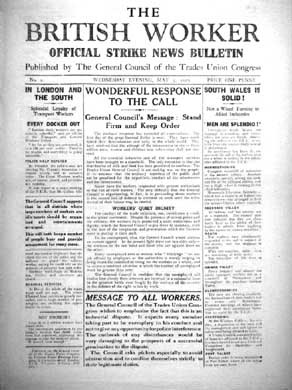
The General Strike (part two)


‘We are in danger. A united enemy is knocking at the gate...’

by Mal Howarth

Mal Howarth is a former branch delegate Blidworth Colliery NUM, area executive Nott’s Area NUM and vice president Nott’s NUM.

BEFORE we look at the strike in 1926, we must go back to 1925 because the key to understand it is in this year. When the first Labour government fell and the Tories took office in November 1924, the offensive against the living conditions of the working class was set for a head-on confrontation.
The miners were to take the brunt of the attack. In the Miners’ Federation AJ Cook replaced Frank Hodges. It was on the last day of June 1925 that the miners’ union received notice from the owners of the termination of the National Wages Agreement, which had been in force since 18th June 1924. The notice was to run for the month of July and terminate at midnight on Friday 31st July 1925.
They also wanted the miners to consider an extension of the seven-hour day; the owners stated that “the terms which can be offered under a seven-hour day are necessarily much less favourable than those which could be offered under an eight-hour day.” They wanted an immediate reduction in wages. But to add insult to injury they also wanted the guarantee of a minimum wage to go and in its place a guarantee of profits to take its place.
On Wednesday 29th July 1925 the Prime Minister, Baldwin, told the miners’ union definitely that “the Government would not grant any subsidy” and that “the coal industry must stand on its own economic foundations”.
On Thursday evening instructions were issued for the embargo on coal movements to be put into force. All unions were to comply with the said order and the effect was immediate.
The Prime Minister who had said “no subsidy” was now willing to offer a nine-month’s subsidy in return for which the mine owners would be willing to withdraw their notices and a full inquiry to be held.
The Government had yielded to the threat of an embargo on the movement of coal. It was a great day for the Labour Movement and it was named Red Friday.
The Baldwin government was not ready for an all-out fight with the British working class, that’s why he had offered a subsidy to hold up miners’ wages for nine months. At the time the Chancellor of the Exchequer was Winston Churchill, known for his anti-working class attitude. The capitalist class was preparing for a confrontation.
The warnings had been given from the militants in the labour movement as early as January 1925. AJ Cook’s message to the delegates at the National Minority Movement was: “We are in danger. A united enemy is knocking at the gate … my slogan is ‘be prepared’.”
The question posed at the time was: was it correct to give increased power to the General Council of the TUC that was preparing to use those powers against the interests of the working class?
Virtually no preparations were made for the impending struggle. Baldwin told delegates at the Tory party conference that action against the Communist Party was under consideration. On 12th October 12 leaders of the Communist Party, Minority Movement and Young Communist League had been arrested. This followed the Labour Party conference, whose main activity was to speed up the removal of communists from the Labour Party’s ranks.
Just before the arrests AJ Cook issued one more warning: “I warn the right-wing leaders of our movement to cease their attacks upon the left-wing. They are encouraging every effort of reaction in this country to destroy our militant fighters. If these are beaten, the path lies open for the propertied interest to smash those who call themselves moderate.”
On 25th September 1925 the newspapers announced the formation of a body called the Organisation for the Maintenance of Supplies, known as OMS. This was to be used for organising those citizens who would be prepared to volunteer to maintain supplies and vital services in the event of a general strike.
During the General Strike many of the middle class had been thrown out of their jobs by the strike. They became Special Constables, paid at the rate of £2 6s 3d per week plus 2/6d-a-day for food. This was the pay for strike breaking. In Wales the pit labourer had been locked out because he refused to accept £1 11s 7½d-a-week. The Miners’ Federation first asked for a minimum wage in 1889 and obtained it by a strike; in 1911 the seven-hour day was won by a strike. Nationalisation of the mines was part of their programme in 1898.
The use of a general strike is to make class struggle obvious to those who deny or ignore it. Action is the one form of propaganda more effective than the press. It makes the worker as class conscious as the employer and it teaches him or her to distrust and rid him or herself of reformist socialist ideas and all trade union leaders who are not prepared for inevitable conflict. Employers who are refused the wages reductions they demand seldom go out of business; they solve their difficulties by means of improved efficiency.
The miners were called to wait for the report of the Royal Commission on the coal industry under the chairmanship of Sir Herbert Samuel on 5th September 1925. There were no representatives of organised labour, as in the other inquiries it was to be known as the Samuel Commission. The three other commissioners were General Sir Herbert Lawrence, Sir William Beveridge and Kenneth Lee.
Samuel had extensive family connections in finance; from 1919 he ruled Palestine as British High Commissioner. Beveridge, during the war of 1914-1918, was in the Ministry of Munitions; he was also Director of the London School of Economics.
Lawrence was a partner in a well-known banking house and was also on the board in several other important companies. Lee chaired the great cotton firm, Total, Broadhurst, Lee and Company; he also chaired the District Bank. Some of the concerns on which General Lawrence and Mr Lee sat belonged to the Federation of British Industries.
It is difficult to imagine any small body of persons more completely representative of capitalist interests and more completely trained in approaching matters from the capitalist standpoint.
This report put to the miners was a proposal for reorganising the mining industry, at some future date, together with proposals for a reduction in wages, to take effect at once.
On 13th April 1926 the owners’ and miners’ representatives came together. The owners said they would meet the miners’ district representatives to consider in each case the district minimum. The miners were opposed and it was full deadlock.
The owners in most districts posted notices in the pits to end existing contracts – employment on existing terms would cease on 30th April. It was a lockout; the owners had delivered their ultimatum.
The Conference of Executives at 12.30pm on Saturday 1st May placed before it, for the first time in British working class history, a proposal for a general strike. This was to take effect at midnight on Monday. It was overwhelmingly accepted.
On Monday evening Ramsay MacDonald, leader of the Labour Party, had altered his way of thinking. He state: “As far as we can see we shall go on. I don’t like general strikes. I haven’t changed my opinion. I have said so in the House of Commons. I don’t like it but honestly, what can be done?”
The right-wing opposed preparations for the strike and when this failed they prepared the most rapid capitulation. On the following Monday morning (10th May) in the British Worker a message from the TUC General Council appeared: “All’s well”. In the second week it was: “Stand Firm. Be Loyal to instructions and trust your leaders”.
Then Sir Herbert Samuel put forward some proposals for a settlement, to be known as the Samuel Memorandum. The main points were that the General Strike should be called off; the subsidy to be renewed “for a reasonable time” while negotiations were reopened; a National Wages Board to be set up under an independent chair to seek a settlement, with no revision of wages unless there were assurances that the commission’s reorganising scheme would be adopted. The Miners’ Federation rejected this; Samuel submitted it to the General Council.
On Wednesday 12th May the noon bulletin from the BBC was: “General Strike ceases today”. What had happened to bring this about? The BBC announcer read a message from the King; the TUC General Council had decided to sue for peace and had asked the Prime Minister to meet them.
The General Council was claiming that an honourable understanding had been reached. But the Government stated that it would not compel employers to take back workers who had participated in the strike. It went on to say that dismissals of workers would be inevitable because of the loss of production and that also employers had an obligation to those who had supplied volunteer labour.
In other words blacklegs were to be looked after and trade unionists victimised. The General Council had unconditionally surrendered.
The miners had to face entirely new proposals – and it was not the Samuel proposals that the Prime Minister put forward now the General Strike was over – they were cast on one side. The lockout notices were not withdrawn; the offer of a subsidy was conditional on an immediate 10 per cent wage cut.
The lockout struggle was to last for over seven months. On Monday 29th November 1926 work was resumed in all important coalfields except South Wales, Yorkshire and Durham. The next day South Wales and Yorkshire went back. Durham had a ballot, which showed 49,217 for rejection of the terms and 40,583 in favour – a majority of 8,634 against. But in view of the two-thirds majority needed to reject the terms – which was not secured – Durham County Federation instructed the men to return to work.
We must remember that the future lies in the hands of those who are not disillusioned and our anger and venom must be directed not at individual betrayers, Prime Minister, trade union leaders and so on but against the real enemy: reformist theory and reformist ideas.
The system attracts people who are in any case of “moderate” disposition, and for those who are not, there is an immensely powerful pull towards the development of such a disposition. For those who resist it there is denunciation, often of great virulence from a multitude of sources.
We must also remember that if someone tells you they are on the side of the oppressed, that tells you next to nothing about their politics. If they tell you who they think are oppressed and how, they tell you a lot.
But Rosa Luxemburg put it in a nutshell when she stated: “I know I have to earn my epaulettes in the German movement but I intend to do it on the left-wing where the enemy is actually being engaged and not on the right where the enemy is being parleyed with.”

Thursday, April 20, 2006

1926 -- The General Strike


by Ken Ruddock

THIS YEAR is the 80th anniversary of the General Strike of May 1926, a momentous event in the history of British trade unionism – one with lessons for today’s trade unions and the labour movement in general.
To understand why the General Council of the Trades Union Congress came to call a general strike starting on midnight of 3rd May 1926, with the support of 3,600,000 workers, it is necessary to go back in time to the years of the First World War 1914-1918 and even before.
During the years running up to 1914 there was growing unrest in Europe. The Socialist International agreed that in the event of war, it should be opposed. On the eve of war, mass demonstrations took place up and down the country. Trafalgar Square saw a huge demonstration addressed by labour leaders Keir Hardy and Arthur Henderson in opposition to war.
Before the month was out, the Labour Party decided to support the Tory government’s war, and along with the TUC, decided that “an immediate effort be made to terminate all existing disputes, whether strikes or lock-outs, and wherever new points of difficulty arise during the war a serious attempt should be made by all concerned to reach an amicable settlement before resorting to strikes and lock-outs.”
This left the workers defenceless against the employers’ attacks on wages and conditions, and was soon followed by the “patriotic” Labour leaders signing the “Treasury Agreement” which neutralised the unions for the duration of the war. It brought with it, in some industries, a complete ban on strikes and compulsory arbitration.
However this did not deter the workers entirely and there were a number of unofficial strikes when employers took advantage of the war to break agreements.
During the many struggles in defence of workers’ conditions, a new form of militant unionism grew: that of the shop stewards who, elected as workshop representatives and leaders, became the answer to collaboration with the state machine.
Examples of the strength of this movement are illustrated by the Clyde strike in June 1915, which arose from an anomaly in rates of pay. The Glasgow district committee of the Amalgamated Society of Engineers made an application for an increase of two pence an hour. This was refused with an offer of a halfpenny and the engineering workers in 15 establishments ceased overtime working.
This was opposed by the ASE executive, who, whilst siding with the employers, organised a ballot on the employers’ offer. It was rejected by 8,927 to 829, resulting in an increased offer of one penny and an increase in piece rates was won.
In July 1915 the South Wales miners, part of the Miners’ Federation of Great Britain who had refused to be a party to the “Treasury Agreement”, made demands for a new agreement on wages and conditions from the mine owners, who were taking advantage of the war to improve their own position.
When the employers rejected the demand out of hand, the Miners’ Federation decided by a majority of 42,850 to strike. Despite threats from the Government 200,000 miners stood firm. In less than a week this resulted in the Government over-riding the mine owners and conceding the main demands.
There were other disputes but it was the Clyde strike that had marked the emergence of the shop stewards as the backbone of a new form of workshop organisation. Out of the strike the Clyde Workers’ Committee was formed, with William Gallacher as chairman (Willy Gallacher became a Communist MP after the war).
Workers’ committees sprang up in London, Sheffield and in other centres of industry and in 1916 a national Shop Stewards’ Movement was formed. The shop stewards became the effective defenders of the workers in the face of the inactive union executives.
The Government had introduced a Munitions Act, under which workers virtually lost all rights of protest. In July 1916 over 1,000 workers were convicted under this Act. It was not only in the industrial field that workers were becoming more militant. Rents strikes against rapacious landlords grew.
In 1917 the news of the Russian Revolution added to the revolutionary spirit of the workers.
With the end of the war in 1918, the Labour Party withdrew its Labour Ministers out of the coalition government and won what became known as the Khaki election, because of the returning soldiers taking part.
The change of government did nothing to improve conditions for the workers. It was again left to the workers to fight their own battles with the employers.
On the Clyde the strike was for a shorter working week. The national officials of the unions failed to support it and it ended in a fortnight. Then came the miners, the MFGB demanded a 30 per cent increase, a six-hour day and nationalisation of the mines.
The Government had continued to control the mines after the war and was now facing a strike with exhausted stocks of coal. The miners had formed the “Triple Alliance” with the railway and transport workers, who had also made claims. The Government was faced with a general strike.
The Prime Minister, Lloyd George, offered the miners a Royal Commission on the one hand, and a threat of armed force on the other. The MFGB president, Robert Smillie, caved in to the threat and won a narrow majority for acceptance of the offer.
The commission, presided over by Mr Justice Sankey, subsequently recommended nationalisation. But the Government, despite the promise to implement the commission’s recommendations, refused to comply and provoked a strike in the Yorkshire coalfields during July and August 1919.
The years that followed deserve an article for themselves. The Lancashire cotton workers won a strike for a 48-hour work and a 30 per cent increase in wages when 300,000 of them came out. The railwaymen struck for a week against threatened wage cuts and won improvements against threats from the Government. And it is worth noting that it was only the conservative influence of JH Thomas that prevented the strike widening into a general move forward. Other sections of the labour force, including dockers, made gains.
All these were during the post-war boom, which was coming to an end, bringing with it a rise in unemployment of two million in the slump of 1921. This inevitably brought with it a general attack on workers’ wages and conditions.
The first sections to come under attack from the employers, with the support of the Government, were the coal miners. They had rejected the coal owners’ demands and were locked out. The Miners’ Federation invoked the aid of the Triple Alliance, which called for a strike on 12th April.
Whilst the workers were prepared to take action, the leaders of the Triple Alliance were not enthusiastic and postponed the strike to 15th April. During this delay Frank Hodges, secretary of the Miners’ Federation, took it upon himself to offer a temporary settlement at a meeting of MPs. The following day his unauthorised action was disowned by his executive.
But the damage had been done and the alliance leaders withdrew their support. This day became known as “Black Friday”. The result was catastrophic. Workers felt they had been betrayed. Three of the four leading personalities associated with Black Friday deserted to the other side. Frank Hodges became a director of the Bank of England; JH Thomas left public life, Robert Williams became a spokesman for the National Government. The fourth member was Ernest Bevin.
During the next three years the effect of Black Friday was to undermine the morale of the workers who were left to fight defensive actions. The miners were defeated and six million workers suffered wage cuts. The employers used lockouts to break any resistance. The effect on trade union membership was dramatic.
But by the end of 1923 there were signs of recovery and workers started to regain their fighting spirit with strikes – many unofficial – of builders, agricultural workers, boilermakers, dockers and seamen.
January 1924 saw the election of the first Labour government under the leadership of Ramsay MacDonald. During an official strike of railwaymen that was taking place at the time, MacDonald showed no sympathy with Aslef, the union leading the strike. This action eventually won some concessions in spite of disunity from the National Union of Railwaymen, which instructed its members to continue working.
The year continued with more unofficial disputes in the shipyards and railway shops. In London the tramway workers struck for higher wages; the busmen joined them and the Tube men were considering sympathetic action. McDonald declared he would invoke the Government’s Emergency Powers Act, which empowered him to declare a state of emergency. Only the simultaneous ending of the strike prevented military intervention.
For some time militant workers had been moving to the left. They had created the National Minority Movement at a conference in London in August that year, with the veteran Tom Mann as president and Harry Pollitt – who had gained a reputation representing the boilermakers as a delegate to Labour Party conferences – as secretary.
By this time Harry Pollitt had become secretary of the Communist Party. The movement had grown in the South Wales and Fife coalfields and had secured the election of AJ Cook as secretary of the MFGB, replacing Hodges after his forced resignation.
In September a new spirit could be seen in the trade unions. Whilst the Labour government had been defeated in the October election, the September TUC congress adopted an Industrial Workers’ Charter; gave the General Council new powers to intervene in disputes, and to draft a scheme for linking the unions into a united front for improving workers living standards. The council was also instructed to call a special congress to decide on industrial action if there was a danger of war.
By 1925 the British capitalists were facing a desperate economic struggle to regain their world position. Prime Minister Baldwin had declared that “all workers in this country have got to take reductions in wages to help this country get on its feet”.
The Miners’ Federation, always the first to come under attack, refused the mine-owners’ demands and received the “complete support” of the TUC General Council, which appointed a special committee to cooperate with the miners in resisting this attack.
The committee, with the support of the railway and transport workers, drew up plans for an embargo on all coal transport in the event of a miners’ lockout. A special conference of union executives endorsed the plan on the day before the mine-owners’ deadline: 30th July.
The Government, unprepared for such action, retreated and announced a nine-month subsidy to enable a Royal Commission to conduct an inquiry. The mine-owners withdrew their proposed lockout. That day is now known as Red Friday.
The General Council declared that the defeat of the Government was “an immense stimulus to every trade unionist”. But communists warned that “the capitalist class will prepare for a crushing attack on the workers” and continually called for preparations to repel such an attack.
The capitalist state had, following its setback on Red Friday, started preparations for a counter attack by forming an “unofficial” Organisation for the Maintenance of Supplies” with a Central Council made up of high-ranking admirals, generals and retired officials of the state, for the purpose of organising strike-breaking “black legs”, special constables and fascist elements.
This organisation, known as OMS, became an official arm of the state, supporting the capitalist employers. Winston Churchill, at the time Chancellor of the Exchequer, made it clear that their action on Red Friday had only been intended to give the Government time to prepare its counter attack.
There was little reaction to all of this from the TUC’s General Council. But the September congress in Scarborough showed the fighting mood of the workers with a vote of 3,082,000 to 79,000 in favour of revolutionary opposition to British imperialism. The conference declared that the aim of the unions, in conjunction with the Labour Party was for the workers’ overthrow of capitalism and pledged itself to strengthen workshop organisation.
Despite these brave words, the congress saw the election of two men associated with Black Friday – JH Thomas and Ernest Bevin. They were joined by WM Citrine as General Council secretary following the death of Fred Bramley. This moved the balance of force on the General Council to the right.
At the following Labour Party conference Thomas and Bevin associated with MacDonald in a counter demonstration to the Scarborough congress. Pressure was put on the unions not to elect communists to the Labour Party.
The Government saw the green light and within a fortnight had jailed 12 Communist Party leaders after the biggest state trial since the Chartist days.
The Miners’ Federation, concerned at the turn of events, made efforts to form an industrial alliance of key unions to prepare for the conflict, which were wrecked by the withdrawal of Thomas’s NUR.
The Royal Commission on the coal industry headed by Sir Arthur Samuel, later to become a lord, produced a report in March 1926, which was vague in its view on recognition of the coal industry under state control. But it was strong in its view that miners should accept longer hours and lower wages.
The miners’ delegate conference on 10th April disillusioned the General Council by standing firm and so did the Minority Movement conference held in late March, attended by 883 delegates representing a million trade unionists, supporting their fight.
The mine owners immediately declared they would only negotiate on a district basis, and gave notice of a lockout for 20th April. They demanded wage reductions so severe that even their president, Evan Williams, admitted the resulting wages would be “miserable”.
In response the TUC General Council regained its backbone in support of the miners and on 27th April decided at last to draft plans for large scale action if necessary.
Negotiations continued the following night of 29th April and the following day. But it became clear that the Government, having completed its preparation, was determined to provoke a conflict. The General Council’s negotiators, of which Thomas was a leading member, reported to union executives the following morning and a vote was taken endorsing a General Strike order by unions representing over 3,600,000 members to fewer than 5,000.
They announced that specified unions would strike as from midnight Monday 3rd May.
They planned that specified trades would be called out in two sections. The first included all transport, printing, iron and steel foundries, heavy chemicals and building workers (except those working on housing and hospitals). The maintenance of food and health services was to be covered by the unions concerned.
Whilst these preparations were going ahead, the General Council still maintained that they had a right to negotiate for the miners, even if it meant a reduction in wages.
But when the Natsopa members refused to print an anti-union leading article in the Daily Mail and went on strike, Baldwin demanded that if negotiations were to continue, the General Council should withdraw the notice of a General Strike. This he made impossible, and despite the misgivings of the General Council, the dye was cast and at midnight on Monday 3rd May an army of a million workers struck.
The next day the TUC communiqué said: “We have from all over the country reports that have surpassed our expectations. Not only the railwaymen and transport men, but all other trades came out in a manner we did not expect immediately. The difficulty of the General Council has been to keep the men in what we might call the second line of defence rather than call them out.”
There were no passenger trains, no newspapers. The Communist Party issued a typewritten Workers’ Bulletin. The General Council, always on the defensive, only produced its own news-sheet, the British Worker, after the Government had produced an official British Gazette.
The trades councils and councils of action speedily organised in many parts of the country, so effective that in some major towns nothing moved without a permit from the trades council. The International Federation of Trade Unions declared its moral and financial support if needed.
The second day of the strike, the London taxi-drivers stopped work. The National Union of Journalists (Glasgow) refused to Blackleg. The National Unemployed Workers’ Committee Movement – already suffering from the employers’ attacks – offered assistance to the trades councils and strike committees.
The Independent Labour Party called on its branches to support the strike. The Communist Party issued a statement in the British Worker with the slogans:
1) All together behind the miners;2) Nationalisation of the mines3) Resignation of Baldwin; formation of a Labour government.
By this time the police were more aggressive with baton charges against strikers in crowds in the streets and making summary arrests. Communist MP Saklatvala was sentenced to two months imprisonment for a speech on May Day.
Days four and five of the strike saw all electrical stations in London on strike, with the withdrawal of electricity from the House of Commons. The Government issued an indemnity to troops for any action considered necessary to maintain order.
There were more battles with police in many towns such as Liverpool and Hull. In London there were 36 arrests. Local strike committees made arrangements with the Cooperative organisation for the supply of food. Communist Isabel Brown was sentenced to three months imprisonment.
On day six, Purcell, the leader of the General Council’s strike organising committee, declared that the Government had issued warrants for the arrest of himself and Ernest Bevin, who was then secretary of the Transport Workers’ Union and a member of the General Council. Other sources reported that the Government had decided to arrest members of the General Council and local strike committees, to call up the army reserve and to repeal the Trades Disputes Act.
At a high mass, Cardinal Bourne declared the General Strike to be a sin against God.
JH Thomas said: “I have never disguised that I did not like the principle of a General Strike.”
On day seven the General Council negotiated with the Cooperative Wholesale Society for credits to the trade unions. It also called for a five per cent levy on all workers not yet on strike.
Day eight saw the General Council issue the strike order for all engineering and shipbuilding workers not yet affected by the strike. Despite increased arrests – 100 in Glasgow and another 25 in Hull – the BBC announced: “There is as yet little sign of a general collapse of the strike.”
And yet on the same day the General Council accepted a rehashed Royal Commission report by Sir Herbert Samuel and called off the strike without any guarantees of any kind, and in the face of miners’ opposition. The General Council of the TUC presented itself at Downing Street at 12 noon on 12th May and informed Baldwin that “the General Strike is being terminated today”.
The General Council had not only treacherously abandoned the miners but had left the trade unions individually to negotiate their members’ return to work, with only a vague understanding from Prime Minister Baldwin that they would return to work on the same conditions as at the start of the General Strike.
The result was a Government official communiqué saying that they would not compel employers to take back workers who had taken part in the in the strike and that the Government had not taken on itself any such obligation.
The individual unions instructed their members to stay out until agreement with employers was reached, which took another four days. The miners refused to accept defeat and fought on until December.
Despite its defeat, the General Strike was the greatest act of defiance against the British capitalist class. It showed a unity of the working class never seen before and which could be built again, provided the lessons of the fallibility of social democratic leadership are understood.

Friday, April 14, 2006

Gay in China

by Ray Jones

On 16th December 2005 gay men and lesbians held their first national celebration in People’s China. Gay bars, clubs, spas, bathhouses and other meeting places are thriving in the large cities and there is a strong on-line gay community.
Gays in China have adopted the rainbow flag and call each other tongzhi (comrade - people who share the same ideals).
Things have certainly come along way since 1997 when gay behaviour in public places ceased to be legally classed as hooliganism. And it was only in April 2001 that homosexuality was deleted from the list of mental disorders.
In effect homosexuality has been legalised but the situation is still far from perfect. The Government has not yet accepted the need for official gay partnerships, although many expect them to do so before long, and prejudice against gays is still strong.
Opinion on gays in China is contradictory. China has been depicted as on a par with ancient Greece in its acceptance of homosexual activity and it seems the case that they have rarely been systematically persecuted there as they have been in other countries.
Chinese literature has many examples of homosexual love stories and poetry – which horrified the Jesuit missionaries when they arrived. Almost all the emperors of the Western Han dynasty (206 BC-25 AD), for example, are reported to have had male lovers.
In China people generally think that sex is sex and that the gender of the partners makes little difference. There has traditionally been no concept of homosexual activity being sinful from a religious perspective as we have had in the West.
But the Confucian tradition pulls in the other direction. At the heart of Confucianism is devotion to the family and therefore it’s three main crimes are, disobeying your parents, not supporting your parents and, the worst, not continuing the family line.
This last point is of course particularly relevant to gays. Many gay men and lesbians can’t face telling their parents and are overwhelmed with guilt. In a sense the pressure for small families may compound the problem – if you only have one child and they turn out to be gay?...
Most gay people feel forced to try to live a heterosexual life style which often results in misery. And with a gay population estimated to be between 39 million and 52 million that’s a lot of misery.
Sadly it was during the Cultural Revolution (1966-76) that gays in China faced their worst persecution and were labelled mentally ill and hooligans. But today homosexuality is becoming more accepted again and their life-style actually fits in with the government’s drive to reduce the population.
As China continues to move forward, as parents become less dependant on their children in old age, as the gay movement grows and as the government continues to listen, things will continue to improve.